
Restaurant in Vienna, Austria
Feine Sichuan-Küche
100ptsSuburban Sichuan Precision
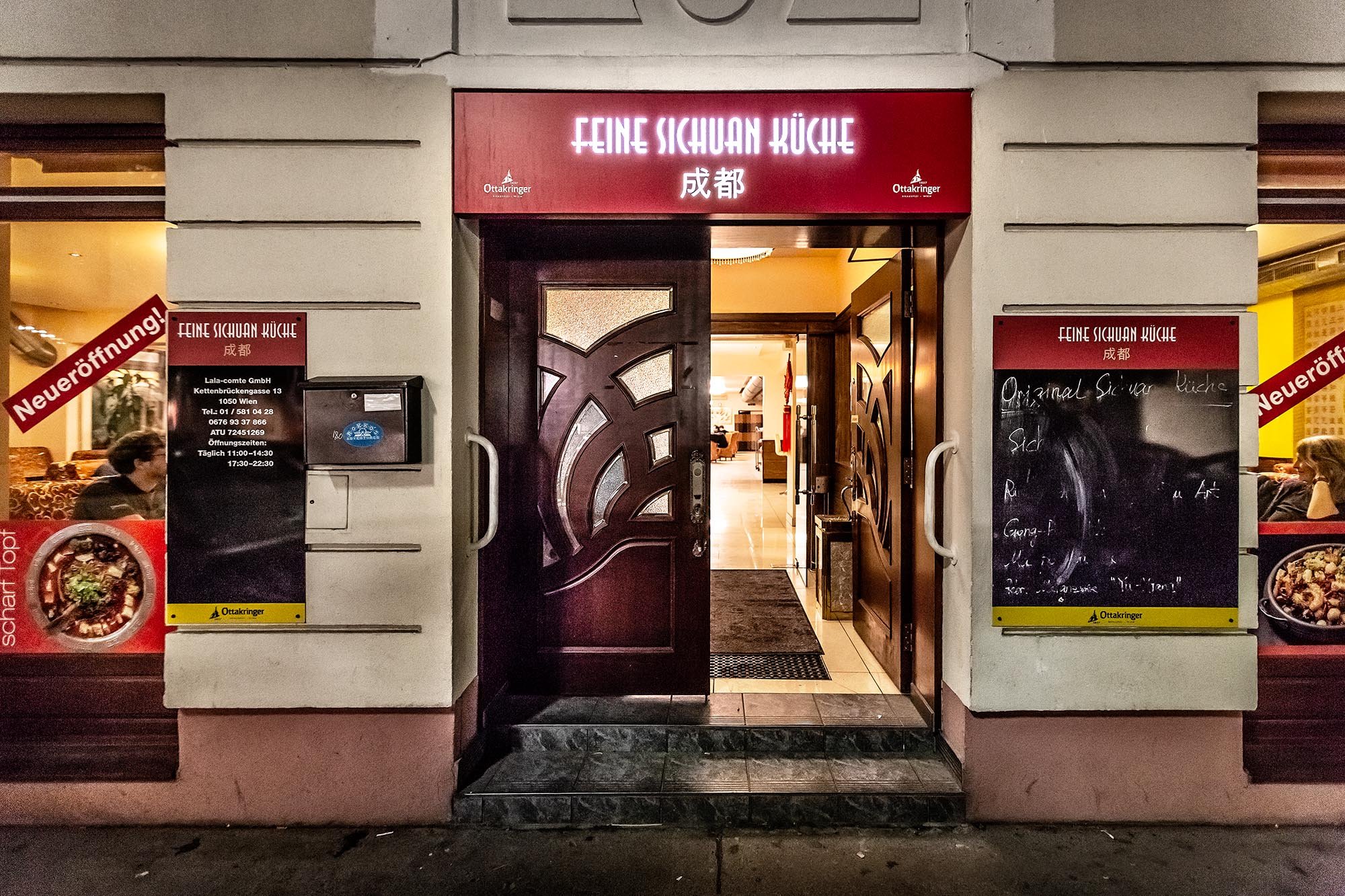
About Feine Sichuan-Küche
Sichuan cooking in Vienna's 14th district, where the heat-forward flavours of southwestern China meet a city more accustomed to schnitzel and strudel. Feine Sichuan-Küche on Hütteldorfer Strasse represents the quieter, less-trafficked end of Vienna's Chinese dining scene, positioned away from the inner districts where most international dining clusters.
Sichuan in the Suburbs: What the 14th District Reveals About Vienna's Chinese Dining Scene
Vienna's serious dining conversation rarely strays west of the Gürtel. The inner districts hold the Michelin weight: Steirereck im Stadtpark, Amador, Konstantin Filippou, and Mraz & Sohn all operate within a narrow geography where restaurant density and critical attention reinforce each other. Feine Sichuan-Küche on Hütteldorfer Strasse sits outside that loop, in the residential 14th district, which is exactly the condition under which neighbourhood Chinese restaurants in European cities tend to operate most honestly. There is no tourist foot traffic to sustain a diluted menu. The clientele is local, repeat, and opinionated in the way that regulars at any neighbourhood restaurant become opinionated.
That geography matters because Sichuan cuisine, more than almost any other Chinese regional tradition, suffers from translation problems in European settings. The cuisine depends on a specific interaction between dried chilies, Sichuan peppercorn, fermented black bean, and doubanjiang paste — a flavour architecture that European markets have historically handled poorly, either softening the heat to inoffensiveness or leaning so hard into it that the numbing quality of the peppercorn gets lost. The measure of a Sichuan restaurant outside China is less about authenticity as a fixed target and more about whether the cook understands what those components are supposed to do together.
The Technique Question: Importing a Heat-Forward Tradition into Central Europe
Austrian cuisine operates on a different register entirely. The traditions that produced Landhaus Bacher and Obauer are built around restraint, fat, acid balance, and seasonal Alpine produce. The crossover between that tradition and Sichuan cooking is not technical — it is logistical. Central European markets now carry dried facing-heaven chilies, Sichuan peppercorn, and fermented doubanjiang in specialist import shops, particularly in cities with established Chinese communities. Vienna has that supply chain. The question for any Sichuan kitchen here is whether it is using it.
The editorial angle that matters with a venue like Feine Sichuan-Küche is not whether it is serving food identical to what you would find in Chengdu, but whether the core technique is intact. Sichuan cooking at its most functional is a high-heat, fast-process cuisine , wok technique generates the wok hei, the slight char and smokiness that slow-cooked approximations cannot replicate. That wok hei is one of the harder things to maintain in a European restaurant context, where gas pressure, equipment age, and kitchen throughput all work against it. Restaurants in cities like Vienna that manage it well are worth tracking for that reason alone.
Where This Fits in Vienna's Chinese Dining Pattern
Vienna's Chinese restaurant scene, like those in most Central European capitals, skews toward Cantonese-adjacent menus designed for broad palatability. Sichuan specialists are a smaller category. Among Austrian fine dining, the dominant reference points remain the Austrian and modern European canon: venues like Doubek, Gourmetrestaurant Tannenhof, and Taubenkobel each work within recognisably European frameworks. A Sichuan kitchen in Penzing is operating in a different lane altogether, which gives it both freedom and risk. Freedom because there is no dominant local Sichuan benchmark to measure against. Risk because without that critical infrastructure, kitchen standards can drift without correction.
Across Austria more broadly, the dining scene that has drawn international attention is mountain-anchored and produce-forward: Döllerer in Golling, Schwarzer Adler in Hall in Tirol, Restaurant 141 by Joachim Jaud, Kräuterreich by Vitus Winkler, Ois in Neufelden, and Stüva in Ischgl all sit within a culinary tradition rooted in the specific character of Austrian land and season. Feine Sichuan-Küche operates on an entirely different axis: it is importing a technique tradition rather than expressing a local one. That is not a diminishment. Some of the most technically demanding restaurants in the world , Le Bernardin in New York and Lazy Bear in San Francisco each built reputations on transplanted techniques applied with discipline , hold their ground precisely because they committed to the rigour of a tradition rather than diluting it for local palatability.
Reading the Menu: What to Prioritise
At any Sichuan restaurant operating outside China, the ordering logic should follow the same principle: lead with the dishes that depend most on technique rather than ingredients, because those reveal whether the kitchen is serious. Mapo tofu is the standard test: the dish is simple in composition but demands precision in the ratio of doubanjiang to broth, the bloom of the peppercorn oil, and the silkiness of the tofu, which should be soft without losing structure. Dan dan noodles test the sesame and chili paste balance. Water-boiled fish and dry-pot preparations test high-heat confidence and spice calibration. These are the dishes that separate a kitchen working from institutional understanding of the cuisine from one working from approximation.
Specific menu details for Feine Sichuan-Küche are not confirmed in the EP Club database, so ordering recommendations beyond this framework would require a verified visit. What the address and positioning suggest is a kitchen oriented toward regulars who know what they want, which typically means a menu that does not need to explain itself with photographs or simplified descriptions. That is a reasonable proxy signal for seriousness, even if it is not a guarantee.
Planning Your Visit
Feine Sichuan-Küche is located at Hütteldorfer Strasse 215 in Vienna's 14th district (Penzing). The address sits in a residential corridor well served by public transport on the U4 line toward Hütteldorf, making it accessible without a car from the inner city. Reservations: contact details are not currently confirmed in the EP Club database; walk-in availability at neighbourhood restaurants in the 14th district tends to be more reliable than at inner-district venues, but calling ahead for evening visits is sensible practice. Dress: no dress code is confirmed; neighbourhood Sichuan restaurants in this tier are universally casual. Budget: price range is not confirmed in the EP Club database; comparable Sichuan restaurants in Vienna's outer districts typically operate in the €15–€35 per person range for a full meal before drinks. For a broader view of Vienna's dining options across price tiers, see our full Vienna restaurants guide.
Frequently Asked Questions
- What should I order at Feine Sichuan-Küche?
- The EP Club database does not carry confirmed dish details for Feine Sichuan-Küche. At any Sichuan kitchen, the clearest signals of kitchen calibration come from dishes that depend on technique over ingredient rarity: mapo tofu, dan dan noodles, and water-boiled preparations are the standard reference points. If the restaurant serves a dry-pot dish, that is also worth considering as a test of high-heat wok confidence. Follow the menu's more specific regional items over any pan-Chinese additions if the option exists.
- How hard is it to get a table at Feine Sichuan-Küche?
- Vienna's outer-district neighbourhood restaurants generally operate without the booking lead times that apply to the inner-city Michelin tier, where venues like Steirereck or Konstantin Filippou require advance planning of weeks or months. Feine Sichuan-Küche, positioned in the residential 14th district without confirmed award recognition in the EP Club database, is unlikely to require that level of advance booking. That said, popular neighbourhood spots with loyal regular clientele can fill quickly on Friday and Saturday evenings; calling ahead before a weekend visit is reasonable practice even if confirmed booking details are not currently available.
- Is Feine Sichuan-Küche suitable for diners who don't eat spicy food?
- Sichuan cuisine is structurally heat-forward, built around dried chilies and the mouth-numbing quality of Sichuan peppercorn, so it is not the most natural fit for diners with a low tolerance for spice. Most Sichuan restaurants in European cities offer some dishes with adjustable heat levels, and certain preparations (cold appetisers, steamed items) carry less fire than the signature braised and wok-cooked dishes. Whether Feine Sichuan-Küche accommodates specific heat preferences is not confirmed in the EP Club database, but the question is worth raising directly with the kitchen before ordering.
More restaurants in Vienna
- Steirereck im StadtparkAustria's most decorated restaurant by a wide margin — three Michelin stars, a top-25 World's 50 Best ranking, and a La Liste score of 98 points. Getting a table is genuinely hard (book four to six weeks out minimum), but Steirereck im Stadtpark justifies every effort with research-driven Austrian cuisine, an extraordinary wine programme, and service that makes three-star dining feel welcoming rather than forbidding.
- AmadorJuan Amador's three-Michelin-starred restaurant in Vienna's 19th district combines Spanish-influenced creativity with Austrian produce and Austria's top-ranked wine program. La Liste scores of 94-95 points and an OAD European ranking of #47 make the case clearly. Book at least six to eight weeks out for weekdays; Saturday tables require three to four months' notice minimum.
Related editorial
- Best Fine Dining Restaurants in ParisFrom three-Michelin-star icons to the next generation of Parisian chefs pushing boundaries, these are the restaurants that define fine dining in the world's culinary capital.
- Best Luxury Hotels in RomeFrom rooftop terraces overlooking ancient ruins to Michelin-starred hotel dining, these are the luxury hotels that make Rome unforgettable.
- Best Cocktail Bars in KyotoFrom sleek lounges to hidden speakeasies, Kyoto's cocktail scene blends Japanese precision with global influence in ways you won't find anywhere else.
Save or rate Feine Sichuan-Küche on Pearl
Keep this venue in your Pearl passport, rate it after you visit, and track it alongside every other place you collect.