
Restaurant in Skardu, Pakistan
Rafsal
100ptsHigh-Altitude Local Dining
About Rafsal
Rafsal sits on the first floor above JS Bank on Skardu's main road, placing it in the heart of one of Pakistan's most remote high-altitude towns. Dining here means eating against the backdrop of a region where supply chains are seasonal, ingredients arrive overland through mountain passes, and the kitchen operates within constraints that shape every dish on the table.
Where the Supply Chain Is the Story
Skardu sits at roughly 2,500 metres above sea level in Gilgit-Baltistan, a region where the road from the rest of Pakistan can close for days after a single rockfall or winter storm. That geography is not incidental to how restaurants here cook. It is the defining condition. Kitchens in towns like Skardu source from what arrives, what survives the journey, and what grows locally in a short mountain summer. For anyone eating in this part of northern Pakistan, that reality is baked into every plate, far more consequently than any farm-to-table marketing claim made at a restaurant with reliable freight access. See our full Skardu restaurants guide for the broader picture of where the town's dining sits.
Rafsal occupies the first floor of the JS Bank building on Skardu's main road, at the address locals navigate by landmark rather than postcode. That placement matters: main-road restaurants in small mountain towns like this function differently from their urban counterparts. They are not destination venues chosen from a map; they are part of the daily rhythm of a town where foot traffic concentrates along a single corridor, and reputation travels by word of mouth across a small, tightly connected population. The building location also signals something about the clientele: a first-floor space above a bank on the commercial spine of town draws a mix of local business, travellers passing through, and the trekkers and expedition teams who use Skardu as a staging post for climbs in the Karakoram.
Ingredient Realities at High Altitude
The ingredient question in Skardu is one that any honest account of eating here has to address directly. Gilgit-Baltistan's growing season runs roughly from late spring through early autumn, and the region produces apricots, mulberries, walnuts, and some vegetables at volume. Apricot in particular is woven into the food culture of the area: dried, pressed into oil, used in both savoury and sweet preparations. These are not imported; they come from the orchards that cover the valley floors and terrace farms cut into hillsides across Baltistan and Hunza. Compare this with the sourcing context at Hunza Food Pavilion in Karimabad, further north in a valley with similarly localised produce traditions.
Protein sourcing in this part of Pakistan follows patterns shaped by altitude and access. Mutton and lamb are the backbone of northern Pakistani cooking at this elevation, with animals grazed on high pastures. Dairy, particularly the strained yoghurt used across the region, comes from local herds. Wheat arrives via road, as do spices from the plains, which means that the aromatic depth of a karahi or a slow-cooked meat dish here depends on supply runs that are seasonal and sometimes interrupted. This is not scarcity as romantic narrative; it is a logistical fact that distinguishes mountain restaurant kitchens from those in cities with daily wholesale markets. The karahi tradition that runs across Pakistani restaurant culture, seen in its most stripped-back form at places like Butt Karahi in Lahore, takes on a different material character when the kitchen is eight hours by road from the nearest major supplier.
The Skardu Restaurant Context
Skardu's restaurant scene is small and organised around function rather than category. The town has grown as a tourism hub, particularly since domestic and limited international flights to Skardu Airport have made the region more accessible in summer months, but the dining infrastructure has not scaled at the same pace as visitor numbers. That creates a situation where a first-floor main-road restaurant like Rafsal is not one option among many in a competitive restaurant quarter; it operates in a town where the number of sit-down dining options can be counted without running out of fingers on one hand.
For comparison, Capital View Restaurant in Islamabad operates in a city where restaurant density and competition drive both quality and specialisation. Skardu's constraints produce a different kind of restaurant: broader in what it offers, tighter in its dependency on what is locally available or can arrive reliably by road. Visitors arriving from cities like Islamabad or Lahore should recalibrate expectations accordingly, not downward, but differently. The measure of quality here is not how a kitchen reproduces metropolitan restaurant conventions; it is how it works within conditions that metropolitan kitchens never face. For a sense of how mountain-town dining works in a comparable northern Pakistan context, Mountain Pizzeria in Bulchi Das offers another data point on how visitor-facing restaurants adapt along the Karakoram routes.
Planning a Visit to Rafsal
Skardu is most accessible between May and September, when the Karakoram Highway is fully open and flights from Islamabad operate with reasonable regularity, weather permitting. The summer window also corresponds with peak trekking and climbing season, which increases both foot traffic in town and demand on the local food supply. Visitors arriving outside this window should factor in that road conditions and supply availability can shift substantially, and that some restaurants in small northern towns reduce hours or close partially in winter. Rafsal's address on the main road makes it findable on arrival in Skardu without advance navigation; the JS Bank building is a functional landmark. No phone or booking information appears in current records, which is consistent with how most restaurants at this tier in northern Pakistan operate: walk-in, assessed on the day. There is no dress code context available for this venue, and none would be expected in a town where practical mountain clothing is the norm across all settings.
For Pakistani restaurant dining at a more formal register elsewhere in the country, Buqayvia Restaurant in Lahore and Sapna Shinwari Restaurant in Abbottabad both represent the Khyber Pakhtunkhwa and Punjab ends of the tradition. Butt Karahi by Usman Tahir in Gujar Khan shows how the karahi format translates into a smaller-town northern Punjab setting. None of these operate under the supply conditions that define Skardu; the comparison is useful precisely because it shows how much geography shapes what ends up on the table.
The global reference points, from Le Bernardin in New York City and Alinea in Chicago to Alain Ducasse at Louis XV in Monte Carlo, exist at the opposite end of the supply-chain spectrum: kitchens with unlimited sourcing options, maximising choice. Rafsal and its Skardu peers operate on the inverse principle, where constraint rather than abundance defines what the kitchen can do. That is not a lesser achievement; it is a different one, and for travellers eating their way through the Karakoram it is one of the more honest expressions of place that any restaurant can offer. See also China Hot Pot in Islamabad, Amber in Hong Kong, Atomix in New York City, Alléno Paris au Pavillon Ledoyen, 8½ Otto e Mezzo Bombana in Hong Kong, Emeril's in New Orleans, and Lazy Bear in San Francisco for the full range of EP Club restaurant coverage across formats and geographies.
Frequently Asked Questions
- Would Rafsal be comfortable with kids?
- Skardu is a practical, unpretentious town, and main-road restaurants here are accustomed to a broad cross-section of visitors including families, trekking groups, and locals of all ages. There is no evidence of a format or price point that would make Rafsal unsuitable for children; the walk-in, no-reservation model that characterises restaurants in this price tier and city type tends to be accommodating rather than restrictive. That said, with no confirmed hours or menu data available, it is worth checking locally on arrival.
- Is Rafsal better for a quiet night or a lively one?
- Skardu is not a city with a late-night dining culture comparable to Lahore or Islamabad, and main-road restaurants in the town tend toward functional energy rather than destination atmosphere. Rafsal's first-floor position above a bank building on a commercial street suggests a daytime and early-evening setting oriented around convenience and locality, rather than a space designed for extended evening socialising. There are no awards or price signals in the current record that would point toward a curated-atmosphere dining format.
- What's the leading thing to order at Rafsal?
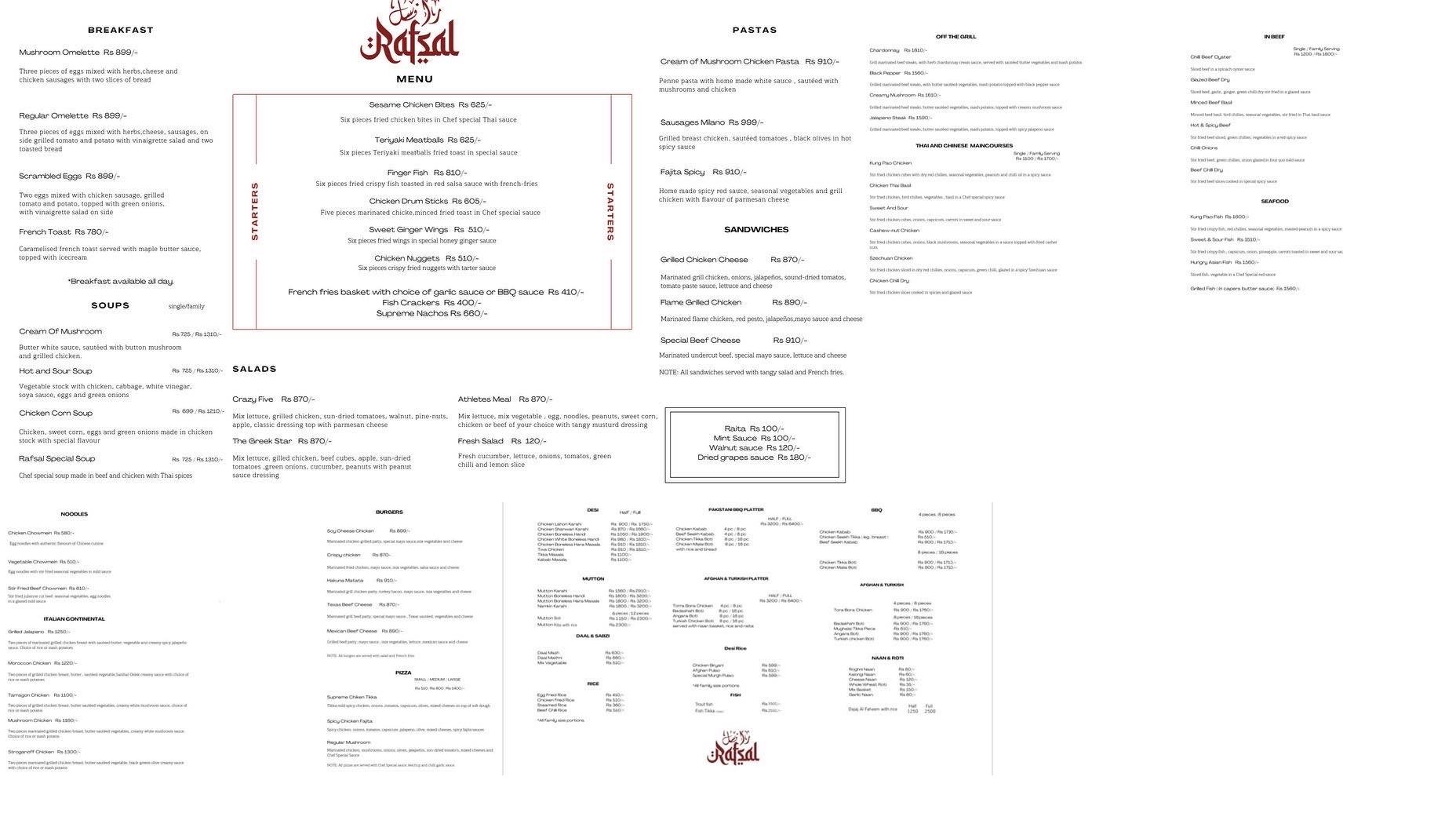
- No confirmed menu data is available in current records, so specific dish recommendations cannot be made with accuracy. What is consistent across northern Pakistani restaurant cooking in Gilgit-Baltistan is the centrality of mutton-based preparations, locally sourced dairy, and the regional flavour of ingredients that have travelled shorter supply chains than their plains equivalents. Any kitchen in Skardu working with these materials is drawing on a culinary tradition that rewards ordering the most locally grounded option on the menu rather than dishes that require imported components.
- Is Rafsal a good option for trekkers using Skardu as a base before heading into the Karakoram?
- Skardu functions as the primary staging town for expeditions heading toward K2, Broad Peak, and the Baltoro Glacier routes, and main-road restaurants like Rafsal are part of the practical infrastructure that trekkers and expedition teams rely on before and after time in the field. The central location on the main road, accessible from the town's guesthouses and hotels without navigation, makes it a logical option for a meal in town. With no confirmed hours available, it is advisable to check opening times locally, particularly outside the May-to-September peak season when mountain-town schedules shift.
Related editorial
- Best Fine Dining Restaurants in ParisFrom three-Michelin-star icons to the next generation of Parisian chefs pushing boundaries, these are the restaurants that define fine dining in the world's culinary capital.
- Best Luxury Hotels in RomeFrom rooftop terraces overlooking ancient ruins to Michelin-starred hotel dining, these are the luxury hotels that make Rome unforgettable.
- Best Cocktail Bars in KyotoFrom sleek lounges to hidden speakeasies, Kyoto's cocktail scene blends Japanese precision with global influence in ways you won't find anywhere else.
Save or rate Rafsal on Pearl
Keep this venue in your Pearl passport, rate it after you visit, and track it alongside every other place you collect.