
Restaurant in Hong Kong, Hong Kong
Saya
250ptsGenuine Isan cooking at honest prices.

About Saya
Saya is a $$ Isan-focused Thai restaurant in Tai Kok Tsui worth the trip for groups who want to share across a menu of genuine Northeast Thai cooking. The Laab Moo Isan and khao soy are kitchen signatures, the portions are generous, and the 4.3 Google rating (256 reviews) is consistent with the value on offer. Booking is easy, making it a low-friction choice compared to busier Thai spots in Central.
The Verdict
If you're weighing up Thai options in Hong Kong, the default move for most diners is Chachawan in Sheung Wan or one of the Samsen locations. Saya earns a different kind of attention: it's a $$ Isan-focused restaurant in Tai Kok Tsui that takes the cuisines of Northeast Thailand seriously rather than softening them for a broad audience. At this price tier, the generous portions and regional specificity make it a strong call for groups looking for a genuinely satisfying meal without the Central premium. Book it for what it is, not as a substitute for a bigger night out.
About Saya
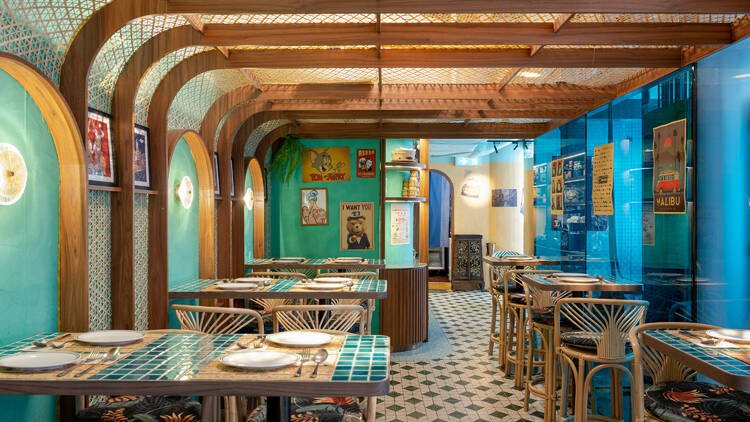
Saya sits at G701 on the ground floor of Square Mile II in Tai Kok Tsui, a residential neighbourhood well north of Hong Kong's dining epicentres. That address alone filters out casual walk-in traffic, which means the room tends to fill with people who came deliberately. The interior commits to a retro tropical register: turquoise colour scheme, rattan furniture, and woven wall coverings that hold together as a considered aesthetic rather than a theme-park approximation.
The kitchen's focus is Isan cuisine, the cooking of Northeast Thailand, a regional tradition defined by fermented flavours, aromatic herbs, dried chillies, and textural contrasts that can be a world apart from the coconut-sweet Central Thai cooking most Hong Kong diners encounter first. Isan food is worth understanding on its own terms before you arrive. The larb, the grilled meats, the fermented fish pastes, the sticky rice served as a utensil as much as a side dish: these are not polished or tourist-facing by nature. Saya's kitchen team is Thai, which matters here because the flavour calibration on regional dishes like this can shift dramatically when the cooking is adapted for an export market. Based on available data, the approach here trends toward authenticity rather than dilution.
The Laab Moo Isan illustrates the kitchen's sensibility well. Ground pork salad is a commonplace dish across Thai restaurants in Hong Kong, but the Saya version incorporates diced pig ears for crunch, and the seasoning reads as tangy and properly spicy rather than gestural. It is the kind of dish where the ingredient choices signal that the kitchen isn't editing for timidity. The khao soy, a coconut milk curry with chargrilled chicken, arrives with the aroma doing significant work before the first bite. Khao soy is associated more directly with Northern Thailand than Isan, but it appears across the menu as a complementary dish that broadens the regional scope. The chargrilling adds a layer of smokiness that distinguishes it from the hotel-Thai versions common elsewhere in the city.
Seasonal Considerations
Isan cooking has a seasonal logic that travellers and food-focused diners should factor into their visit. In Northeast Thailand, the dry season (roughly November through April) aligns with peak production of the fermented and preserved ingredients central to the cuisine: fermented fish (pla ra), dried meats, and the gathered herbs that define larb and other salads. Hong Kong's Thai restaurants that source ingredients carefully, or that rely on Thai kitchen teams maintaining supply relationships, will reflect this in the freshness and intensity of the dishes. If your trip falls between November and April, that is when the core Isan pantry is at its most expressive and when dishes like larb and fermented-pork preparations are worth ordering without hesitation. The shoulder months of May through October see a shift toward fresher, less fermented profiles in authentic Isan cooking, with more emphasis on grilled proteins and broth-based dishes. This is not a reason to avoid Saya outside the dry season, but it is worth knowing which dishes to prioritise depending on when you visit. For Thai restaurant comparisons in Bangkok where the seasonal sourcing logic is more transparent, Nahm and Samrub Samrub Thai offer useful reference points for what the full seasonal expression of Thai regional cooking can look like.
Who It's For
Saya works leading for groups of three or more who want to share across the menu. The generous portion sizes are confirmed in venue data, and the economics at $$ tier mean a table of four can cover serious ground without the bill becoming a conversation. It is also a reasonable pick for food-focused diners who have already worked through the more prominent Thai addresses in Hong Kong and want to engage with a more specific regional tradition. Solo diners and couples will find it functional but may not extract maximum value from a menu built around sharing. For exploration across Thai cuisine globally, AKKEE in Pak Kret and Aksorn in Bangkok are worth adding to your radar for context on how Thai regional cooking is being documented and served elsewhere.
Getting There and Booking
Tai Kok Tsui is accessible by MTR (Olympic station on the Tung Chung Line is the closest option) and is a direct cab ride from Mong Kok or Tsim Sha Tsui. It is not a neighbourhood you pass through by accident, so factor in the transit leg when planning an evening. Booking is rated Easy, and at $$ in a non-tourist neighbourhood, walk-in availability is likely more realistic here than at comparable Thai spots in Central or Sheung Wan. That said, the room will fill on weekend evenings for groups, so a reservation is still the sensible move if you are coming with four or more people. No phone or website data is available in Pearl's records; check Google or OpenTable for current booking access.
For a broader picture of where Saya fits among Hong Kong's dining options, see our full Hong Kong restaurants guide. If you're planning accommodation or other experiences around your visit, our Hong Kong hotels guide, bars guide, and experiences guide are useful starting points. For Thai restaurant context outside Hong Kong, Chim by Siam Wisdom in Bangkok and Boo Raan in Knokke both offer reference points on how Isan and regional Thai cooking travels internationally.
Practical Details
| Detail | Saya | Chachawan | Samsen (Wan Chai) | Thai Pai Dong |
|---|---|---|---|---|
| Price tier | $$ | $$ | $$ | $ |
| Cuisine focus | Isan / NE Thai | Isan / NE Thai | Thai street food | Thai casual |
| Neighbourhood | Tai Kok Tsui | Sheung Wan | Wan Chai | Various |
| Booking difficulty | Easy | Moderate | Moderate | Easy |
| Good for groups | Yes | Yes | Yes | Yes |
| Google rating | 4.3 (256 reviews) | — | — | , |
Pearl links: Samsen (Wan Chai) | Thai Pai Dong | 8 1/2 Otto e Mezzo Bombana (Hong Kong) | Hong Kong wineries guide | L'Orchidée (Altkirch) | Le Salon de Thé de Joël Robuchon Hong Kong
FAQs
- What should a first-timer know about Saya? Saya specialises in Isan cuisine from Northeast Thailand, not the coconut-sweet Central Thai cooking that dominates many Hong Kong menus. Expect fermented flavours, proper heat, and textural contrasts. It is a $$ restaurant in Tai Kok Tsui, a residential neighbourhood that requires a deliberate trip. The Google rating of 4.3 across 256 reviews is a reliable baseline for a venue at this price point. Order broadly and share across the table to get the full picture of what the kitchen does.
- What should I wear to Saya? Smart casual is the sensible call. The retro tropical interior and $$ price point put this firmly in relaxed territory. There is no indication of a dress code from available data. You will not be out of place in neat jeans and a shirt, and there is no reason to dress up beyond that.
- Does Saya handle dietary restrictions? No specific dietary policy data is available in Pearl's records. Isan cooking frequently uses fish sauce, fermented shrimp paste, and pork in foundational preparations, which creates real constraints for vegetarians and pescatarians even when dishes appear plant-based. If you have strict requirements, call ahead directly. The venue has no website or phone listed in current Pearl data, so contact will need to come through Google or a booking platform.
- How far ahead should I book Saya? Booking is rated Easy, and Tai Kok Tsui does not draw the foot traffic of Central or Sheung Wan. For a weekday dinner or a couple, same-week booking is likely fine. For a weekend group of four or more, booking two to three days ahead is a sensible precaution. This is not a venue where you need to plan weeks out, unlike higher-profile Thai addresses such as Chachawan.
- Can Saya accommodate groups? Yes. Venue data explicitly confirms that generous portions make it a strong choice for friendly get-togethers. Sharing across a larger table is the format that suits the menu leading. No private dining room data is available, but for groups of four to eight, the standard dining room should work well at $$ pricing. Contact the venue directly for parties larger than eight.
Compare Saya
| Venue | Cuisine | Price | Awards | Booking Difficulty | Value |
|---|---|---|---|---|---|
| Saya | Thai | $$ | A turquoise colour scheme, rattan furniture and wall coverings impart a retro tropical vibe. The menu is dominated by Isan cuisine from Northeast Thailand, intelligently crafted by a Thai kitchen team. Laab Moo Isan tastes tangy and spicy; diced pig ears add crunchy texture to the ground pork salad. Aroma-laden khao soy features coconut milk curry and chargrilled chicken. The generous portions make it a great spot for friendly get-togethers.; A turquoise colour scheme, rattan furniture and wall coverings impart a retro tropical vibe. The menu is dominated by Isan cuisine from Northeast Thailand, intelligently crafted by a Thai kitchen team. Laab Moo Isan tastes tangy and spicy; diced pig ears add crunchy texture to the ground pork salad. Aroma-laden khao soy features coconut milk curry and chargrilled chicken. The generous portions make it a great spot for friendly get-togethers. | Easy | — |
| 8 1/2 Otto e Mezzo Bombana (Hong Kong) | Italian | $$$$ | Michelin 3 Star, World's 50 Best | Unknown | — |
| Ta Vie | Japanese - French, Innovative | $$$$ | Michelin 3 Star, World's 50 Best | Unknown | — |
| Feuille | French Contemporary | $$$ | Michelin 1 Star, World's 50 Best | Unknown | — |
| The Chairman | Chinese, Cantonese | $$ | Michelin 1 Star, World's 50 Best | Unknown | — |
| Neighborhood | International, European Contemporary | $$ | Michelin 1 Star, World's 50 Best | Unknown | — |
What to weigh when choosing between Saya and alternatives.
Frequently Asked Questions
What should a first-timer know about Saya?
Saya focuses on Isan cuisine from Northeast Thailand, a regional style less common in Hong Kong than central Thai cooking. The kitchen is Thai-run and the menu leans spicy and tangy — dishes like Laab Moo Isan and khao soy are confirmed highlights in the venue record. At $$, portions are generous, so ordering broadly across the menu makes sense. The address in Tai Kok Tsui means a short MTR or cab ride from central Kowloon, so factor in travel time.
What should I wear to Saya?
The setting is casual — rattan furniture, turquoise walls, and a retro tropical feel. There is no dress code indicated in the venue data, so relaxed everyday clothing is appropriate. This is a neighbourhood spot, not a formal dining room.
Does Saya handle dietary restrictions?
The venue data does not specify dietary accommodation policies. Given the Isan-focused menu, fish sauce, pork, and shellfish pastes are common base ingredients in this cuisine, so guests with strict dietary requirements should check the venue's official channels before booking.
How far ahead should I book Saya?
No booking window data is available for Saya. As a ground-floor neighbourhood restaurant in Tai Kok Tsui at a $$ price point, it is unlikely to be as pressed for reservations as high-demand venues in Central or Sheung Wan — but calling ahead for groups is advisable given the generous portion format that suits shared dining.
Can Saya accommodate groups?
Yes, this is one of the stronger use cases for Saya. The venue data explicitly notes generous portions and describes it as a good spot for friendly get-togethers. Groups of three or more who want to share across a Isan-style spread will get the most from the menu and the price point.
Recognized By

More restaurants in Hong Kong
- AmberAmber holds three Michelin stars, a Green Star, and a 97-point La Liste score — making it the most credentialled French fine-dining address in Hong Kong. Chef Richard Ekkebus runs a tasting menu that fuses Japanese and French technique with strict sustainable sourcing. Book at least eight weeks ahead; dinner availability is near impossible without significant advance planning.
- CapriceCaprice holds three Michelin stars and a La Liste score of 99 points, making it one of the most credentialled French restaurants in Asia. On the sixth floor of the Four Seasons Hotel Hong Kong, it delivers a structured à la carte menu from Chef Guillaume Galliot alongside floor-to-ceiling harbour views. Book four to six weeks out for dinner; lunch offers a quieter entry point at the same kitchen level.
- The ChairmanThe Chairman is the strongest case for contemporary Cantonese cooking in Hong Kong and, at $$ pricing, one of the best-value highly awarded restaurants in Asia. Ranked #2 in Asia's 50 Best (2025) and holding a Michelin star, it demands serious advance booking — online only, on specific days — but delivers an experience that justifies the effort for any serious food traveller.
- Ta VieTa Vie holds three Michelin stars and a top-25 OAD Asia ranking, making it one of Hong Kong's most credentialed restaurants. Chef Hideaki Sato's seasonal tasting menus express Japanese ingredient philosophy through French technique in a deliberately quiet, intimate room. Book as early as possible — availability is near impossible, dinner only, Tuesday and Thursday through Sunday.
- WING RestaurantWING ranks #3 in Asia's 50 Best Restaurants 2025 and holds the Gin Mare Art of Hospitality Award — two of the more credible signals that both the kitchen and the front-of-house are performing at a serious level. Chef Vicky Cheng's seasonal tasting menu works across China's eight regional cuisines with technical precision. Booking is Near Impossible, so plan well ahead; Friday lunch is the only daytime option.
- 8 1/2 Otto e Mezzo Bombana (Hong Kong)The only Italian restaurant outside Italy with three Michelin stars, Otto e Mezzo has held that distinction continuously since 2012. Book the tasting menu, time your visit for truffle season (October–December) if possible, and plan well ahead — tables are genuinely difficult to secure. At the $$$$ price point, it is the reference address for Italian fine dining in Hong Kong.
Related editorial
- Best Fine Dining Restaurants in ParisFrom three-Michelin-star icons to the next generation of Parisian chefs pushing boundaries, these are the restaurants that define fine dining in the world's culinary capital.
- Best Luxury Hotels in RomeFrom rooftop terraces overlooking ancient ruins to Michelin-starred hotel dining, these are the luxury hotels that make Rome unforgettable.
- Best Cocktail Bars in KyotoFrom sleek lounges to hidden speakeasies, Kyoto's cocktail scene blends Japanese precision with global influence in ways you won't find anywhere else.
Save or rate Saya on Pearl
Keep this venue in your Pearl passport, rate it after you visit, and track it alongside every other place you collect.