
Restaurant in Nieuwersluis, Netherlands
Bloei - Flora Batava
100ptsEstate-Rooted Vegetarian Dining

About Bloei - Flora Batava
Set on the historic Flora Batava domain in Nieuwersluis, Bloei is a restaurant with a clear direction and real raw material: a garden estate with deep roots in Dutch horticultural history, a four-course vegetarian menu, and a veranda that earns its place. The kitchen has the ingredients for something significant in the Netherlands plant-based dining scene, though the execution still reads more classical than the setting demands.
A Domain With a Proposition
The approach to Flora Batava does most of the work before you even reach the door. The estate at Rijksstraatweg 6 in Nieuwersluis carries the kind of physical authority that few Dutch dining addresses can claim, a domain with a horticultural legacy that long predates the current restaurant and grounds that frame the experience before the menu arrives. For a kitchen positioning around vegetarian cooking, this matters: the landscape around you is not decorative, it is the argument. Plant-forward restaurants that can point to the soil outside their windows occupy a different register from those that source identically to everyone else but call themselves green.
Bloei sits inside a broader shift in Dutch fine dining, where ingredient provenance and growing philosophy are increasingly the hinge on which a restaurant's identity turns. Places like De Nieuwe Winkel in Nijmegen have shown that organic-led, plant-forward tasting menus can operate at the highest tier of Dutch gastronomy. Bloei has the estate context to make a comparable statement; the question of whether the kitchen currently matches that context is one worth considering honestly.
The Veranda and the Setting as First Course
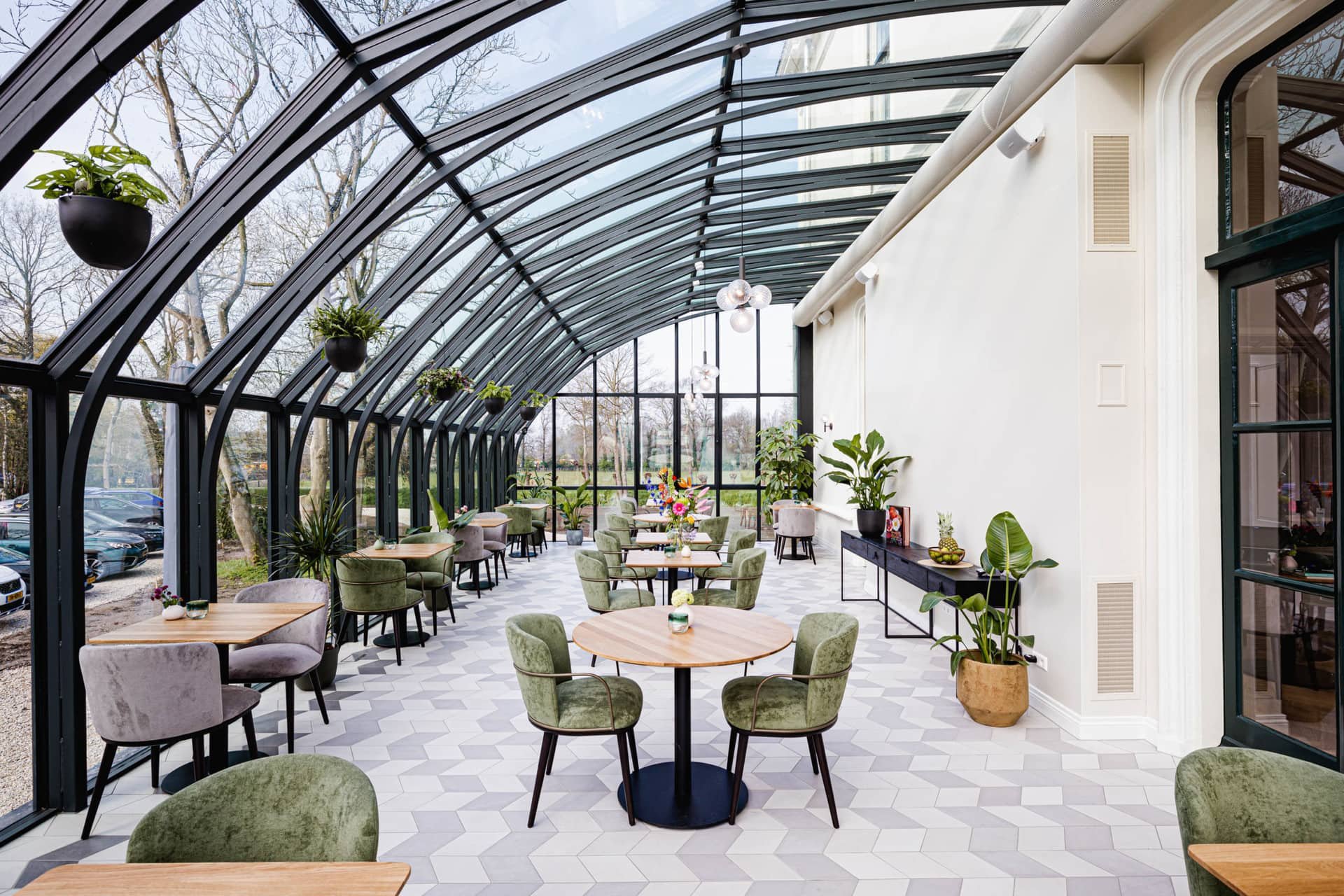
The veranda at Flora Batava is not an afterthought. In a country where outdoor dining is weather-contingent for much of the year, a well-constructed covered veranda changes the seasonal arithmetic considerably, extending the window in which guests can eat in proximity to the garden rather than simply inside a building that happens to be adjacent to one. For a restaurant whose entire premise rests on the relationship between land and plate, that physical continuity matters more than it would at a conventional address.
The atmosphere on arrival reads as convivial and grounded rather than formal. The domain setting gives the place an unhurried quality that distinguishes it from urban fine dining, where pace is often dictated by turn times and noise levels. Visitors arriving from Amsterdam, roughly 25 kilometres south, are coming to a different tempo as much as a different place. That tonal shift is part of what Flora Batava is selling, and on that front, the experience delivers.
The Vegetarian Menu in Context
Four-course vegetarian menu at Bloei addresses something that the Dutch restaurant scene has historically underinvested in: a structured, multi-course format built entirely around plant ingredients, offered within a fine-dining estate setting rather than a casual urban bistro. The format itself signals intent. A four-course structure demands discipline in sequencing, contrast, and pacing in ways that a single vegetarian dish bolted onto a conventional menu does not.
Estate context raises the question of sourcing with some urgency. Flora Batava's history as a domain associated with horticulture and botanical cultivation creates an expectation that the kitchen draws from, or at least in dialogue with, what the land around it produces. A vegetarian restaurant whose ingredients travel long supply chains is a different proposition from one whose menu is shaped by what is growing metres away. Agnes Block, the historical figure associated with the original Flora Batava estate and its botanical ambitions, established a precedent for treating plants as objects of serious attention. Whether the current kitchen honours that through its sourcing choices is the central evaluative question for any visit.
For context on what the high tier of Dutch creative cooking looks like, De Librije in Zwolle and Aan de Poel in Amstelveen set the benchmark for technical ambition and sourcing rigour at the premium end. At the plant-forward edge specifically, De Groene Lantaarn in Staphorst offers a useful regional comparison. Bloei does not yet operate in that peer group, but the asset base is there.
Where the Gap Lies
The honest assessment, and one worth making plainly, is that Bloei's current execution reads more classical than the setting demands. An estate with this kind of provenance and a kitchen committed to vegetarian cooking has the conditions to produce something genuinely specific to this place and this soil. The risk with classical presentation in that context is that it softens what could be a sharper identity: a restaurant that is doing something particular and knows it, rather than a pleasant country-house dining room that happens to have a vegetarian menu.
This is not a dismissal. It is a statement about potential that the setting makes hard to ignore. The gap between where Bloei currently operates and where it could operate is legible precisely because the ingredients for something more considered are already present. Kitchens that close that gap tend to do so by letting the sourcing story drive the menu architecture, by making provenance visible rather than implied, and by treating the four-course format as an argument rather than a convention.
Planning Your Visit
Flora Batava is located at Rijksstraatweg 6 in Nieuwersluis, a small municipality in the province of Utrecht within comfortable driving distance of Amsterdam and accessible by regional routes through the Green Heart of Holland. The estate setting means arrival by car is the most practical option for most visitors. The veranda makes the warmer months particularly well-suited for a visit, though the domain retains its character year-round.
For those building a broader Nieuwersluis itinerary, Bistrotel 't Amsterdammertje offers a classic alternative at the €€ tier for those who want a second meal or a more casual option in the same area. The EP Club guides to Nieuwersluis restaurants, hotels, bars, wineries, and experiences map the wider area for those extending a stay. For anyone interested in the broader range of Dutch creative cooking at the premium tier, the EP Club profiles of 't Nonnetje in Harderwijk, Ciel Bleu in Amsterdam, De Bokkedoorns in Overveen, De Lindehof in Nuenen, De Lindenhof in Giethoorn, and Brut172 in Reijmerstok provide useful comparative reference points across the country's fine dining range.
Frequently Asked Questions
Is Bloei a family-friendly restaurant?
The domain setting and relaxed pace make Flora Batava more accommodating than a formal urban fine-dining room, but the four-course vegetarian format and estate pricing position this as an adult-oriented experience rather than a family casual destination in Nieuwersluis.
What should I expect atmosphere-wise at Bloei?
If you arrive expecting a high-energy urban restaurant, the domain at Flora Batava will reorient you quickly. The atmosphere is gracious and traditional, with the veranda and grounds doing significant atmospheric work. Based on the available assessment, the setting consistently delivers; the cooking currently reads as more conservative than the surroundings suggest, so calibrate expectations accordingly rather than arriving hoping for a cutting-edge plant-forward experience at a Nordic-influenced or avant-garde register.
What should I order at Bloei?
The four-course vegetarian menu is the kitchen's central statement and the format most aligned with the estate's identity. Given that the restaurant's premise rests on plant-based cooking in a horticulturally significant setting, engaging with the full menu sequence rather than ordering à la carte gives the most complete picture of what the kitchen is attempting. Beyond that, specific dish guidance requires current menu data not available here. For reference on what plant-forward menus look like at the most ambitious level in the Netherlands, De Nieuwe Winkel in Nijmegen provides a useful comparative benchmark, as does the produce-driven approach at venues like Le Bernardin in New York City and Emeril's in New Orleans for those interested in how sourcing philosophy shapes menu architecture at a sustained level.
Recognized By

Related editorial
- Best Fine Dining Restaurants in ParisFrom three-Michelin-star icons to the next generation of Parisian chefs pushing boundaries, these are the restaurants that define fine dining in the world's culinary capital.
- Best Luxury Hotels in RomeFrom rooftop terraces overlooking ancient ruins to Michelin-starred hotel dining, these are the luxury hotels that make Rome unforgettable.
- Best Cocktail Bars in KyotoFrom sleek lounges to hidden speakeasies, Kyoto's cocktail scene blends Japanese precision with global influence in ways you won't find anywhere else.
Save or rate Bloei - Flora Batava on Pearl
Keep this venue in your Pearl passport, rate it after you visit, and track it alongside every other place you collect.