
Hotel in Wiesbaden, Germany
Hotel Nassauer Hof
525ptsWilhelmine Grand Hotel


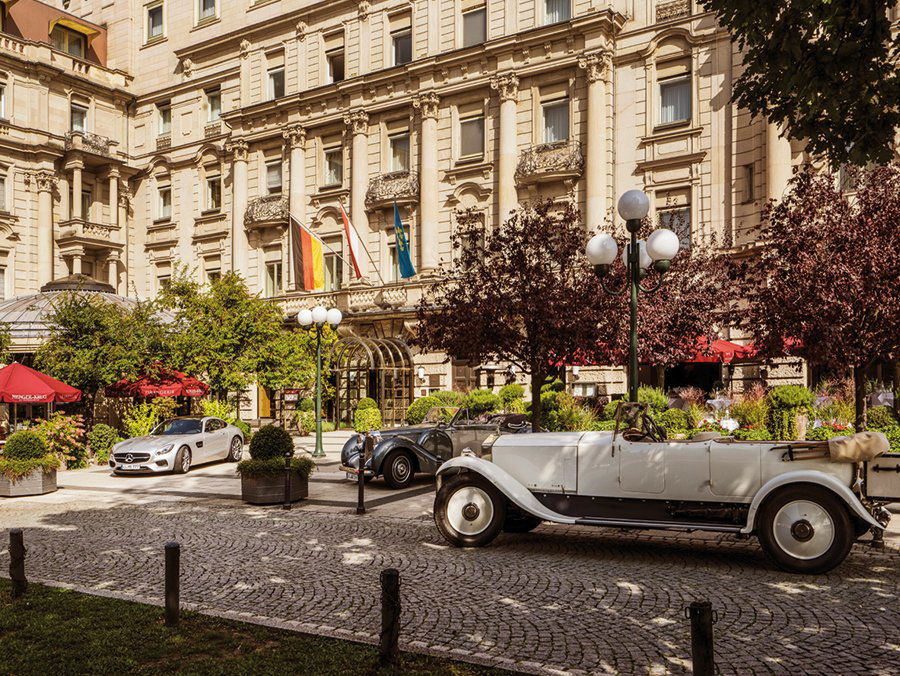
About Hotel Nassauer Hof
Hotel Nassauer Hof has anchored Wiesbaden's Kaiser Friedrich Platz for more than 200 years, earning Leading Hotels of the World membership and hosting figures from Emperor Wilhelm II to Audrey Hepburn. The property is currently closed for renovation and scheduled to reopen in 2028, when it will return as the city's definitive address for grand hotel tradition.
A Grand Hotel on the Square: Architecture, History, and the Weight of Two Centuries
Wiesbaden has always occupied an unusual position in German urban culture: a spa city that drew European royalty and aristocracy through the 19th and early 20th centuries, its built environment shaped by Wilhelmine classicism and a civic confidence that came from being the Prussian Rhine province's wealthiest address. The hotels that survived that era and kept their original fabric intact are rare. Hotel Nassauer Hof at Kaiser Friedrich Platz 3-4 is one of them, and its architecture tells that story more plainly than any historical register could.
Grand hotels of this vintage in German cities tend to fall into two categories: those that were rebuilt after wartime destruction and carry their heritage as a brand identity rather than a physical reality, and those whose original fabric remains largely continuous. Nassauer Hof belongs to the latter group. Its position directly on Kaiser Friedrich Platz places it at the ceremonial centre of Wiesbaden, the square that has functioned as the city's social fulcrum since the Belle Époque, when the thermal baths across the road drew visitors from across the continent. The hotel's address is, in this sense, inseparable from its architectural significance: it was built to be seen from the square, and to see the square in return.
That relationship between a grand hotel and its public setting is worth pausing on. The great European palace hotels of the late 19th century were rarely conceived as private retreats. They were designed as extensions of civic life, places where the public realm of the boulevard or the park met the private world of the guest. The Nassauer Hof fits that tradition: a facade addressed to the square, a lobby conceived as a receiving room for the city, and interiors that accumulated layers of decoration and significance over more than 200 years of continuous use.
The Renovation Question: What Closing Until 2028 Signals
Hotel Nassauer Hof is currently closed for renovation and will reopen in 2028. That timeline matters for two reasons. First, it signals the scale of work involved: a multi-year closure on a historic property of this type typically means structural intervention, not a cosmetic refresh. Second, it positions the reopened hotel within a recognisable pattern in European grand hotel history, where properties that have deferred major investment for decades undergo a single comprehensive programme that effectively resets the physical baseline.
The question for any reader tracking the German luxury hotel market is what the reopened Nassauer Hof will look like relative to its peer set. Germany's historic palace hotels have taken divergent paths through recent renovation cycles. Properties like the Fairmont Hotel Vier Jahreszeiten in Hamburg and the Excelsior Hotel Ernst in Cologne have maintained continuous operation while updating interiors incrementally. The Nassauer Hof's decision to close entirely suggests a different ambition: a more complete rethinking of the guest experience rather than a rolling programme of room-by-room updates.
Its membership in Leading Hotels of the World, confirmed as of 2025, provides a meaningful reference point. That collection groups properties on the basis of independent standards across service, physical condition, and overall experience, and retaining membership through a period of closure indicates that the property's standing within that network remains intact. When the hotel reopens, it will re-enter the German market carrying that affiliation, which places it in a peer conversation with properties like the Breidenbacher Hof in Düsseldorf and the Hotel de Rome in Berlin, both of which have navigated similar questions about historic fabric and contemporary expectation.
Two Centuries of Documented Presence
The historical record attached to Hotel Nassauer Hof is, by European grand hotel standards, unusually specific. The 1903 meeting between Emperor Wilhelm II and Tsar Nicholas II on the property's premises is the kind of documented episode that anchors a hotel in political as well as social history. That encounter took place at a moment when Wiesbaden was functioning at full capacity as a European resort city, drawing heads of state alongside the nobility and wealthy bourgeoisie who made the spa season their annual fixture.
Later associations confirm a different register: Karl Lagerfeld, Audrey Hepburn, and regular stays by the 14th Dalai Lama speak to a post-war continuity of the hotel as a preferred address for figures who could, in principle, stay anywhere. That pattern of return visits from notable guests is a meaningful signal in the grand hotel world. It suggests not just a single impressive stay but a sustained quality of discretion and service that earns repeat loyalty from guests with unusually high reference points.
For a broader understanding of what Wiesbaden offers as a destination, the EP Club's full Wiesbaden guide maps the city's dining, culture, and accommodation across neighbourhoods.
Where Nassauer Hof Sits in the German Luxury Hotel Picture
Germany's luxury hotel market has never been fully consolidated around one or two dominant cities in the way that London or Paris has. Instead, it is distributed: Munich carries the Bavarian spa and design tradition (see the Mandarin Oriental Munich), Baden-Baden and the Black Forest anchor a wellness-centred offering (the Hotel Bareiss in Baiersbronn and Schloss Elmau in Elmau represent that tier), and the historic spa cities of Hesse and the Rhineland carry their own strand of 19th-century grand hotel culture.
Wiesbaden belongs firmly to that last group. The city's identity as a thermal resort, its Wilhelmine architecture, and its role as Hesse's state capital give it a character that differs from both the Alpine retreat model and the urban business-hotel market. Nassauer Hof is the property that most completely embodies Wiesbaden's particular version of grand hotel tradition: a continuous address on the central square, more than two centuries of operation, and a guest history that spans the late imperial period through the present day.
Readers planning ahead for post-2028 visits should note that the property will re-enter a competitive German luxury segment in which several peers have completed their own renovation cycles in recent years. Properties such as the Althoff Seehotel Überfahrt in Rottach-Egern, the Bülow Palais in Dresden, and the Villa Contessa in Bad Saarow each represent versions of the historic German property that has been reset for contemporary expectations. Nassauer Hof's comprehensive closure programme positions it to compete in that renovated tier rather than carrying the wear of deferred maintenance that has affected some long-operating properties in the segment.
Planning Around the Reopening
Hotel Nassauer Hof is not accepting reservations during the renovation period and will reopen in 2028. For travellers with a specific interest in the property, the most reliable approach is to monitor the hotel's official communications as the reopening date approaches, since Leading Hotels of the World properties in this category typically see demand concentrated around the initial reopening window. The hotel's Kaiser Friedrich Platz address will remain the same: a central Wiesbaden location within walking distance of the city's thermal baths, the Kurhaus, and the Hessisches Staatstheater.
Those seeking comparable German grand hotel experiences before 2028 might consider the Esplanade in Saarbrücken, the Hotel Ketschauer Hof in Deidesheim, or further afield, the Kempinski Hotel Berchtesgaden and Weissenhaus Private Nature Luxury Resort for different expressions of the premium German stay. For those drawn specifically to the grand hotel tradition in an international context, the Aman Venice and The Fifth Avenue Hotel in New York City offer useful points of comparison in terms of how historic properties manage the tension between preservation and contemporary hospitality standards.
Frequently Asked Questions
What kind of setting is Hotel Nassauer Hof?
Hotel Nassauer Hof occupies a direct position on Kaiser Friedrich Platz, Wiesbaden's central square. It is a European grand hotel of the Wilhelmine era, with more than 200 years of operational history and Leading Hotels of the World membership. The setting is urban and ceremonial rather than resort-style, with the city's thermal baths and cultural institutions within walking distance. Note that the hotel is closed for renovation until 2028.
What is the main draw of Hotel Nassauer Hof?
The combination of a specific and documented historical record, a central Wiesbaden address, and continued Leading Hotels of the World affiliation places Nassauer Hof in a small group of German properties that carry genuine grand hotel continuity rather than a reconstructed heritage identity. Its guest history, spanning from Wilhelm II and Nicholas II in 1903 to the 14th Dalai Lama's regular stays, reflects a sustained level of discretion and service that has attracted returning guests with high reference points across more than a century.
What is the leading room type at Hotel Nassauer Hof?
Room-specific data is not available during the pre-reopening period, and the renovation may result in a revised room configuration compared to the pre-closure layout. The Leading Hotels of the World membership provides assurance that the property will meet that collection's standards at reopening, but specific room type recommendations should be confirmed directly with the hotel once it publishes its post-renovation offering in 2028.
Should I book Hotel Nassauer Hof in advance?
The hotel is not accepting reservations while closed for renovation. The current target reopening is 2028. Given the property's historical standing and its Leading Hotels of the World affiliation, demand at reopening is likely to be concentrated, particularly for premium room categories. Monitoring the hotel's official channels as 2028 approaches is the most practical approach; attempting to book well ahead of the formal reservation opening will not be possible through standard channels.
Recognized By


Related editorial
- Best Fine Dining Restaurants in ParisFrom three-Michelin-star icons to the next generation of Parisian chefs pushing boundaries, these are the restaurants that define fine dining in the world's culinary capital.
- Best Luxury Hotels in RomeFrom rooftop terraces overlooking ancient ruins to Michelin-starred hotel dining, these are the luxury hotels that make Rome unforgettable.
- Best Cocktail Bars in KyotoFrom sleek lounges to hidden speakeasies, Kyoto's cocktail scene blends Japanese precision with global influence in ways you won't find anywhere else.
Save or rate Hotel Nassauer Hof on Pearl
Keep this venue in your Pearl passport, rate it after you visit, and track it alongside every other place you collect.