
Hotel in Vienna, Austria
Hotel Sacher Wien
2,075ptsHabsburg-Era Grand Hotel





About Hotel Sacher Wien
Occupying a prime position opposite the Vienna State Opera since 1876, Hotel Sacher Wien is one of Europe's most historically grounded luxury hotels. Ranked 49th in the World's 50 Best Hotels (2025) and awarded Michelin 3 Keys (2024), its 149 rooms and suites combine 19th-century architecture with contemporary comfort. The original Sacher-Torte, a recipe guarded since 1832, remains the hotel's most recognizable calling card.
Where Vienna's Imperial Past Meets Its Present
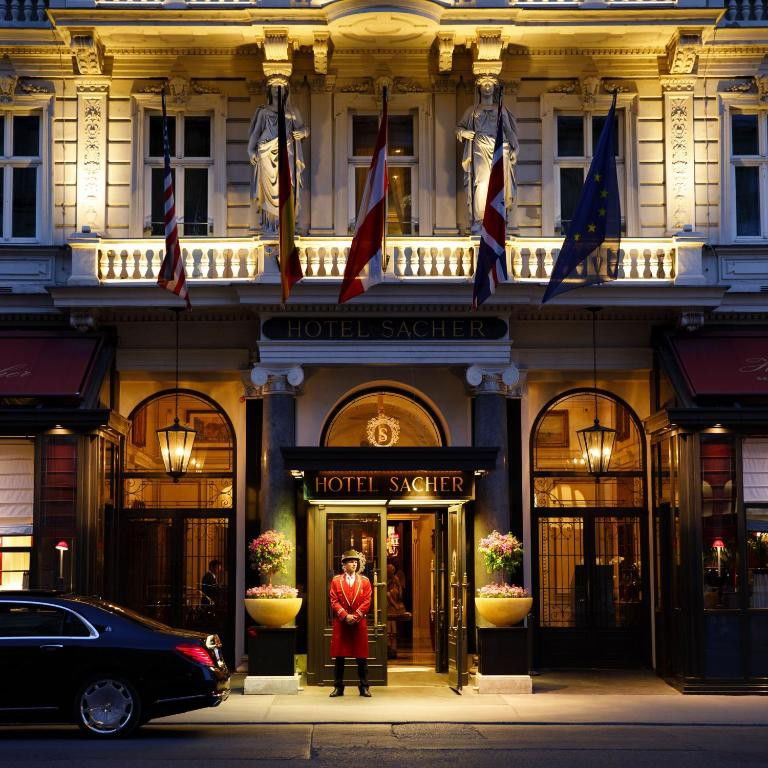
Approach the Philharmoniker Strasse entrance on any given evening and the scene resolves itself quickly: concertgoers in formal dress crossing from the State Opera, a porter holding the brass-handled door, and the faint sound of live piano drifting through the lobby. Hotel Sacher Wien has occupied this corner of the first district since 1876, and the physical address does much of the editorial work. No hotel in Vienna sits closer to the Opera, the Albertina, and the Hofburg complex simultaneously, and that geography has shaped the hotel's identity as much as any design decision. The building is not merely near culture; it is embedded in it.
In the broader context of Vienna's luxury hotel market, Sacher occupies a specific and increasingly rare position: a grand historic property still owned and operated by a local family, the Gürtler and Winkler families, rather than an international hotel group. That distinction matters. Where properties such as Rosewood Vienna, Park Hyatt Vienna, and The Amauris Vienna represent the internationalization of Viennese luxury, Sacher represents its indigenous continuation. The distinction is visible in the details: a portrait gallery documenting visits by figures including Indira Gandhi and John F. Kennedy, antiques sourced to the building's original period, and a room numbering system so embedded in repeat-guest culture that regulars request their preferred color scheme rather than a room number.
149 Rooms Built Around a Single Building's Logic
The 149 rooms and suites are organized around the architectural logic of the 1876 structure, which means no two are identical. Parquet flooring runs throughout, double-glazed windows manage the ambient noise from one of Vienna's busiest intersections, and marble bathrooms are standard rather than a suite-tier upgrade. The renovations overseen by designer Pierre-Yves Rochon brought the interiors into the 21st century without erasing the 19th, a balance that properties attempting a similar historical register frequently fail to achieve. Rooms on the sixth and seventh floors are decorated in soft red and blue tones; lower floors use taupe and green. The seventh-floor Penthouse includes a rooftop terrace with direct sightlines to the Albertina, the Opera, and the Stephansdom cathedral, making it the hotel's most spatially argued accommodation.
The attic conversion added 52 rooms to the inventory, bringing the total to its current count and giving the hotel a contemporary upper tier that sits above the original building's height. Mirror televisions in bathrooms, rainfall showerheads, and in-room technology represent the modernization layer, while the antiques and original artworks in each room remain from the hotel's accumulated history. At rates from approximately $944 per night, the hotel positions itself against Vienna's top tier, a peer set that includes Hotel Imperial and Almanac Palais Vienna.
The Sacher Trilogy: Three Rooms, One Culinary Argument
Vienna's historic hotel dining has generally split into two modes: formal grande salle formats that perform their own grandeur, and more intimate rooms that attempt to serve the neighborhood rather than the guest list. Sacher runs both simultaneously through what the hotel calls the Sacher trilogy. The Rote Bar pairs live piano with Viennese cuisine and an Opera sightline. The Grüne Bar operates as the fine-dining counterpart, combining locally sourced ingredients with a broader international frame. The Blaue Bar functions as a pre- and post-Opera drinks room, calibrated to the performance schedule across the street.
The most recent addition, Sacher Eck, opened in 2017 and takes a different approach entirely: velvet red settees and a modern interpretation of the Viennese coffeehouse, without the formality or the long waits that traditional coffeehouses in the first district now generate. The coffeehouse tradition in Vienna is UNESCO-listed and culturally freighted in ways that can make newer entrants feel either reverential to the point of stiffness or insufficiently committed. Sacher Eck occupies a practical middle position.
Then there is Café Sacher Wien itself, which operates less as a hotel amenity and more as a destination that happens to sit inside the hotel. The Original Sacher-Torte, a dense chocolate cake layered with apricot jam, has been served here since a recipe first documented in 1832. The café draws visitors who have no intention of staying at the hotel, which creates a hospitality model where public and private functions overlap in the ground floor rather than being separated by security or reservation requirements. Café Bel Étage offers a quieter alternative with the same coffee and cake program for guests who prefer to avoid the café's midday volume.
Sourcing, Materials, and the Sustainability Register
The editorial angle on sustainability at legacy grand hotels is necessarily different from the conversation at purpose-built eco-properties. A hotel that has operated continuously since 1876 is not going to position itself through carbon-neutral certifications or architectural passivhaus credentials. What it can do is document sourcing practices across its restaurant operations and spa treatments, and frame longevity itself as a form of sustainability argument. Buildings that have been maintained rather than demolished and rebuilt represent a form of material conservation that new construction cannot replicate.
The Grüne Bar's locally sourced ingredient emphasis places it within a broader shift among Vienna's fine-dining restaurants toward regional Austrian produce and shorter supply chains, a movement that has gathered pace in the city's culinary scene over the past decade. The Sacher Boutique Spa uses product labels from Seed To Skin and Ligne St. Barth, both positioned as cleaner-formulation brands relative to conventional luxury spa lines. The spa's fifth-floor location, accessible via dedicated elevators for robed guests, keeps the treatment experience separate from the hotel's public circulation.
Spa also promotes what it calls the Time to Chocolate body line, a no-calorie formulation developed around the hotel's Torte identity. It is a logical extension of the Sacher brand rather than a conventional sustainability credential, but it reflects a pattern common among heritage luxury properties: using their most distinctive product as a platform for adjacent categories. For guests focused on more rigorous environmental programs, properties such as Naturhotel Waldklause in Längenfeld or Alpen-Wellness Resort Hochfirst in Obergurgl represent Austria's more explicitly committed eco-luxury tier.
Recognition and Competitive Position
Hotel's current standing is supported by multiple external measures. It ranked 49th in the World's 50 Best Hotels list for 2025, holds Michelin 3 Keys as of 2024, is a Leading Hotels of the World member, and scored 98.5 points in La Liste Leading Hotels 2026. Taken together, these place it inside the upper bracket of European grand hotels, a peer set that at the international level includes properties such as Aman Venice and, in the American market, The Fifth Avenue Hotel in New York City. Within Vienna, its closest comparators are Hotel Imperial on the Ringstrasse and, at a more design-contemporary register, Hotel Sans Souci Wien.
Google's 4.5 rating across more than 13,000 reviews is a useful volume signal: at that scale, the score reflects consistent operational delivery rather than a curated sample. For a hotel approaching its 150th year of continuous operation, consistency is the primary credential. The Sacher is not competing on novelty.
Planning Your Stay
The hotel sits at Philharmoniker Strasse 4 in Vienna's first district, within walking distance of the Opera, the Albertina, and the Hofburg. Rates start from approximately $944 per night, placing it clearly in Vienna's leading accommodation tier. Guests planning around Opera performances should account for the hotel's position directly opposite the State Opera, which makes pre-performance logistics direct but also means the street-level environment is busy on performance nights. The Café Sacher Wien operates as a public venue and draws significant foot traffic independent of hotel occupancy, so guests seeking a quieter coffee experience should ask for Café Bel Étage instead. The seventh-floor terrace rooms and the Penthouse represent the strongest view argument in the building; guests should request these specifically when booking.
For broader planning across Vienna, our full Vienna restaurants guide covers the city's dining scene in detail. Those extending their Austria itinerary beyond Vienna can explore options including Rosewood Schloss Fuschl in Hof bei Salzburg, Schloss Mönchstein in Salzburg, Grand Tirolia Kitzbühel, DAS EDELWEISS in Grossarl, Falkensteiner Schlosshotel Velden, Hotel Schloss Seefels in Techelsberg, Hotel Almhof Schneider in Lech, LEADING Hotel Hochgurgl, Aktiv & Wellnesshotel Bergfried in Tux, Chalet Untersberg in Grodig, Hotel Schwarzer Adler Innsbruck, and 25hours Hotel Vienna at MuseumsQuartier for a more contemporary Vienna alternative. Altstadt Vienna offers a design-hotel counterpoint in the seventh district.
Frequently Asked Questions
- What is the vibe at Hotel Sacher Wien?
- The atmosphere is formal without being stiff, weighted toward the cultural calendar of the Vienna State Opera directly opposite. The lobby and bars draw a mix of hotel guests, Opera attendees, and Viennese regulars, with live piano in the Rote Bar setting the tone on most evenings. At $944 per night entry rates and with multiple international awards including the World's 50 Best Hotels ranking (49th, 2025), the hotel pitches firmly at visitors who treat accommodation as part of the cultural program rather than a logistical necessity.
- Which room category should I book at Hotel Sacher Wien?
- The upper floors, specifically the sixth and seventh, were refurbished in soft contemporary tones and carry the strongest view arguments: the State Opera, the Albertina, and the Stephansdom are all visible from the top tier. Regular guests refer to color schemes rather than room numbers when requesting their preferences, which signals the degree to which individual room character matters here. The Penthouse on the seventh floor includes a private rooftop terrace and represents the hotel's most spatially distinctive option. Michelin 3 Keys (2024) and the La Liste 98.5-point score confirm the overall quality floor across all categories.
- What is the main draw of Hotel Sacher Wien?
- The combination of location, institutional history, and the Original Sacher-Torte makes the hotel function simultaneously as a grand accommodation and a cultural reference point in Vienna. It ranked 49th in the World's 50 Best Hotels (2025) and holds Michelin 3 Keys (2024), credentials that confirm its position in the top tier of European historic hotels. For visitors to Vienna, the address on Philharmoniker Strasse directly opposite the State Opera resolves a significant portion of the city's cultural itinerary within a one-minute walk.
- Is Hotel Sacher Wien reservation-only?
- Hotel rooms require advance booking and, at rates from approximately $944 per night with the recognition profile it carries (World's 50 Best Hotels, Michelin 3 Keys), lead times for preferred room categories can extend significantly, particularly around the Opera season. Café Sacher Wien, however, operates as a public venue and does not require a hotel reservation, though wait times during peak tourist periods are common. Guests who want guaranteed seating at the café without waiting are better served by the Café Bel Étage, which is less publicly visible.
- How does the Original Sacher-Torte connect to the hotel's history, and where is it served?
- The Sacher-Torte recipe has been associated with the hotel since 1832, when Franz Sacher first created it; the Vienna property traces its direct lineage through Eduard Sacher, Franz's son, who founded the hotel in 1876. The cake, a dense chocolate sponge layered with apricot jam, is served at Café Sacher Wien on the ground floor and at Café Bel Étage. The Gürtler and Winkler families, who continue to own and operate the hotel, have maintained the original recipe as a closely guarded property asset. The hotel's La Liste Leading Hotels score of 98.5 points (2026) and its 4.5 Google rating across more than 13,000 reviews suggest that the Torte's draw, far from being a nostalgic footnote, remains central to why guests choose this address in a city with no shortage of grand hotel alternatives.
Recognized By


More hotels in Vienna
- 25hours Hotel Vienna at MuseumsQuartier25hours Hotel Vienna at MuseumsQuartier is a design-conscious mid-tier hotel in Vienna's 7th district, a short walk from the MuseumsQuartier arts complex and the Naschmarkt. Booking is easy and availability is generally reliable. If you're returning for a second stay, upgrading one room category is usually worth the modest price difference.
- Austria Trend Hotel Schloss WilhelminenbergA 19th-century castle hotel on the hills west of Vienna, Schloss Wilhelminenberg suits special occasions where setting and quiet matter more than city-centre proximity. Expect functional Austria Trend service rather than luxury attentiveness. Easy to book, and strongest in spring or early autumn when the hillside gardens justify the out-of-centre location.
Related editorial
- Best Fine Dining Restaurants in ParisFrom three-Michelin-star icons to the next generation of Parisian chefs pushing boundaries, these are the restaurants that define fine dining in the world's culinary capital.
- Best Luxury Hotels in RomeFrom rooftop terraces overlooking ancient ruins to Michelin-starred hotel dining, these are the luxury hotels that make Rome unforgettable.
- Best Cocktail Bars in KyotoFrom sleek lounges to hidden speakeasies, Kyoto's cocktail scene blends Japanese precision with global influence in ways you won't find anywhere else.
Save or rate Hotel Sacher Wien on Pearl
Keep this venue in your Pearl passport, rate it after you visit, and track it alongside every other place you collect.