
Hotel in Vienna, Austria
Hotel Imperial
1,125ptsImperial Continuity




About Hotel Imperial
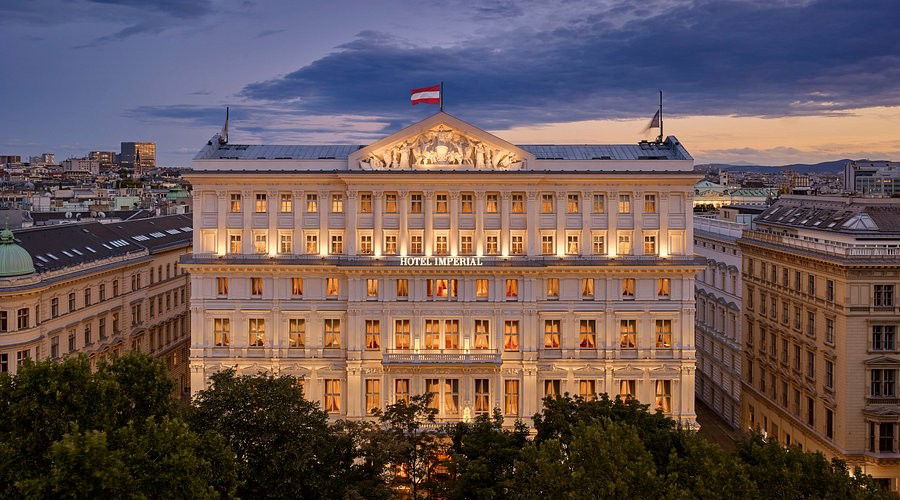
Built as a private palace in 1863 and converted to a hotel in 1873, Hotel Imperial occupies a defining position on Vienna's Ringstrasse. The official lodging for guests of the Austrian government, it holds 138 rooms across 59-plus suites, earns two Michelin Keys (2024), and scores 93 points on La Liste's 2026 Top Hotels ranking. Restaurant Opus carries three Gault et Millau toques, and Café Imperial remains the home of the city's most discussed torte.
Where the Ringstrasse Sets the Standard
Vienna's luxury hotel tier divides, broadly, into two types: the palace conversion that carries its history as a credential, and the newer design property that positions itself against a contemporary peer set. Hotel Imperial belongs firmly to the first category, and it does so with more documentation than almost any other property on the continent. Built in 1863 as the Vienna residence of the Prince of Württemberg, it was converted to a hotel in 1873, placing it among the oldest continually operating grand hotels in Central Europe. Its address on Kärntner Ring — the arc of the Ringstrasse that Emperor Franz Joseph commissioned as a statement of Habsburg ambition — means the building itself is part of the urban argument Vienna makes about itself.
That context matters when comparing options at Vienna's upper end. Properties like Rosewood Vienna, Park Hyatt Vienna, and The Amauris Vienna each offer a distinct reading of the city's luxury register. Hotel Imperial's reading is the most historically literal: 138 rooms including over 59 suites, interiors preserved in 19th-century style, silk-lined walls, marble bathrooms, and antiques sourced to period. The entry sequence , 14 chandeliers, a rotating display of fresh flowers in glass , signals immediately that this is a place that treats its own preservation as a form of service. La Liste's 2026 Leading Hotels ranking scored it 93 points, and Michelin awarded it two Keys in 2024, credentials that place it alongside a narrow peer set in the city.
The Physical Environment as Editorial Statement
Grand hotel design in the 19th-century European tradition operated on a specific logic: the building should make arriving guests feel they had been granted access to something that had existed long before them and would continue long after. Hotel Imperial executes that logic without revision. The grand marble staircase leading to the first-floor Royal Suites is not a reproduction; it is the original structure, maintained rather than restored. The suites on that level connect to adjoining rooms that historically accommodated bodyguards and entourages , an architectural detail that speaks to the category of guest the hotel was built to receive.
Upper floors, made more accessible by lifts installed as a later concession to practicality, now include rooms with terraces overlooking the Ringstrasse and the broader downtown area. Those fifth-floor rooms represent the clearest argument for the hotel's position: from that vantage point, the Vienna that the building was designed to anchor is visible in a single sightline. All suites operate with private butler service, a logistical standard that fewer hotels at any price point now maintain consistently.
For those comparing room configurations: the Royal Suites on the first floor represent the historic core of the property, with ceiling heights and period detailing that the upper-floor rooms, however well-appointed, cannot replicate. At a published rate from $546 per night for standard room configurations, the hotel sits at the upper end of Vienna's market but below the entry point of some newer ultra-luxury properties in European capitals.
A Kitchen and Floor That Work as a System
The editorial angle on Hotel Imperial's food and beverage program is leading understood as a question of coordination rather than individual performance. Three-toque recognition from Gault et Millau for restaurant Opus , awarded under the Luxury Collection Hotels and Resorts framework , reflects a sustained standard across kitchen output, front-of-house execution, and the wine and service program that connects them. In formal hotel dining at this level, the gap between kitchen capability and floor delivery is where the experience either holds or breaks. The Gault et Millau score suggests it holds.
Opus serves classic Austrian cuisine with international influences in a format that reads as deliberately formal. The dining room, redesigned by Alexander Kravetz alongside the Imperial Bar and Café Imperial Wien, translates the building's 19th-century grandeur into a contemporary register without abandoning the visual vocabulary of the original. That balance , period reference without period stiffness , is harder to achieve than either pure heritage preservation or clean modernization, and it shapes how the service team operates: formal in structure, but calibrated for guests who are not necessarily dining ceremonially.
The sommeliers and front-of-house team at a property with this level of diplomatic and celebrity footfall operate under conditions that test coordination constantly. The hotel has functioned as the official lodging for guests of the Austrian government since 1873, a designation that creates a category of service requirement beyond standard luxury hospitality. That institutional dimension shapes the culture of the floor, for better and sometimes for worse , the experience can read as highly controlled rather than warm. Knowing this in advance shifts how you approach the meal.
Café Imperial and the Imperial Torte
Vienna's coffeehouse culture sits at the intersection of food, social ritual, and civic identity in a way that few other cities' café traditions manage. The Café Imperial Wien does not simply occupy that tradition; it holds one of its most specific artifacts. The Imperial Torte , a dense, marzipan-layered chocolate confection developed for the hotel , is among the most documented desserts in a city whose pastry culture is documented obsessively. Ordering it at Café Imperial Wien rather than taking it away as a packaged souvenir is a different experience: the café's renovated interior, like Opus, interprets the building's grandeur through Kravetz's contemporary lens, and the torte arrives in a context that gives it historical grounding.
The café functions as a lower-friction entry point to the property for non-staying guests. Unlike Opus, which operates in a formal dinner register, Café Imperial Wien is accessible for a single coffee or pastry, making it the sensible first visit for anyone wanting to take the measure of the building before committing to a full meal or a room.
How This Hotel Positions Against Its Vienna Peers
Vienna's palace-hotel segment has added properties in recent years. Hotel Sacher Wien operates a comparable historical argument from the Staatsoper side of the Ringstrasse. Almanac Palais Vienna and Hotel Sans Souci Wien approach Vienna's architectural heritage from a design-forward rather than preservation-forward position. Altstadt Vienna and 25hours Hotel Vienna at MuseumsQuartier operate in a different register entirely, aimed at guests for whom the imperial reference is less relevant than contemporary programming.
Hotel Imperial's argument is direct: no other property in Vienna has held the government lodging designation for as long, and none carries a guestbook that runs from Wagner in 1875 through the Three Tenors to the present day. That continuity is either the hotel's central appeal or largely irrelevant to you, depending on why you're choosing Vienna in the first place.
If Austria beyond the capital is part of your itinerary, the EP Club covers a range of properties across the country: Rosewood Schloss Fuschl in Hof bei Salzburg, Schloss Mönchstein in Salzburg, Grand Tirolia Kitzbühel, Falkensteiner Schlosshotel Velden, Hotel Schloss Seefels in Techelsberg, Hotel Almhof Schneider in Lech, DAS EDELWEISS in Grossarl, Alpen-Wellness Resort Hochfirst in Obergurgl, Aktiv & Wellnesshotel Bergfried in Tux, Naturhotel Waldklause in Längenfeld, LEADING Hotel Hochgurgl, Chalet Untersberg in Grodig, and Hotel Schwarzer Adler in Innsbruck. For those extending to Italy, Aman Venice operates in a structurally similar palace-conversion category. Our full Vienna guide covers the city's dining and hospitality options in further depth.
Planning a Stay
Hotel Imperial sits at Kärntner Ring 16 in the first district, directly on the Ringstrasse, within walking distance of the Staatsoper, the Kunsthistorisches Museum, and the historic centre. The 138-room configuration includes over 59 suites, with butler service across all suite categories. Published rates start from $546 per night for standard rooms; suite pricing scales considerably above that. The hotel holds Michelin two Keys recognition (2024) and 93 points from La Liste (2026). Restaurant Opus carries three Gault et Millau toques. Google reviews average 4.7 across 1,678 ratings, a stable score for a property at this scale and price point.
For comparison purposes when planning: grand palace hotels operating in New York at a similar historical register include The Fifth Avenue Hotel and Aman New York, both of which offer a useful benchmark for what the palace-conversion category delivers at international scale.
Frequently Asked Questions
What's the most popular room type at Hotel Imperial?
The Royal Suites on the first floor represent the most historically significant accommodation the property offers, connected to adjoining rooms that reflect the building's original diplomatic purpose. They carry the highest ceiling heights and the most complete period detailing. At the other end, fifth-floor rooms with Ringstrasse terraces have grown in demand following the installation of lifts. The hotel's 59-plus suites span a range of configurations, all serviced by private butlers. The property holds Michelin two Keys (2024) and a La Liste score of 93 points (2026), with rates from $546 per night for standard rooms , suite pricing runs considerably higher.
What's the defining thing about Hotel Imperial?
The defining credential is continuity: Hotel Imperial has served as the official lodging for guests of the Austrian government since 1873, a designation held by no other Vienna property. That institutional history, combined with a guestbook running from Wagner in 1875 to contemporary heads of state, places it in a category where historical documentation rather than recent renovation is the primary trust signal. The Gault et Millau three-toque rating for restaurant Opus and Michelin's two Keys (2024) confirm that the operational standard has kept pace with the historical argument. Rates from $546 per night; Vienna's Ringstrasse location is central to all major cultural sites.
Can I walk in to Hotel Imperial?
Café Imperial Wien functions as the most accessible entry point , a coffee and a slice of Imperial Torte requires no reservation and no prior relationship with the property. Restaurant Opus operates in a formal dinner register where advance booking is the expectation, particularly for groups or specific suite dining arrangements. For room reservations, the Luxury Collection Hotels and Resorts channel handles bookings; the hotel does not publish direct contact details through EP Club at this time. Given the property's government lodging function, certain periods and floors may have restricted access without notice, so confirming availability in advance is advisable.
Recognized By


More hotels in Vienna
- 25hours Hotel Vienna at MuseumsQuartier25hours Hotel Vienna at MuseumsQuartier is a design-conscious mid-tier hotel in Vienna's 7th district, a short walk from the MuseumsQuartier arts complex and the Naschmarkt. Booking is easy and availability is generally reliable. If you're returning for a second stay, upgrading one room category is usually worth the modest price difference.
- Austria Trend Hotel Schloss WilhelminenbergA 19th-century castle hotel on the hills west of Vienna, Schloss Wilhelminenberg suits special occasions where setting and quiet matter more than city-centre proximity. Expect functional Austria Trend service rather than luxury attentiveness. Easy to book, and strongest in spring or early autumn when the hillside gardens justify the out-of-centre location.
Related editorial
- Best Fine Dining Restaurants in ParisFrom three-Michelin-star icons to the next generation of Parisian chefs pushing boundaries, these are the restaurants that define fine dining in the world's culinary capital.
- Best Luxury Hotels in RomeFrom rooftop terraces overlooking ancient ruins to Michelin-starred hotel dining, these are the luxury hotels that make Rome unforgettable.
- Best Cocktail Bars in KyotoFrom sleek lounges to hidden speakeasies, Kyoto's cocktail scene blends Japanese precision with global influence in ways you won't find anywhere else.
Save or rate Hotel Imperial on Pearl
Keep this venue in your Pearl passport, rate it after you visit, and track it alongside every other place you collect.