
Hotel in Saint-Jean-de-Trézy, France
Domaine de Rymska & Spa
850Pearl PointsWorking-Estate Hospitality


About Domaine de Rymska & Spa
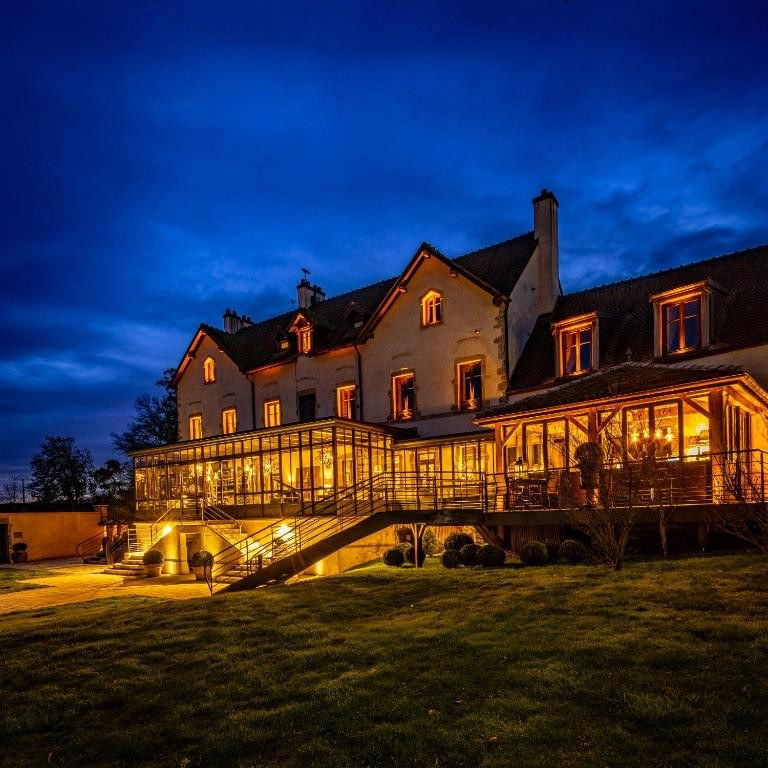
On an 80-hectare farming estate along the Burgundy wine route, Domaine de Rymska earns its Michelin One Key (2024) through the rare coherence between place and plate. Fourteen rooms occupy a carefully restored château where historical architecture meets contemporary interior work, and La Table de Rymska draws directly from the estate's own gardens, orchards, and livestock. Rates from $378 per night.
Burgundy's Working Estate Model, at Its Most Considered
The Burgundy wine route between Beaune and the Côte Chalonnaise generates a particular kind of hospitality property: the estate-as-destination, where the land itself dictates both the architecture and the menu. Domaine de Rymska, set within an 80-hectare working farm outside the village of Saint-Jean-de-Trézy, sits squarely within that tradition, but at a tier that few properties in this corridor reach. Its 2024 Michelin One Key designation places it in a small cohort of French rural properties where the accommodation standard and the culinary offer are treated as equally serious disciplines.
The Architecture of Restoration
What distinguishes this category of Burgundian property is the approach to historical fabric. The region is dense with châteaux and farmhouses that have been converted into hotels, and the spectrum runs from theme-park pastiche to over-minimalist renovation that strips out everything that made the building worth preserving. Domaine de Rymska occupies a more difficult middle position: the restored building honours its historical roots without performing them. The rooms and suites are a contemporary creation rather than an antique restoration, a meaningful distinction in this context. Antique restoration produces museums you sleep in. Contemporary creation inside historical walls produces spaces where the bones of the building remain legible while the surfaces, the light, and the furnishings belong to the present.
The estate's 80 hectares provide the physical context for this architecture to read correctly. A 14-room hotel on a small urban plot is simply a boutique hotel. The same building set inside a working range of livestock, gardens, and orchards becomes something with more structural logic: the scale of the land justifies the intimacy of the property, and the working nature of the estate gives the interiors a purposeful backdrop that designed-from-scratch rural retreats cannot replicate. This relationship between built environment and agricultural land is something the leading French estate properties, Les Sources de Caudalie in Bordeaux and Château Lafaurie-Peyraguey in Sauternes among them, understand implicitly. At Rymska, the working farm is not set dressing. It is the supply chain.
La Table de Rymska and the Farm-to-Table Discipline
In France, farm-to-table as a marketing phrase has been diluted to near meaninglessness. Restaurants attach the label to menus sourced from regional wholesalers rather than their own soil. What separates an estate restaurant from a restaurant that claims estate provenance is whether the supply relationship is verifiable and proximate. At Domaine de Rymska, the gardens, orchards, and livestock are on the same 80 hectares as the hotel, which compresses the distance between field and kitchen to something measurable in minutes rather than kilometres.
La Table de Rymska translates that proximity into what the property describes as culinary art from estate produce. The Michelin One Key signals that the overall hotel experience is at the level where this claim is taken seriously and assessed against peers. The restaurant's quality is not incidental to the hotel's recognition, it is constitutive of it. This is the model that properties like Villa La Coste in Provence and Baumanière in Les Baux-de-Provence have demonstrated at scale: when a property controls its land and its kitchen simultaneously, the dining becomes the most direct expression of the estate's identity.
Burgundy's broader culinary tradition is useful context here. This is a region that has long placed vegetable and grain cultivation alongside its vineyards, and the Côte Chalonnaise south of Beaune is wine-producing territory where the table has always been taken as seriously as the cellar. An estate restaurant in this specific geography operates within a deeply established set of expectations around seasonal produce and local sourcing, expectations that the region's most serious kitchens have been meeting for generations.
Scale, Format, and What Fourteen Rooms Means
Luxury rural hospitality in France has split between two formats. The first is the large-château model: extensive grounds, 40 or more rooms, conference facilities, and a spa scaled to serve a mixed leisure and corporate market. The second is the intimate estate model: fewer than 20 rooms, high per-night rates, and a guest experience calibrated around exclusivity and attention rather than volume. Domaine de Rymska's 14-room format places it firmly in the second category, with rates from $378 per night (and an EP Club member rate of $412, reflecting peak or enhanced inventory). At that scale, service ratios are structurally different from larger properties, and the architecture of the building imposes a natural residential character on the stay.
Comparable properties in this format across France include Castelbrac in Dinard, Château de Montcaud in Sabran, and Château du Grand-Lucé in the Loire, all restored historical properties where the room count is kept low enough to sustain a house-party register. Domaine Les Crayères in Reims operates in a similar vein at slightly larger scale, with a more urban-adjacent context. At Rymska, the surrounding farmland insulates the property from the kind of visitor throughput that erodes the residential quality in busier rural destinations.
Getting There and Planning the Stay
Beaune, the wine-route capital with its own concentration of restaurants and the Hôtel-Dieu, is close enough to include as a day excursion without the estate losing its sense of remove.
For guests comparing this property against other estate-hotel formats across France, the closest analogues in terms of scale, agricultural integration, and culinary seriousness are Château de la Gaude in Aix-en-Provence and La Bastide de Gordes in the Luberon, though neither operates within the specific Burgundian farming tradition that frames Rymska's identity. For those whose itinerary extends to the French Riviera, Hotel du Cap-Eden-Roc and La Réserve Ramatuelle occupy a different register entirely, coastal, larger in scale, and priced accordingly, but they represent the broader range of French luxury hospitality within which Rymska positions itself as a quieter, more land-rooted alternative.
Location
1, rue du Château de, La Fosse, 71490 Saint-Jean-de-Trézy
Saint-Jean-de-Trézy, France
Recognized By


Explore Saint-Jean-de-Trézy
Save or rate Domaine de Rymska & Spa on Pearl
Keep this venue in your Pearl passport, rate it after you visit, and track it alongside every other place you collect.