

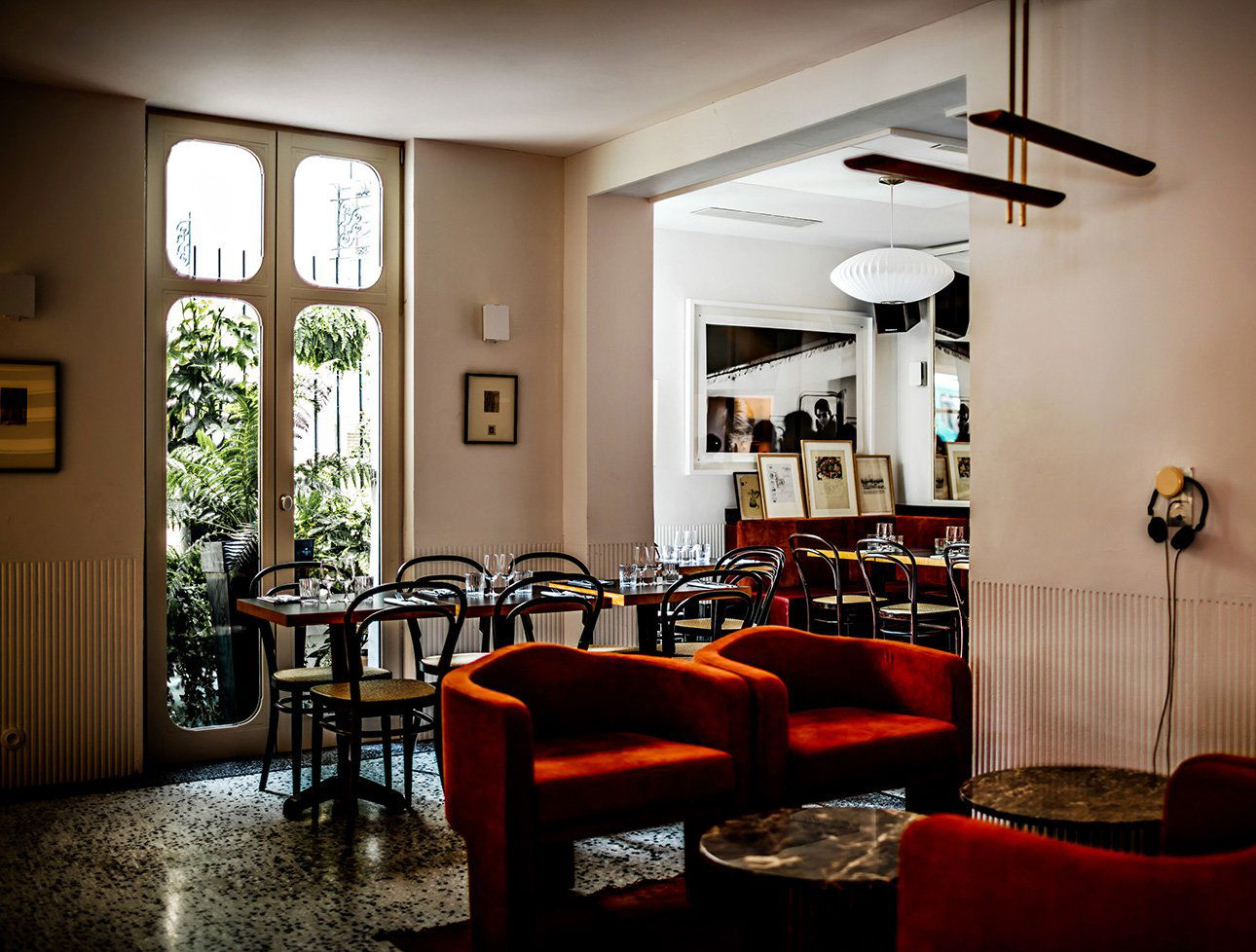
Rue Frochot runs off Place Pigalle at a slight angle, and the walk along it tells you something useful about how the 9th arrondissement works. The neon that once announced cabarets and late-night entertainments has given way to a quieter form of creativity: ateliers, small production companies, a handful of addresses that have absorbed the neighbourhood's history rather than traded on it as nostalgia. Le Pigalle, at number 9, belongs to that second category. The building carries the street's accumulated atmosphere in a way that newer arrivals on Boulevard de Clichy cannot replicate.
The 9th has undergone a recognisable cycle over the past fifteen years. A district that non-Parisians once associated primarily with Moulin Rouge tourism has attracted a layer of hospitality that positions itself against the neighbourhood's actual history rather than against the postcard version of it. Le Pigalle's stated identity draws directly from that local lineage, framing its character around what the area has always produced: creative energy with a particular Parisian edge, specific to this part of the city rather than transferable to another arrondissement.
For guests staying at the major palace hotels further west, such as Cheval Blanc Paris, Hotel Plaza Athénée, or Hôtel de Crillon, Le Pigalle represents a different register entirely. It is not competing with the 8th arrondissement's formality. It is operating from a different premise.
The Neighbourhood as Context
Pigalle's cultural geography has always been more layered than its reputation suggests. The same blocks that housed Toulouse-Lautrec's favourite haunts later became home to recording studios and rehearsal spaces. Through most of the 20th century, the neighbourhood operated as a working creative district with its own internal logic, distinct from the curated bohemianism of Saint-Germain-des-Prés or the academic register of the Latin Quarter.
The contemporary 9th has positioned itself at an interesting junction. It is close enough to the 8th and 10th to draw visitors moving across the city, but retains a distinct residential character that the tourist-heavy arrondissements around it lack. The streets between Pigalle and Notre-Dame-de-Lorette particularly have become an axis for mid-range hospitality that takes local history seriously. Le Pigalle's address on rue Frochot places it at the centre of that axis.
This is worth registering for anyone building an itinerary around Paris's 9th. The area rewards lateral movement: the Musée de la Vie Romantique sits a short walk away, and the covered passages of the 2nd are reachable on foot. A venue rooted in the neighbourhood's history functions as an orientation point as much as a destination. Context about where to stay in Paris matters here; properties like La Réserve Paris and Le Bristol Paris offer proximity to different axes of the city, and understanding those distinctions shapes how you approach a neighbourhood like this one.
What the Space Communicates
Addresses in the 9th that have survived multiple cycles of reinvention tend to share a formal quality: they do not over-explain themselves. The venue's neon-lit, creative past is referenced in its positioning without being staged for consumption. That distinction matters. There is a category of Paris address that deploys neighbourhood history as decoration, and a smaller category that has genuinely grown out of it. Le Pigalle claims the second position.
The editorial angle worth examining here is the collaborative dynamic between a venue's front-facing identity and its back-of-house culture. In the 9th, where several addresses have developed reputations built more on atmosphere than on formal credentials, the question of how a space manages the relationship between its public character and its operational discipline is a telling one. A venue that cites deep local roots is making a specific claim about institutional memory, about how long-term staff relationships and neighbourhood-specific knowledge compound over time in ways that a newer concept cannot replicate regardless of its investment level.
The neon-lit descriptor in Le Pigalle's own account of itself is not incidental. Neon in this part of Paris carries a specific historical charge: it references the district's entertainment past without romanticising it. That calibration, choosing reference points that are specific rather than generic, is characteristic of how the better addresses in the 9th have defined themselves in the past decade.
How It Sits Within the Paris Scene
Paris hospitality in 2024 operates across a pronounced range of formats. At one end, the palace hotels maintain their position through formal service structures and award recognition: Four Seasons George V, Le Meurice, and Airelles Château de Versailles represent different expressions of that tier. At the other end, a generation of neighbourhood-specific addresses has built identity through local embeddedness and a deliberate distance from the conventions of grand hotel hospitality.
Le Pigalle belongs in that second category, though it is worth noting that this category is itself internally differentiated. There is a meaningful difference between a venue that markets neighbourhood character and a venue that has accumulated it organically. The claim of deep local roots, if substantiated by the address's history on rue Frochot, places it in a position that newer arrivals to the 9th cannot occupy by design alone.
For a fuller picture of where this address fits across Paris's restaurant and hotel landscape, our full Paris restaurants guide maps the city's key arrondissements against their hospitality character. The 9th is covered in the context of how the Right Bank has diversified its offer beyond the traditional luxury axis of the 1st and 8th.
Travellers who want to contrast this kind of address with France's broader hospitality landscape might also consider what properties in other regions signal about local rootedness. Les Sources de Caudalie in Bordeaux, Domaine Les Crayères in Reims, and Baumanière Les Baux-de-Provence each represent region-specific institutional depth, which is a different expression of the same underlying premise. Outside France, properties like Aman Venice demonstrate how embedded local context translates across hospitality categories.
Know Before You Go
Planning Details
- Address: 9 rue Frochot, Paris 75009, France
- Arrondissement: 9th (Pigalle / Notre-Dame-de-Lorette)
- Nearest Metro: Pigalle (Lines 2 and 12) or Saint-Georges (Line 12)
- Booking: Contact details not confirmed at time of publication; check current availability directly
- Hours: Not confirmed at time of publication
- Pricing: Not confirmed at time of publication
- Note: The 9th is walkable from the 2nd, 10th, and 18th arrondissements; the area is leading explored on foot
Frequently Asked Questions
Why do people go to Le Pigalle?
Le Pigalle draws visitors who are specifically interested in the 9th arrondissement's creative history and want an address with genuine neighbourhood roots rather than a concept imported from elsewhere. The venue's positioning, anchored to rue Frochot's neon-lit, bohemian past, places it in a distinct tier from the formal palace hotels of the 8th or the destination restaurants of the 1st. For travellers already familiar with addresses like Cheval Blanc Paris or Four Seasons George V, Le Pigalle represents a deliberate departure toward a more neighbourhood-specific register. It is a useful anchor for an itinerary built around the Right Bank's less formally mapped districts, and it connects naturally to the area's galleries, passage couvertes, and independent hospitality that have developed around it over the past decade.
What makes Le Pigalle's address on rue Frochot significant?
Rue Frochot has a specific place in the 9th's social history that is distinct from the broader Pigalle area. The street has housed artists, performers, and creative practitioners across multiple eras, giving it a layered identity that the surrounding neighbourhood's more commercial stretches do not share. An address at number 9 carries that accumulated character in a way that is not replicable by a newer arrival regardless of concept or investment. For context on how other French properties translate deep local roots into hospitality identity, compare the positioning of La Bastide de Gordes, Villa La Coste, or Royal Champagne Hotel and Spa, each of which builds identity from a specific regional and historical foundation rather than from a transferable luxury formula.
