
Hotel in Paris, France
Hôtel Madame Rêve
1,175ptsAdaptive Heritage Luxury


About Hôtel Madame Rêve
Occupying the restored Haussmannian shell of the former Louvre Post Office on Rue du Louvre, Hôtel Madame Rêve is a five-star property earning Michelin's One Key distinction (2024), a Gault & Millau Exceptional Hotel rating (2025), and 92.5 points from La Liste Top Hotels (2026). Eighty-three rooms across a landmark 1er arrondissement address, with a 1,000m² rooftop and Japanese-French dining at La Plume.
A Postmaster's Palace, Repurposed
The building at 48 Rue du Louvre has a particular kind of institutional weight. It housed Paris's central post office for over a century before closing in 2015, its Haussmannian facade accumulating the quiet authority of a public institution that had outlasted several republics. That authority is now the raw material of Hôtel Madame Rêve, where the restored envelope of a 19th-century sorting house has been turned into one of the 1er arrondissement's more considered luxury openings of recent years. Arriving on foot from the Louvre or the Bourse de Commerce — both within a short walk — you approach a facade that reads as civic monument before it reads as hotel, which is precisely the point.
Paris's luxury hotel tier has diversified sharply over the past decade. Where a handful of palace-designated addresses once defined the upper bracket, the city now hosts a range of formats: the grand palaces of the 8th arrondissement (places like Le Bristol Paris, Four Seasons George V, and Hôtel de Crillon), the architecturally singular conversions such as Cheval Blanc Paris on the Samaritaine block, and the intimately scaled design properties that operate with smaller key counts and a tighter editorial identity. Hôtel Madame Rêve belongs to this last category, with 83 rooms housed inside a landmark structure that few developers would have had the patience to restore correctly.
What the Restoration Actually Produced
The lobby level is the sensory thesis statement for the whole property. The work carried out under the direction of founder and art director Laurent Taïeb and designer Andrée Putman treated the Haussmannian bones as an asset rather than an obstacle. The result is a space that reads as postmodern period piece: the romance of the telegram-and-trunk-call era reinterpreted through contemporary materials and a disciplined design eye. This is the kind of interior that rewards a slow look , the mail-themed art woven through the rooms and corridors is not decorative afterthought but a sustained conceptual argument about the building's identity.
The 83 rooms and suites sit in clear contrast to the lobby's layered historical references. They run contemporary, finished in warm tones that absorb rather than reflect the light from Rue du Louvre below. A number of rooms face inward, which adds a measure of acoustic quiet that street-facing rooms in this arrondissement rarely manage. Paris's luxury conversion model, practiced at properties from Le Meurice on Rue de Rivoli to La Réserve Paris off the Champs-Élysées, typically asks guests to accept that history and acoustic comfort exist in tension. The inward-facing configuration here is one practical resolution to that tension.
Penthouse sits at the property's vertical peak, with panoramic views across the rooftops toward the Eiffel Tower and Montmartre. At the five-star tier in Paris, a room with that sightline commands a substantial premium above the base rate (rooms from approximately $602 per night). Whether the Penthouse represents the property's most considered room experience or simply its most dramatic one depends on what you're asking of the stay. Guests prioritizing quiet and the mail-themed interior design programme may find the mid-floor inward-facing suites a more coherent expression of the hotel's identity; guests wanting Paris at eye level will find the Penthouse does what it promises.
The Rooftop and the Restaurants
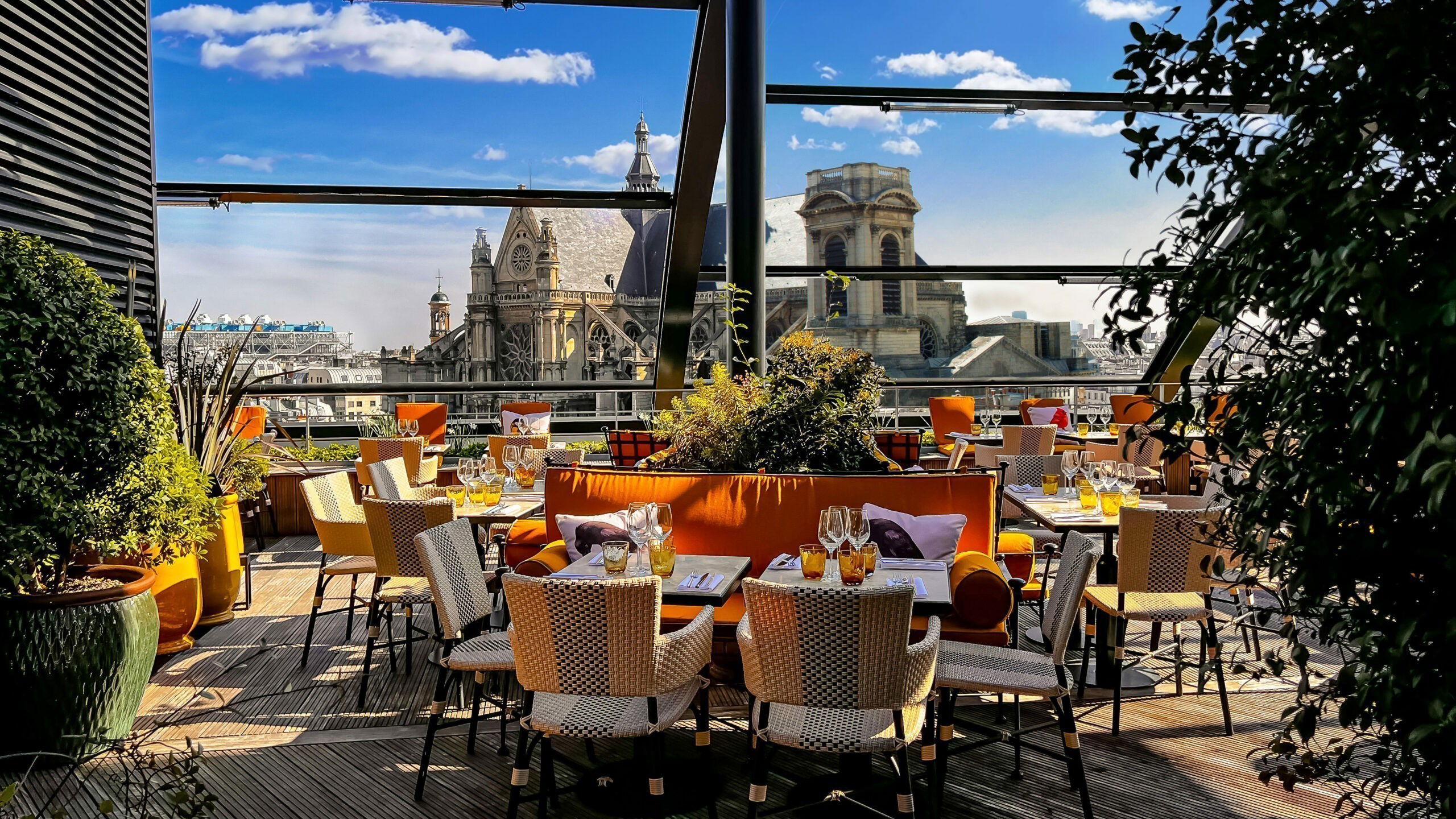
1,000m² rooftop is the property's most discussed physical asset, and for good reason. At that scale, a Paris rooftop is not a narrow terrace with four sun loungers , it functions as a contained garden, the vegetal planting creating a degree of enclosure and sensory separation from the city below even as the panorama of Haussmannian zinc rooftops and distant monuments remains fully present. During daytime hours, the rooftop operates as an exclusive space for hotel guests, a policy that keeps the guest-to-space ratio manageable. Reservations are not required in the conventional sense, but the access restriction means arrivals earlier in the day, before the afternoon light shifts off the tower to the southwest, tend to yield the better experience.
Paris rooftops at the luxury hotel tier have become a competitive format in their own right. The model practiced here, a working garden rather than a bare terrace with a view, aligns the property with a broader trend in urban luxury: the turn toward green, planted spaces as an antidote to the density and stone-heaviness of central Paris. At the scale of 1,000m², Hôtel Madame Rêve's rooftop sits in a different category from the bar-terrace formats at properties such as Hotel Plaza Athénée.
At ground level, Kitchen operates as the all-day restaurant opening onto an intimate terrace , a practical anchor for guests who want to eat well without navigating the arrondissement's lunch and dinner rush. La Plume, the property's more ambitious dining format, works a Japanese-French register that positions it within a broader Parisian culinary pattern: the high-end fusion that has been producing some of the city's most interesting cooking for a decade and a half, typically at counters and small dining rooms where the Japanese technique disciplines the French product sourcing. La Plume's city views add a visual dimension that few restaurant formats in the 1er can match at that floor level. For a wider sense of where this fits in Paris's dining scene, our full Paris restaurants guide maps the relevant comparisons.
Credentials and Competitive Position
The property's award stack is worth reading carefully because the three bodies involved assess different things. Michelin's One Key designation (2024) evaluates hotel quality through a hospitality lens calibrated to the same standards the guide applies to restaurants: precision, consistency, and the relationship between concept and execution. Gault & Millau's Exceptional Hotel rating (2025) at five points is the top tier of that guide's hotel programme, which tends to weight experiential originality alongside technical standard. La Liste's 92.5-point score in its 2026 Leading Hotels ranking places the property in a segment that sits below the absolute peak of Parisian palace hotels but well above the broader five-star market.
Taken together, these three signals describe a hotel that has been assessed across multiple frameworks and found consistent. That kind of cross-body recognition is not automatic for a conversion property of this age and scale. Among the 1er arrondissement's luxury options, Hôtel Madame Rêve occupies a distinct position: smaller and more design-led than the major palace addresses, more historically rooted than the design-forward newcomers, and more conceptually coherent than the international-chain five-stars that treat a Paris address as interchangeable with any other flagship city.
For comparison within the French luxury hotel tier, the châteaux-and-domaine model practiced at places like Airelles Château de Versailles, Domaine Les Crayères in Reims, or Baumanière Les Baux-de-Provence answers a different brief entirely: those properties are destinations in themselves, where the surrounding landscape and cuisine form the core proposition. Hôtel Madame Rêve operates from the opposite premise , the city is the product, and the hotel's job is to place you inside it with as little friction and as much considered atmosphere as possible.
Planning a Stay
The property sits at 48 Rue du Louvre in the 1er arrondissement, within walking distance of the Louvre, the Bourse de Commerce, and the Samaritaine department store. The Louvre–Rivoli Métro station is the closest rapid-transit point. Base room rates from approximately $602 per night reflect the five-star conversion tier in central Paris, a bracket that sits below the declared palace hotels (Four Seasons George V, Le Meurice) but above the broader luxury market. The spa provides an on-site recovery option that matters more than it might elsewhere: the 1er arrondissement is a high-footfall district and the walking distances between the major museum clusters add up quickly over a multi-day visit. For guests extending their French stay beyond Paris, properties such as La Réserve Ramatuelle, Les Sources de Caudalie in Bordeaux, and Royal Champagne Hotel & Spa in Champillon represent the same tier of considered luxury in their respective regions.
FAQ
- What's the main draw of Hôtel Madame Rêve?
- The combination of a historically significant building , the former Louvre Post Office, closed in 2015 and restored under the direction of Laurent Taïeb and Andrée Putman , with three independent award recognitions (Michelin One Key 2024, Gault & Millau Exceptional Hotel 2025, La Liste 92.5 points 2026) and a 1,000m² rooftop garden in the 1er arrondissement. Rates from approximately $602 per night place it in the upper-tier conversion category rather than the declared palace segment. The location, within walking distance of the Louvre, the Bourse de Commerce, and the Samaritaine, adds practical weight to the case for staying here rather than in the 8th.
- Which room offers the leading experience at Hôtel Madame Rêve?
- The Penthouse delivers the property's headline view: panoramic sightlines to the Eiffel Tower and Montmartre from the building's highest point. For guests whose priority is the hotel's design narrative rather than the skyline, the inward-facing rooms and suites offer more acoustic quiet and a closer engagement with the mail-themed art programme that runs through the interior. The award recognitions from Michelin, Gault & Millau, and La Liste apply to the property as a whole, so the question is whether the visual drama of the upper floors or the considered interior calm of the courtyard-facing rooms better matches what you're looking for from a central Paris stay.
Recognized By


More hotels in Paris
- 42 Av. Gabriel42 Av. Gabriel sits in one of Paris's most competitive hotel corridors, steps from the Champs-Élysées gardens in the 8th arrondissement. Full pricing and awards data are not yet confirmed, so book direct and verify upgrade eligibility at reservation. For verified alternatives nearby, see Le Bristol Paris, Hôtel de Crillon, or La Réserve Paris.
- Auberge FloraAuberge Flora is a boutique hotel in Paris's 11th arrondissement, offering a neighbourhood-embedded alternative to the palace-district properties at a lower price point. It books easily, sits close to the Marais and Bastille, and suits travellers who want a design-forward base rather than full concierge service. A practical choice if location flexibility and value matter more than brand prestige.
Related editorial
- Best Fine Dining Restaurants in ParisFrom three-Michelin-star icons to the next generation of Parisian chefs pushing boundaries, these are the restaurants that define fine dining in the world's culinary capital.
- Best Luxury Hotels in RomeFrom rooftop terraces overlooking ancient ruins to Michelin-starred hotel dining, these are the luxury hotels that make Rome unforgettable.
- Best Cocktail Bars in KyotoFrom sleek lounges to hidden speakeasies, Kyoto's cocktail scene blends Japanese precision with global influence in ways you won't find anywhere else.
Save or rate Hôtel Madame Rêve on Pearl
Keep this venue in your Pearl passport, rate it after you visit, and track it alongside every other place you collect.