
Hotel in Münster, Germany
Mauritzhof Hotel Münster
650ptsGothic-City Midcentury Contrast


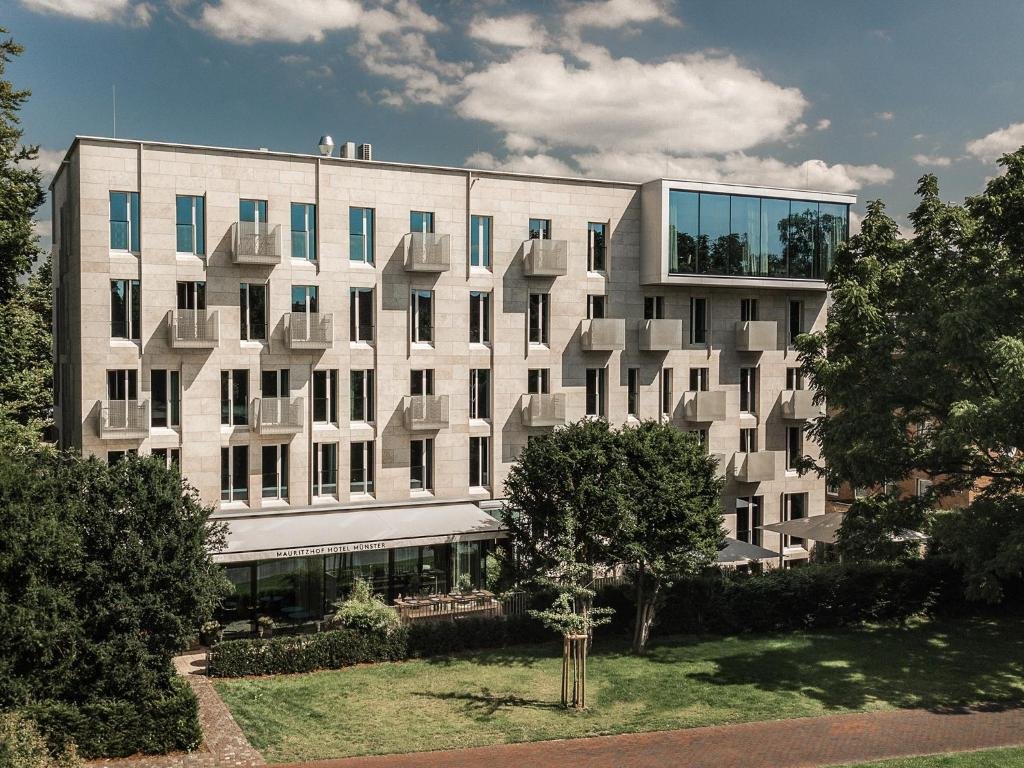
About Mauritzhof Hotel Münster
A 50-room design-led boutique in central Münster, Mauritzhof Hotel channels the city's Gothic heritage through a palette of slate, taupe, and turquoise — dark woods, velvet upholstery, and midcentury furniture creating an atmosphere closer to a Scandinavian design hotel than a conventional German city property. Rooms are soundproofed, with parquet floors and underfloor-heated bathrooms, starting from around $217 per night.
Where Gothic Münster Meets Midcentury Design
Germany's boutique hotel scene has split cleanly between two modes: the grand historic property restored to period formality, and the design-forward city hotel that draws on local architectural character while translating it through a contemporary lens. Mauritzhof Hotel Münster belongs firmly to the second category. The city itself provides the reference point: Münster is defined by its Gothic churches, their dark stone and soaring spires shaping the skyline in ways that few German cities outside of Cologne or Freiburg can match. At Eisenbahnstraße 17, the Mauritzhof takes that chromatic vocabulary and runs it through a midcentury filter — slate gray, taupe, and flashes of turquoise against dark wood and glass — producing something that feels less like a local heritage hotel and more like a Scandinavian design property that happens to have a view of church spires from its balconies.
That design sensibility is genuinely considered rather than cosmetic. Sleek midcentury furniture sits alongside rich fabrics , velvet and leather upholstery , in a combination that rewards the kind of traveller who notices when a sofa is well-proportioned. This places Mauritzhof in a niche peer set: properties with a strong visual identity but modest scale, more interested in atmosphere than amenity counts. For broader reference points in Germany's design-led boutique tier, consider how properties like Bülow Palais in Dresden or LA MAISON in Saarlouis each find their design logic in the character of their respective cities. Mauritzhof operates by the same principle, anchored in Münster's particular shade of Gothic northern Germany.
50 Rooms, Parquet Floors, and a Fireplace Martini
At 50 rooms, the Mauritzhof sits in the smaller end of Germany's city hotel spectrum, closer to the boutique scale where staff-to-guest ratios tend to work in the guest's favour. Guest rooms are soundproofed , a detail that matters considerably in a city-centre location , and finished with parquet floors and feather beds. Nespresso machines and muted lighting keep the in-room experience restrained rather than over-specified. The bathrooms include underfloor heating, a practical amenity that shifts from comfort to necessity during Münster's winters, which arrive early and linger.
Some rooms offer balconies with views across a skyline punctuated by the towers of St. Paulus Dom and the city's other Gothic landmarks. This is the kind of orientation detail worth requesting at booking: the contrast between the room's dark, interior-focused palette and the external view of medieval stonework is a significant part of what makes the hotel's setting coherent rather than arbitrary.
Downstairs, the property functions as a genuine gathering point rather than a pass-through lobby. A fireplace creates a focal point for evening drinks, and the terrace opens for lunch in warmer months , a reasonable place to pause before taking out one of Münster's bicycles, the default mode of transport for a city where cycling infrastructure has been a civic priority for decades. Münster's compact centre makes the hotel's location on Eisenbahnstraße logical for visitors covering the cathedral quarter, the Prinzipalmarkt, and the university district on two wheels.
How Mauritzhof Sits in Münster's Hotel Market
Münster doesn't carry the same international hotel density as Hamburg or Munich. The city attracts business travellers, academics connected to the university, and cultural visitors drawn to the cathedral and the Westphalian State Museum. That visitor mix supports a hotel market with fewer large international flags and more room for design-led independents to define their own tier. At a rate around $217 per night, the Mauritzhof prices as a mid-to-upper city hotel rather than a luxury property , closer in positioning to a confident boutique than to the grand-hotel tier occupied by properties like Fairmont Hotel Vier Jahreszeiten in Hamburg or Excelsior Hotel Ernst in Cologne.
For travellers comparing across Germany's design-conscious boutique properties, the Mauritzhof's peer set is more accurately the group of regionally rooted independents than any chain-affiliated flag. Properties such as Hotel Ketschauer Hof in Deidesheim or Esplanade Saarbrücken occupy comparable positions: city and town hotels where design investment is the differentiating argument rather than spa facilities or F&B; scope. Further afield in Germany's premium tier, Schloss Elmau, Althoff Seehotel Überfahrt, and Mandarin Oriental Munich represent a different competitive tier entirely, where wellness infrastructure and F&B; programmes carry significant weight. Mauritzhof makes no claim on that territory, and the cleaner, more focused offering it provides is appropriate for what Münster asks of its hotels.
Planning a Stay: What to Know Before You Book
Münster is accessible by train from Dortmund (roughly 45 minutes) and Cologne (under 90 minutes), making it a plausible extension from either city rather than a destination requiring a dedicated long-haul connection. The hotel's central address on Eisenbahnstraße puts it within walking distance of the main station and the cathedral quarter, which concentrates most of what first-time visitors want to cover. For those arriving by rail from further afield, direct ICE connections to Münster run from Frankfurt and Amsterdam, making the city reasonably reachable without domestic flights.
The most practical window for balcony rooms facing the Gothic skyline is autumn, when the light is sharp and the spires read clearly against grey skies , conditions that make the hotel's own interior palette feel more climatically coherent. Summer brings the terrace into full operation, and the city's cycling culture peaks between May and September, when the network of bike paths connecting the old town is at its most navigable for visitors. Winter stays earn the underfloor-heated bathrooms and the fireplace downstairs in a way that summer visits don't quite justify.
For broader context on Münster's dining and neighbourhood character, see our full Münster restaurants guide. Travellers using the Mauritzhof as a base for a wider German itinerary may also consider how it connects with design-conscious properties in adjacent regions, including Der Öschberghof in Donaueschingen, Luisenhöhe in Horben, or BUDERSAND Hotel on Sylt for coastal contrast. Those building a European itinerary with design-led accommodation as the organising principle might extend the logic further to Aman Venice or Aman New York, where the same design-first, smaller-scale philosophy operates at a higher price bracket.
Frequently Asked Questions
Is Mauritzhof Hotel Münster more formal or casual?
The atmosphere is closer to relaxed than formal. The design is considered and deliberate , dark wood, velvet, midcentury furniture , but the scale of 50 rooms keeps the tone from tipping into the ceremonial register of grand-hotel properties. The fireplace bar downstairs and the terrace lunch setup suggest a hotel that functions well for both business stays and unhurried leisure visits. At around $217 per night, it sits at a price point where guests expect quality finishes rather than white-glove service protocols.
Which room category should I book at Mauritzhof Hotel Münster?
Rooms with balconies facing the Gothic skyline are the stronger choice for first-time visitors, given that the visual contrast between the hotel's modern interior and Münster's medieval spires is a defining part of the stay. All rooms share the same parquet floors, feather beds, and underfloor-heated bathrooms, so the main differentiation between categories comes down to orientation and balcony access. Request this specifically at booking rather than relying on a standard allocation.
What makes Mauritzhof Hotel Münster worth visiting?
Münster's design-hotel options are limited relative to larger German cities, and a property that translates the city's Gothic architectural character into a coherent contemporary aesthetic without reverting to heritage pastiche fills a genuine gap. The combination of a considered design programme, soundproofed rooms, underfloor heating, and a central location within cycling distance of the cathedral quarter makes it a practical and visually engaging base for the city. For travellers whose German itinerary already includes grander properties like Hotel de Rome in Berlin or Kempinski Hotel Berchtesgaden, the Mauritzhof offers a different register: smaller, sharper, and rooted in a city that rewards slower exploration.
Recognized By


Related editorial
- Best Fine Dining Restaurants in ParisFrom three-Michelin-star icons to the next generation of Parisian chefs pushing boundaries, these are the restaurants that define fine dining in the world's culinary capital.
- Best Luxury Hotels in RomeFrom rooftop terraces overlooking ancient ruins to Michelin-starred hotel dining, these are the luxury hotels that make Rome unforgettable.
- Best Cocktail Bars in KyotoFrom sleek lounges to hidden speakeasies, Kyoto's cocktail scene blends Japanese precision with global influence in ways you won't find anywhere else.
Save or rate Mauritzhof Hotel Münster on Pearl
Keep this venue in your Pearl passport, rate it after you visit, and track it alongside every other place you collect.