
Hotel in Marrakesh, Morocco
Maison Brummell Majorelle
500ptsModernist Medina Restraint

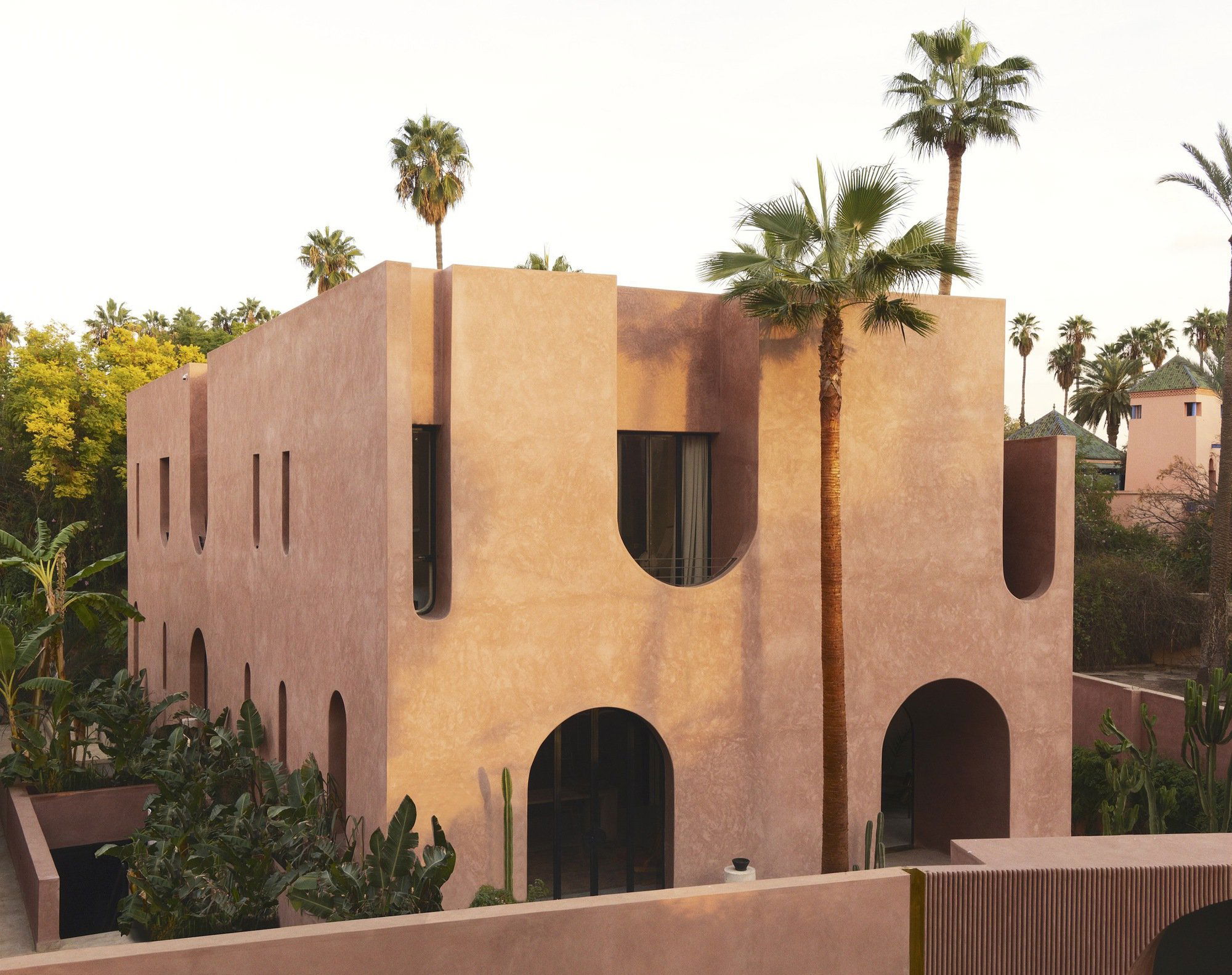
About Maison Brummell Majorelle
Eight rooms behind terrazzo walls, steps from the Majorelle Gardens, Maison Brummell Majorelle is among Marrakesh's more considered small hotels. Arab architectural elements, tadelakt plasterwork, and mashrabiya-inspired alcoves sit alongside sculptural modern furnishings. A marble hammam, outdoor pool, and honesty bar in the Chimney Room round out a property that earns its position in the city's boutique tier.
A Neighbourhood Shaped by a Garden
The Guéliz-Majorelle quarter of Marrakesh operates on a different register to the medina. Where the old city rewards disorientation, this neighbourhood rewards attention: the wide, tree-lined streets eventually give way to ochre walls and then, unexpectedly, to cobalt blue. The Majorelle Gardens, planted across roughly four acres by the French artist Jacques Majorelle in the 1920s and famously acquired by Yves Saint Laurent and Pierre Bergé in 1980 to prevent their sale to property developers, set the cultural tone for everything around them. They are one of the few genuinely civic acts of preservation in modern Moroccan history, and the neighbourhood still carries that charge. Small design-led hotels have gathered here precisely because the area offers proximity to one of the city's great cultural anchors without the compression of the medina.
Maison Brummell Majorelle sits at that address at 7 Rue Al Madina, its terrazzo walls flush with the street. Eight rooms is a scale that matters in Marrakesh, where the difference between eight keys and eighty is the difference between a house and a resort. At this size, the hotel operates closer to a private residence than a hospitality operation, and the architectural decisions read accordingly.
The Architecture of Restraint
Boutique hotels in Morocco divide broadly into two camps: those that perform Moroccan ornament at high volume, and those that extract the structural logic of Moroccan craft and apply it with more economy. Maison Brummell Majorelle belongs to the second group. Architects Bergendy Cooke and Amine Abouraoui worked with smooth stone flooring, tadelakt plaster walls, and a staircase carved to suggest it emerged from a single block of rock. The effect is sculptural rather than decorative. Italian-made suspension lamps and brass details appear without competing with the masonry work. The volume of the rooms, with built-in lounge seating and bespoke wooden furniture in pale stone surroundings, functions more like a considered interior than a hotel room dressed with local references.
Moroccan craft tradition is present throughout, but absorbed rather than displayed. The alcoves reference mashrabiya screens, the carved wooden lattice panels that historically gave women in riads the ability to observe the street without being observed from it. Here, that reference is structural rather than literal: it shapes sightlines and spatial rhythm without reproducing the ornament. It is a decision that places this property in a specific and relatively small peer set among Moroccan hotels, alongside properties like El Fenn and Ksar Char-Bagh, which similarly use local craft as structural language rather than surface decoration. Properties like La Mamounia and Royal Mansour operate at a different scale and with different intentions, as does the garden-resort model found at Amanjena. The larger international footprints of Four Seasons Resort Marrakech and Fairmont Royal Palm Marrakech represent a different category entirely.
Sourced From Here: What Breakfast Signals About the Property
In a hotel of eight rooms, what arrives at the breakfast table functions as an editorial statement. The spread at Maison Brummell Majorelle includes traditional Moroccan pastries and mint tea, served either inside or in the courtyard depending on the weather. This is not a trivial choice. The morning meal in Morocco, specifically the combination of msemen flatbreads, beghrir semolina crepes, honey, argan oil, and fresh herbs, draws directly from the country's agricultural south and the regional production networks around Marrakesh. Mint tea is brewed here from fresh leaves, not dried bags, a distinction that matters both for flavour and for what it signals about sourcing intent. At properties of this scale, the breakfast is often where sourcing decisions are most visible: there is no central purchasing department, no buffer between a local supplier and the table. The proximity is structural.
The courtyard terraces where breakfast is sometimes served sit alongside a garden and an outdoor swimming pool. The hammam in the lower level is fitted in marble and includes an indoor plunge pool and a heated stone block for traditional Moroccan body treatments. This is a hammam configured for use rather than display, which again distinguishes it from some of the more theatrical spa installations found at larger properties in the city.
Evenings and the Chimney Room
The Chimney Room, with its fireplace and modular sofas, operates on an honesty bar system for nightcaps. In Marrakesh, where evenings drop in temperature considerably from October through March, a fireplace is functional rather than atmospheric. The honesty bar format is a deliberate signal: it assumes a guest who does not need to be managed. At eight rooms, that assumption holds.
Communal areas on the lower level, including the gardens and terraces, are designed to allow guests to share space without the geometry of a hotel lobby. The layout, according to the architects, makes it easy to forget that other guests are present. For a hotel at this address, in a neighbourhood where the gardens next door can draw significant numbers of visitors during peak season, that degree of spatial separation is part of what the property is selling.
Placing Maison Brummell in Morocco's Small Hotel Circuit
Morocco's boutique hotel circuit extends well beyond Marrakesh. Properties like Jnane Tamsna in Marrakech, Hotel Sahrai in Fes, and Dar Ahlam in Ouarzazate each occupy different positions within a broader range of design-conscious riads and guesthouses. Further afield, Dar Maya in Essaouira, Dar al Hossoun in Taroudant, and Banyan Tree Tamouda Bay in Fnideq demonstrate how the country's hospitality has expanded into coastal and southern formats. Larger city hotels like the Hyatt Regency Casablanca, Fes Marriott Jnan Palace, Fairmont La Marina Rabat Salé, Fairmont Tazi Palace Tangier, and the beach resort model at Hilton Taghazout Bay represent a parallel, higher-volume track. Maison Brummell sits at the opposite end of that spectrum.
For travellers planning across countries, comparable small-scale design properties in other cities include Aman Venice and The Fifth Avenue Hotel in New York City, both of which operate within a similar logic of restrained scale and material specificity. Aman New York and IZZA Marrakech offer different points of comparison for those weighing scale against intimacy. Our full Marrakesh guide maps the city's dining and hotel options by neighbourhood and price tier.
Planning Your Stay
The hotel's eight rooms divide into two categories: those with a small private deck and those with a private garden and outdoor tub. Given the property's scale and the Majorelle Gardens' significant drawing power during spring and autumn, availability during peak season warrants early planning. The address at 7 Rue Al Madina places guests within walking distance of the gardens themselves, and a reasonable taxi or short walk from the medina's edge. Breakfast is included in the format and serves as a grounded entry point into the day. The hammam operates on-site and is available for traditional Moroccan body treatments without the need to leave the property. Evenings work around the Chimney Room's honesty bar rather than a formal bar program, which suits the residential character of the hotel.
Frequently Asked Questions
What room should I choose at Maison Brummell Majorelle?
The two room categories offer a clear trade-off: deck rooms suit guests who want outdoor space without the larger footprint, while garden rooms with private outdoor tubs are worth the step up for anyone prioritising seclusion. The hotel's eight-room total means that even the smaller category does not feel like a concession. If the stay extends into the cooler months between October and March, proximity to the Chimney Room on the lower level becomes a more relevant factor than the outdoor configuration.
What is the defining thing about Maison Brummell Majorelle?
Scale. Eight rooms in a Marrakesh neighbourhood anchored by one of the city's great cultural preservation stories produces a hotel that functions closer to a private house than a conventional hospitality operation. The architectural decisions, tadelakt walls, a staircase carved to look like solid rock, mashrabiya-referenced alcoves, read as structural commitments rather than decorative gestures. That positions it in a different category from the city's larger luxury properties, and in a specific tier of design-led small hotels that Marrakesh has increasingly come to support.
How hard is it to get in to Maison Brummell Majorelle?
At eight rooms, availability is genuinely limited. The Majorelle Gardens draw substantial visitor numbers during spring (March to May) and autumn (September to November), and the hotel's address means it attracts guests specifically seeking that proximity. If those windows are on the itinerary, booking as early as possible is the practical approach. Outside peak season, particularly January through February, availability is more open and the neighbourhood quieter.
Is the hammam at Maison Brummell Majorelle suitable for a full traditional treatment?
The on-site hammam is fitted in marble and includes both an indoor plunge pool and a heated stone block, the standard configuration for Moroccan body treatments including the kessa scrub and rhassoul clay application. Having the facility inside the property removes the logistical friction of booking at an external hammam in the medina, which can require more planning and language navigation, particularly for first-time visitors to Morocco. It is a meaningful practical advantage at a property of this size.
Recognized By

Related editorial
- Best Fine Dining Restaurants in ParisFrom three-Michelin-star icons to the next generation of Parisian chefs pushing boundaries, these are the restaurants that define fine dining in the world's culinary capital.
- Best Luxury Hotels in RomeFrom rooftop terraces overlooking ancient ruins to Michelin-starred hotel dining, these are the luxury hotels that make Rome unforgettable.
- Best Cocktail Bars in KyotoFrom sleek lounges to hidden speakeasies, Kyoto's cocktail scene blends Japanese precision with global influence in ways you won't find anywhere else.
Save or rate Maison Brummell Majorelle on Pearl
Keep this venue in your Pearl passport, rate it after you visit, and track it alongside every other place you collect.