

Hotel in Mana Pools Region, Zimbabwe
Tembo Plains Camp
225Pearl PointsFloodplain Canvas Immersion

About Tembo Plains Camp
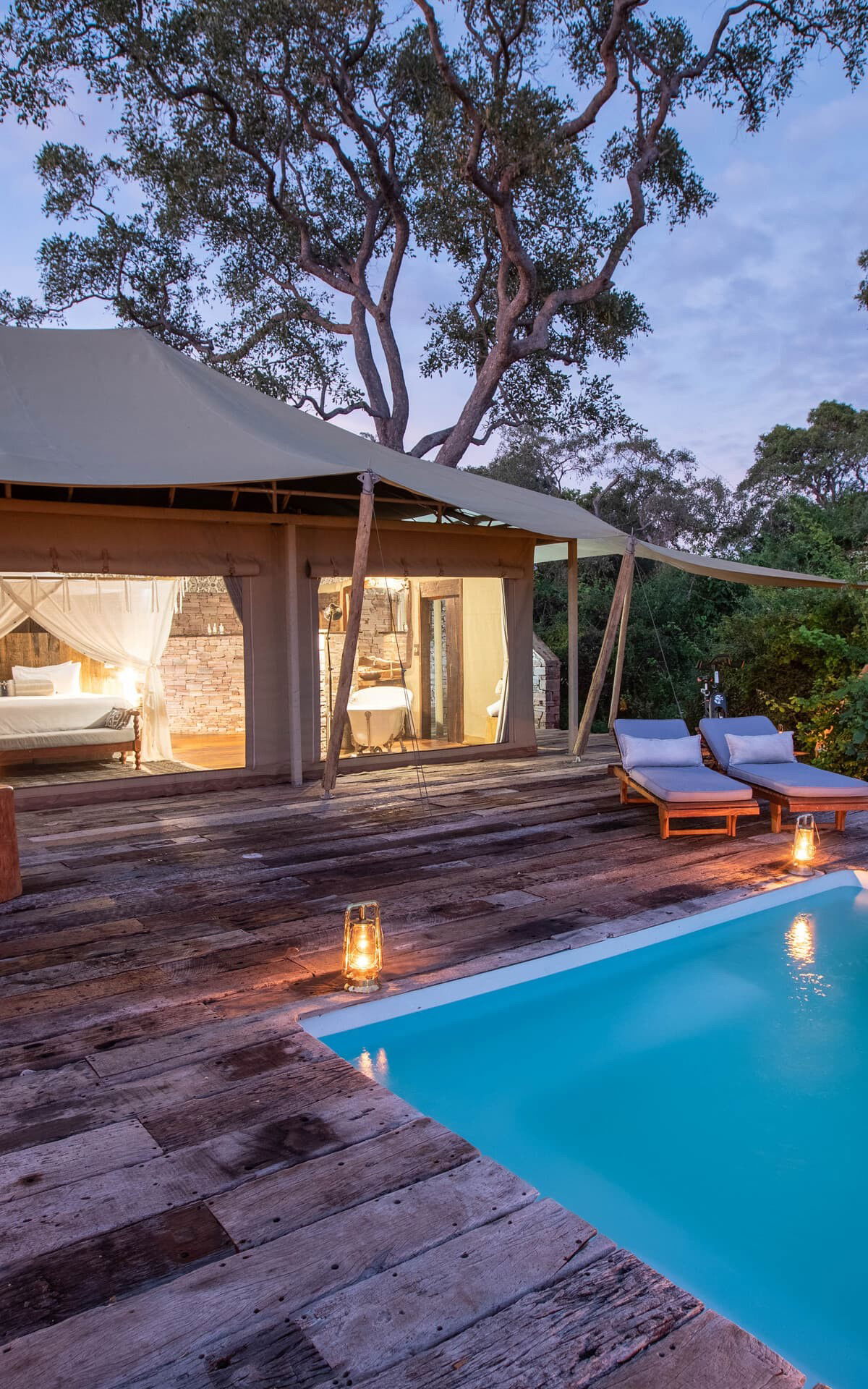
Set inside the Sapi Private Reserve on the Zambezi escarpment, Tembo Plains Camp operates at the quieter, more exclusive end of Zimbabwe's safari circuit. Large canvas suites, a private swimming pool, direct access to Mana Pools-adjacent wilderness place it firmly in the specialist, low-volume tier. from verified guests signals consistent delivery on a high-promise format.
Canvas and Wilderness: How Sapi Private Reserve Shapes the Safari Camp Format
The Mana Pools region operates at a different register from Zimbabwe's more accessible parks. The floodplains along the Zambezi draw elephant, lion, wild dog through terrain that rewards patience and proximity rather than distance and speed. Within this context, the camp format matters enormously: the physical structure of a property determines how directly guests encounter the surrounding ecology, Tembo Plains Camp, positioned on Sapi Private Reserve, is built around a design philosophy that refuses to put walls between its guests and the bush.
Large Canvas Suites: A Structural Argument About Immersion
The large canvas suite format used here is not simply an aesthetic choice, it represents a deliberate architectural position. Across southern Africa's premium tier, camps have increasingly split between fixed-structure lodges with considerable permanent infrastructure and soft-structure canvas properties that prioritise permeability over permanence. Tembo Plains Camp sits firmly in the latter tradition. Canvas walls and open-sided living zones allow temperature, sound, movement from the surrounding reserve to remain present in ways that stone and glass construction forecloses. Guests hear the riverine forest at night and feel the Zambezi air move through the space rather than experiencing the bush through a framed window. The distinction is meaningful: it changes what a stay actually feels like across 24 hours rather than only during guided activity hours.
In comparing this approach with fixed-structure properties operating on comparable reserves, from Wilderness Ruckomechi in Mana Pools to Somalisa Camp in Hwange, the canvas format consistently produces a different quality of engagement. The trade-off is thermal: canvas suites require more attentive climate management from operators, the leading properties address this through thoughtful orientation, overhead fans, shaded deck structures rather than air conditioning that would re-introduce the sealed-room problem through a different mechanism.
Private Pool Infrastructure in the Safari Context
Each suite includes a private swimming pool, which in this setting functions less as a luxury amenity and more as a structural solution to the midday hours. Game activity in the Zambezi valley concentrates at dawn and dusk; the hours between roughly 10am and 4pm are ecologically quiet and thermally demanding. A private pool attached to a canvas suite allows guests to remain outdoors in proximity to the bush during hours when a sealed interior room would sever that connection entirely. The architecture, in other words, solves a practical problem rather than simply signalling category. Comparable private-pool configurations appear at African properties like Singita Pamushana Lodge in Chiredzi, where the same logic of extending usable outdoor hours through water infrastructure applies.
Globally, the private-pool suite format has become a differentiator in premium properties from Hotel Esencia in Tulum to Amangiri in Canyon Point, each using the pool-suite configuration to extend the hours guests spend meaningfully in their immediate environment rather than retreating to interior common spaces. Tembo Plains Camp applies the same principle to the specific thermal and ecological conditions of the Mana Pools region.
Conservation Program as Operational Infrastructure
Sapi Private Reserve operates under a conservation concession model that distinguishes it from national park access. The wildlife conservation program embedded in the camp's operational structure is not ancillary, it directly governs what kind of guiding, activity, land management is possible on the reserve. Properties operating inside conservation concessions can offer activities unavailable in national parks: walking safaris without fixed routes, night driving, closer vehicle approaches governed by trained guides rather than general park regulations. This gives the physical design of the camp a corresponding freedom: the open-sided, permeable canvas structures make sense precisely because the surrounding land is managed to support close-range wildlife presence around the camp perimeter. The design and the conservation model reinforce each other.
This pairing of design philosophy and conservation mandate is increasingly the marker that separates the top tier of southern African safari camps from both the volume operators and the purely aesthetic design-led properties. Wilderness Little Makalolo in Hwange operates under a similar logic, where the concession model shapes what the physical camp can be and do.
The Zambezi River Safari: Adding a Waterway Dimension
The Zambezi river safari component gives Tembo Plains Camp access to a wildlife corridor that purely land-based camps cannot reach. The Zambezi through this stretch hosts hippopotamus, crocodile, significant elephant concentrations at the water's edge, while the river itself provides a perspective, low, unhurried, water-level, that changes what wildlife encounters feel like relative to land vehicle approaches. This is a meaningful structural addition to the activity programme: river and land game viewing in combination cover a broader ecological range than either format alone. Guests at Anantara Stanley and Livingstone in Victoria Falls access the Zambezi through a different configuration, the urban-adjacent resort format versus the deep-bush reserve position of Tembo Plains Camp represents one of the clearest divergences in how the Zimbabwean safari circuit has stratified.
Access and Planning
Harare International Airport sits approximately 281 kilometres from Sapi Private Reserve, with the GPS coordinates for Tembo Plains Camp recorded at -15.6547, 29.6846. The practical route for most guests involves a fly-in connection from Harare or Johannesburg to a regional airstrip, with ground or light aircraft transfers completing the journey into the reserve. The remoteness is structural: Sapi Private Reserve's position gives it the low-traffic wildlife density that makes the camp format work, that same position requires more logistical planning than properties accessible by road from Victoria Falls or Harare. Booking should account for transfer coordination well in advance, particularly given the limited light aircraft capacity on regional routes during peak season (May through October, when the Zambezi valley's dry conditions concentrate wildlife around water sources and game viewing is at its most productive).
The camp from verified reviews and has been an EP Club member since May 2025, placing it in the early cohort of African bush properties to enter the EP Club portfolio. For reference properties across comparable global design traditions, properties that similarly use architecture to extend meaningful time in a distinctive environment, see Castello di Reschio in Lisciano Niccone, Hotel Bel-Air in Los Angeles, or La Réserve Paris, each of which uses physical design to create a specific quality of presence rather than simply to signal category. In the African context, the canvas suite with private pool and conservation-concession access is the equivalent mechanism, architecture in service of a particular kind of engagement with place.
Location
Sapi Private Reserve, Sapi
Mana Pools Region, Zimbabwe
Recognized By

Explore Mana Pools Region
Save or rate Tembo Plains Camp on Pearl
Keep this venue in your Pearl passport, rate it after you visit, and track it alongside every other place you collect.