
Hotel in Madrid, Spain
Mandarin Oriental Ritz, Madrid
1,600ptsPalace-Scale Gastronomy





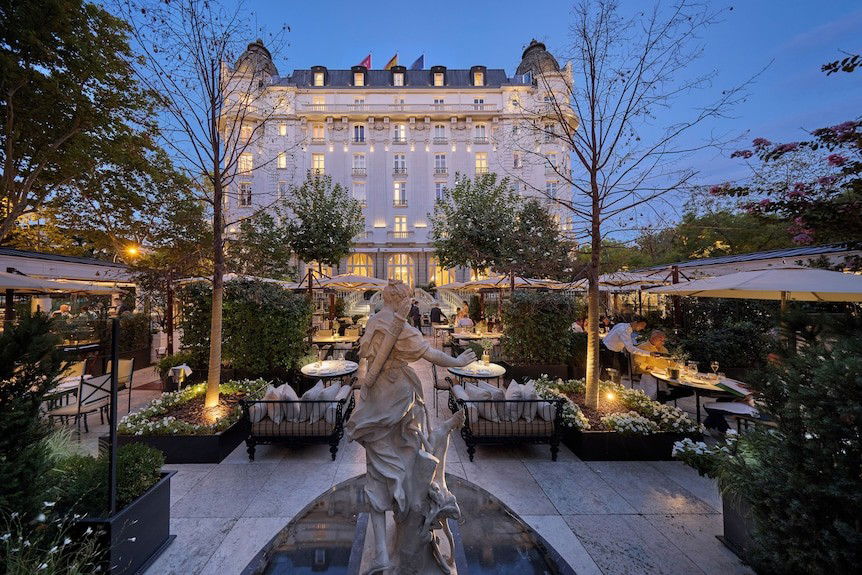
About Mandarin Oriental Ritz, Madrid
Reopened in April 2021 after a three-year Gilles & Boissier restoration, the Mandarin Oriental Ritz occupies Madrid’s most culturally loaded corner: directly across from the Prado Museum and adjacent to El Retiro Park. Its 154 rooms and suites combine Belle Époque architecture with contemporary infrastructure, and its flagship restaurant Deessa holds two Michelin Stars under three-starred chef Quique Dacosta’s culinary direction.
A Belle Époque Palace on Madrid’s Most Consequential Corner
Plaza de la Lealtad sits at the convergence of three of Europe’s foremost art institutions: the Prado Museum directly across the street, the Thyssen-Bornemisza a short walk west, and the Reina Sofía minutes south. It is a location that has made this address the gravitational centre of Madrid’s cultural district since 1910, when King Alfonso XIII inaugurated the hotel at the urging of César Ritz. The monumental Belle Époque facade, with its classical symmetry and pale stone, signals long before you enter that this is a building with institutional weight. El Retiro Park opens up behind the hotel, offering one of the capital’s largest green spaces as an immediate neighbour. Few hotel locations in Europe carry this density of meaning.
What Reopening in 2021 Actually Changed
Madrid’s grand-palace hotel tier had long operated in two modes: heritage spectacle with dated infrastructure, or wholesale modernisation that erases what made the property worth visiting. The Ritz’s April 2021 reopening, after three years of restoration overseen by Paris-based design house Gilles & Boissier, charted a different course. The architecture was treated as non-negotiable; the interiors were brought into conversation with it rather than against it. Dark oak floors now run through the 100 rooms and 53 suites (154 keys in total). Marble showers with Natura Bissé bath products from Barcelona replaced whatever had been there before. The guest rooms read as classic-contemporary without the usual contradictions that phrase produces: the proportions and mouldings are period, but the lighting, technology, and comfort layers are not.
The renovation also addressed the single most conspicuous absence in the hotel’s first century of operation: a spa and wellness facility. The new subterranean complex now offers an indoor swimming pool, a vitality pool, experience showers, a steam room, and a dedicated treatment room under the banner of The Beauty Concept. This is a meaningful shift in the hotel’s competitive positioning. In a city where the Four Seasons Hotel Madrid opened in 2020 with a comprehensive wellness floor, and where Rosewood Villa Magna has long offered spa access, the pre-renovation Ritz had a structural gap that the 2021 works finally closed.
Five Restaurants, One Culinary Reference Point
Spain’s fine dining establishment has spent two decades bifurcating between Basque-school avant-garde and Mediterranean produce-driven cooking. Quique Dacosta—who oversees the hotel’s five gastronomic outlets—comes from the latter tradition: his three-Michelin-starred restaurant on the Costa Blanca built its reputation on proximity to Valencia’s rice-growing delta, the Mediterranean coast’s seafood supply chains, and the market gardens that define the region’s larder. That sourcing logic carries into the Ritz’s food and beverage programme in ways that matter beyond marketing. The black rice paella with shrimp and sea bass served in El Jardín del Ritz draws directly from the Valencian rice tradition; the grilled lamb ribs in Palm Court reference the interior Castilian plateau that surrounds Madrid. These are not decorative origin stories. They reflect a programme where the raw materials define the menu rather than the other way around.
Deessa, the hotel’s flagship restaurant, holds two Michelin Stars and operates in the white-walled, gold-ceilinged main dining room as the most concentrated expression of Dacosta’s approach. Ambitious tasting menus here apply the same ingredient logic at higher intensity: Mediterranean seafood and Spanish market produce treated with technical rigour. For guests eating across the hotel’s full outlet range, the coherence of the sourcing philosophy is detectable even in the more casual formats. Palm Court’s afternoon tea and El Jardín del Ritz’s terrace menu occupy different price registers, but they share a supply-chain logic that distinguishes this food programme from hotels where F&B is an afterthought.
The drinking formats complement the food rather than running parallel to it. Pictura operates as a cocktail bar with sleek, conversation-length seating; the Champagne Bar takes an explicitly pairing-driven approach, with bites like fried egg and caviar alongside sparkling wine. Neither format reaches for novelty at the expense of substance, which is consistent with how the broader programme is conceived. For comparison on Madrid’s hotel bar scene, Gran Hotel Inglés and CoolRooms Palacio de Atocha offer different registers of the city’s hotel bar culture, but neither operates at this gastronomic depth.
Where the Ritz Sits in Madrid’s Luxury Hotel Tier
Madrid’s top-end hotel market has grown considerably denser since 2018. The Four Seasons’s arrival in the Canalejas complex introduced a large-scale institutional competitor; Gran Meliá Palacio de los Duques offers a different palace-hotel experience near the Opera; smaller design-led properties like Hotel Unico Madrid and Only YOU Boutique Hotel Madrid address a guest who prefers less institutional scale. The Mandarin Oriental Ritz sits apart from most of these by virtue of three things that cannot be replicated: a building dating to 1910 with documented royal and cultural history, a location on the Golden Triangle, and a food programme with two Michelin Stars in its flagship room.
The hotel’s external validation reflects this positioning. La Liste ranked it at 99 points in its 2026 Leading Hotels assessment; World’s 50 Best Hotels placed it at number 71 in 2025; and Michelin’s hotel designation awarded three keys in 2024. A Google rating of 4.7 across more than 4,000 reviews is consistent with that recognition, and unusual at the volume of reviews the property has accumulated. Within Mandarin Oriental’s own Spanish presence, the Madrid property carries a different weight than Mandarin Oriental Barcelona, which occupies a very different architectural and neighbourhood context on Passeig de Gràcia.
Spain has no shortage of palace hotels with serious culinary credentials. Atrio Restaurante Hotel in Cáceres and Akelarre in San Sebastián represent how regional Spanish properties have built international reputations around chef-driven identity. The Ritz’s approach differs in that it combines this gastronomic seriousness with the full infrastructure of a grand urban palace hotel. Wine-forward rural retreats like Abadfía Retuerta LeDomaine and Terra Dominicata in Escaladei offer immersive ingredient-to-table experiences tied to their agricultural surroundings, which is a different proposition. The Ritz translates a version of that sourcing seriousness into a city-centre format.
Suite Selection and Room Logic
Rooms in the named suites carry the most ornate expression of the Gilles & Boissier design language: the Presidential Suite at 2,013 square feet includes two powder rooms, two living rooms, and a formal reception hall. For guests not operating at that scale, the Junior Suite at 538 square feet and the Superior Room at 319 square feet both include dark oak floors and marble showers with Natura Bissé products. The 89 connecting room configurations make the hotel practical for family travel or group bookings at a scale most palace hotels do not accommodate. Rates have been published at around $1,859 for standard configurations, which positions this in the upper bracket of Madrid’s luxury hotel market but below comparable grand-palace properties in Paris or London. For guests who find the scale or price point of the Ritz more than their trip requires, Hotel Rector offers a smaller and more intimate alternative in the city.
Getting There and Planning Your Stay
Madrid-Barajas Airport sits approximately 20 minutes from the hotel by car when traffic cooperates, which makes arrival logistics direct even for early check-ins or late departures. The hotel’s concierge team offers organised excursions including stadium visits and food market tastings for guests who want to extend the food-sourcing thread of the hotel’s programme into the city itself. The Mercado de San Miguel and the Mercado de la Paz are both within reach; the latter, in the Salamanca district, is where Madrid’s more ingredient-focused shoppers do their daily market runs. Staff uniforms throughout the property are designed by Spanish fashion figure Jorge Vázquez, a detail that ties the hotel’s visual identity to Spanish creative industry rather than generic luxury hospitality convention.
For those planning wider Spanish itineraries, the Ritz serves as a natural anchor point before or after visits to properties such as Cap Rocat in Cala Blava, La Residencia, A Belmond Hotel, Mallorca, or Marbella Club Hotel. Those building itineraries around hotel-restaurant combinations elsewhere in Spain should consult our listings for Pepe Vieira Restaurant & Hotel in Poio, Mas de Torrent Hotel & Spa in Torrent, Torre del Marqués Hotel Spa & Winery, Hotel Can Cera in Palma, and Casa Beatnik Hotel in A Coruña. For grand-palace hotel comparisons beyond Spain, The Fifth Avenue Hotel in New York City, Aman New York, and Aman Venice offer instructive points of reference for how different cities interpret the category. See our full Madrid restaurants guide for wider context on where the city’s dining scene is moving.
Frequently Asked Questions
- Which room offers the leading experience at Mandarin Oriental Ritz, Madrid?
- The Presidential Suite at 2,013 square feet represents the most complete expression of the hotel’s design language, with two powder rooms, two living rooms, and a formal reception hall. For guests who do not require that scale, the Junior Suite at 538 square feet includes all the core material details (dark oak floors, marble shower, Natura Bissé products) at a more approachable size. All 154 rooms and suites share the same material standards from the 2021 Gilles & Boissier renovation. Rates from around $1,859 put the property at the upper end of Madrid’s luxury hotel market, consistent with its La Liste 99-point and World’s 50 Best Hotels ranking.
- What is Mandarin Oriental Ritz, Madrid leading at?
- The hotel’s strongest claim is the combination of location, architectural heritage, and gastronomic depth that few urban luxury hotels can assemble simultaneously. The Prado Museum is directly across Plaza de la Lealtad; the Thyssen-Bornemisza and Reina Sofía are minutes away. Deessa holds two Michelin Stars under Quique Dacosta’s oversight, and the broader five-outlet food programme maintains a sourcing coherence across price registers. The 2021 renovation closed the wellness gap that had left the pre-renovation property behind peers. La Liste (99 points, 2026), World’s 50 Best Hotels (number 71, 2025), and three Michelin Keys (2024) collectively confirm a hotel operating across multiple categories at once.
Recognized By


Related editorial
- Best Fine Dining Restaurants in ParisFrom three-Michelin-star icons to the next generation of Parisian chefs pushing boundaries, these are the restaurants that define fine dining in the world's culinary capital.
- Best Luxury Hotels in RomeFrom rooftop terraces overlooking ancient ruins to Michelin-starred hotel dining, these are the luxury hotels that make Rome unforgettable.
- Best Cocktail Bars in KyotoFrom sleek lounges to hidden speakeasies, Kyoto's cocktail scene blends Japanese precision with global influence in ways you won't find anywhere else.
Save or rate Mandarin Oriental Ritz, Madrid on Pearl
Keep this venue in your Pearl passport, rate it after you visit, and track it alongside every other place you collect.