
Hotel in Lake Powell, United States
Amangiri
500ptsGeological Immersion Architecture

About Amangiri
Amangiri holds three MICHELIN Keys in the 2025 guide, placing it among a small cohort of American desert properties where the architecture is the primary amenity. Set against the canyon geology of southern Utah, the hotel's low-profile concrete mass blends into the surrounding rock in ways that make the landscape inseparable from the interior. For travellers planning a Colorado Plateau itinerary, it anchors the experience.
Where the Building Becomes the View
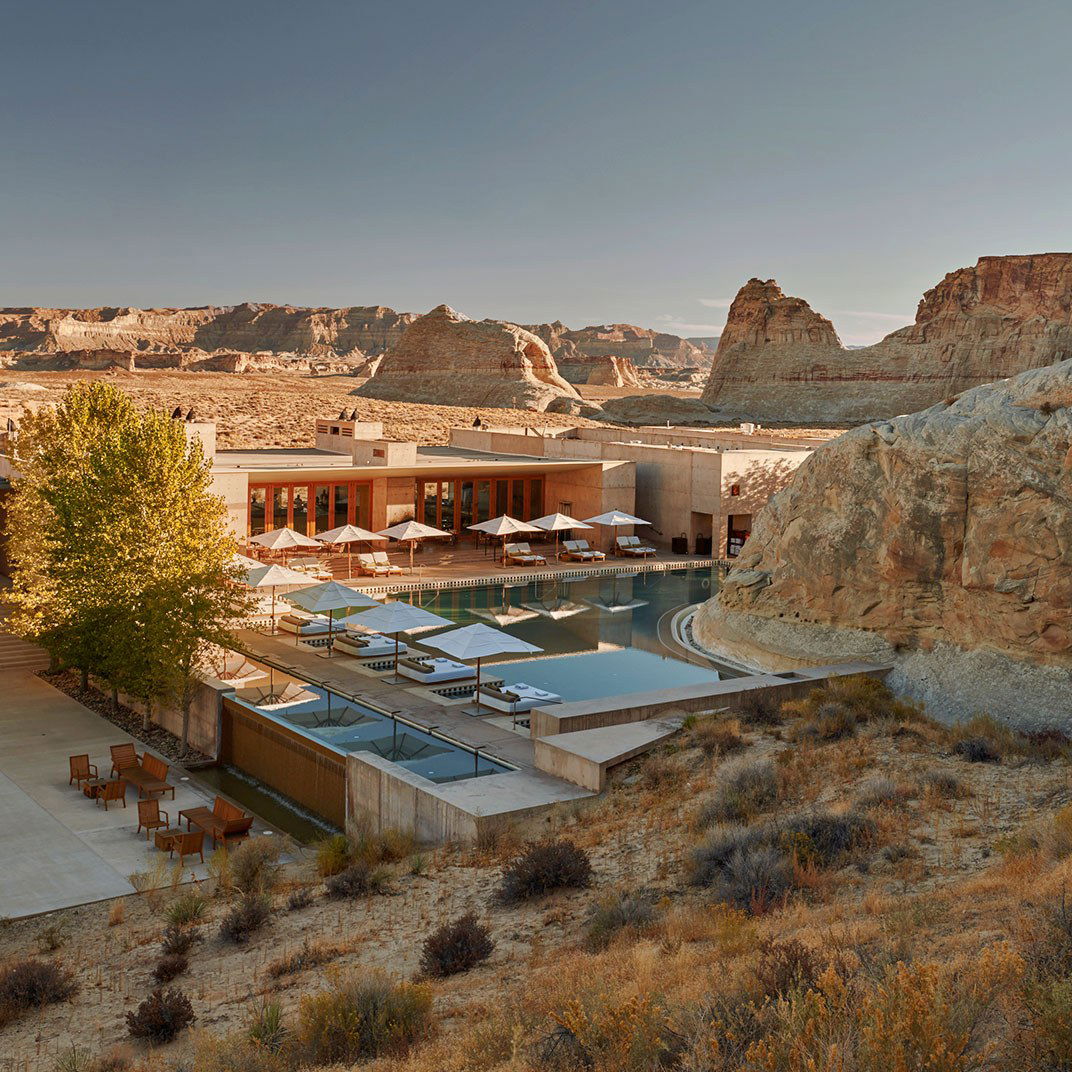
The American desert luxury tier has consolidated around a specific design language: low-mass structures that read as geological outcroppings rather than hospitality buildings. Amangiri, in Utah's Canyon Point area near Lake Powell, is the clearest expression of that approach on the Colorado Plateau. The hotel's concrete pavilions track the contours of the surrounding mesa rather than imposing on them, and the central pool wraps around an existing rock formation that designers chose to preserve rather than remove. That decision — to orient the architecture around the land's terms, not the project's — defines the property's aesthetic identity more than any single interior detail.
Amangiri received three MICHELIN Keys in the 2025 guide, the highest distinction awarded under Michelin's hotel evaluation programme, which it launched in the United States in recent years. Three Keys places Amangiri in a small national cohort whose properties are assessed on experience, design, and service coherence rather than room count or brand affiliation. For context on what that tier looks like across different markets, properties such as The Fifth Avenue Hotel in New York City and The Beverly Hills Hotel in Los Angeles operate in the same award tier but in dense urban contexts. Amangiri's recognition is unusual because it arrives in a landscape where the hotel's closest competitor is the geology itself.
The Architecture as Primary Amenity
The design of Amangiri was handled by Marwan Al-Sayed, Wendell Burnette, and Rick Joy , three architects whose practices share a preoccupation with materiality and site response in arid climates. Their approach here was to limit the hotel's formal vocabulary to poured concrete, wood, and glass, and to keep the built envelope low enough that the surrounding sandstone formations remain the dominant vertical elements in every sightline. From the central pool terrace, the rock rises above the roofline, not the other way around.
Interior volumes follow the same logic. Public spaces are proportioned to feel expansive without height , wide rather than tall, with sight lines calibrated toward the exterior rather than inward toward conventional hospitality focal points like reception desks or dining room centrepieces. The material palette inside mirrors what is already outside: warm concrete, pale stone, tones that sit in the same register as the canyon's ochre and rust. There is almost no colour that does not already exist in the surrounding terrain.
This design discipline places Amangiri in a different competitive set from resort properties that use architecture as theatrical backdrop. The building is not spectacular in the conventional sense; it does not announce itself. It holds back, and the landscape moves forward. That posture requires a guest who finds that exchange interesting rather than austere , which is perhaps the most accurate self-selection filter for whether this property is the right choice.
Setting and Arrival
The southern Utah plateau that surrounds Amangiri is among the more geologically concentrated areas of the American Southwest. The Grand Staircase-Escalante National Monument, Glen Canyon National Recreation Area, and the formations of the Vermilion Cliffs are all within reach. The nearest commercial airport with meaningful connectivity is Page, Arizona, though most guests arriving from major hubs fly into Las Vegas or Salt Lake City, both of which require several hours of ground transfer across some of the more dramatic highway scenery in the country. That distance is part of the proposition. Properties that position themselves in genuine remoteness, as Amangiri does, are asking guests to treat the journey as a threshold rather than an inconvenience.
For readers building a longer Southwest itinerary, the hotel sits within reasonable range of experiences and properties across the Four Corners region. The Canyon Point property associated with Amangiri offers a smaller-format alternative for those wanting the same design lineage with more seclusion. Further out, Dunton Hot Springs in Colorado and Canyon Ranch Tucson represent different points on the spectrum of desert and mountain wellness hospitality, though neither operates with Amangiri's architectural rigour.
How Amangiri Sits in the American Luxury Hotel Tier
The Aman brand occupies a consistent position globally: properties with limited keys, high revenue per available room, and a guest profile that skews toward repeat travellers with long Aman histories rather than first-time luxury hotel guests. Amangiri fits that pattern in the American context. Properties like Post Ranch Inn in Big Sur, Meadowood Napa Valley, and Sage Lodge in Pray, Montana all operate in a similar register , landscape-embedded, design-conscious, operationally intensive , though each carries different culinary and programme identities.
What distinguishes Amangiri from most of its American peer set is the completeness of the design argument. At Troutbeck in Amenia or The Stavrand in Guerneville, the design draws from the vernacular of their respective regions , country house, Sonoma farmstead , which grounds them in a different kind of place-specificity. Amangiri's specificity is more elemental: it is not about a regional architectural tradition but about the raw geological fact of where it sits. That is a narrower brief, executed with very few compromises.
For travellers who have moved through the urban Aman tier , including Aman Venice , the Utah property reads as its formal inverse. Where the Venice property works by inserting itself into a historic palace structure, Amangiri works by pretending, as convincingly as architecture can, that it was always there.
Planning a Stay
Given the remoteness and limited room inventory typical of Aman properties, advance planning at Amangiri matters more than at urban properties where availability is more fluid. Spring and autumn are the primary seasons on the Colorado Plateau: temperatures in summer push well above 100°F, which compresses the comfortable outdoor activity window significantly, while winter can bring cold nights and occasional road conditions that complicate arrival. The shoulder seasons , late March through May and September through November , give the most reliable access to the surrounding terrain. Guests oriented around guided canyon activities should factor programme availability into their booking timeline, as high-demand dates fill independently of room availability.
For readers comparing this against other destination resort formats, Four Seasons at The Surf Club in Surfside, Kona Village in Hawaii, and Little Palm Island in Florida all share the destination resort DNA , isolated, activity-anchored, high service ratios , but in coastal formats where weather windows are wider and access is easier. Amangiri trades that accessibility for something the coastal tier cannot offer: a physical environment with no equivalent on the continent.
See our full Lake Powell restaurants and hotels guide for broader context on the region's hospitality offer.
Frequently Asked Questions
What should I expect atmosphere-wise at Amangiri?
The atmosphere at Amangiri is quiet in the precise sense: the property is designed to produce very little noise from the built environment, and the surrounding desert does the same. There is no conventional resort animation , no poolside programming, no lobby bar scene in the urban sense. The experience is oriented toward the geological environment outside, and the hotel's architecture functions as a frame for that rather than a destination in itself. Guests who find that exchange interesting will consider the property one of the more considered hospitality environments in the American West. Those who want curated social energy and a programmed atmosphere are better served by properties in denser resort contexts. Three MICHELIN Keys confirms the execution quality, but the atmosphere is meditative by design, not by accident.
Which room category should I book at Amangiri?
Without current room-specific data confirmed for this editorial record, the general principle at Aman properties is that suite categories are structured around view orientation and private outdoor space rather than conventional amenities differentials. At a landscape-first property operating at the three-MICHELIN-Keys level, the room selection decision should be driven by how much private access to the exterior you want , whether a terrace or plunge pool that faces the canyon formations matters to you as much as the interior. Guests booking for the first time should consult the property directly on current inventory and view categories, as configurations of this type can change and the most relevant detail is which orientations are available at the time of booking.
Recognized By
Related editorial
- Asia's 50 Best Restaurants 2026: The Chairman and Wing Go 1-2 from the Same BuildingThe Chairman takes No. 1 and Wing climbs to No. 2 at Asia's 50 Best Restaurants 2026. Both operate from the same Hong Kong building. Here's what it means.
- Four Seasons Yachts Debut: 95 Suites, 11 Restaurants, and a March 2026 Maiden VoyageFour Seasons I launches March 20, 2026, with 95 suites, a one-to-one staff ratio, and 11 onboard restaurants. Worth tracking if you want hotel-grade service at sea.
- LA Michelin Guide 2026: Seven New Restaurants from Tlayudas to Uzbek DumplingsMichelin's March 2026 California Guide update adds six LA restaurants and one Montecito newcomer, spanning Oaxacan tlayudas, Uzbek manti, and Korean-Italian pasta.
Save or rate Amangiri on Pearl
Keep this venue in your Pearl passport, rate it after you visit, and track it alongside every other place you collect.