
Hotel in Ardmore, Ireland
Cliff House Hotel
650ptsCliff-Integrated Coastal Retreat


About Cliff House Hotel
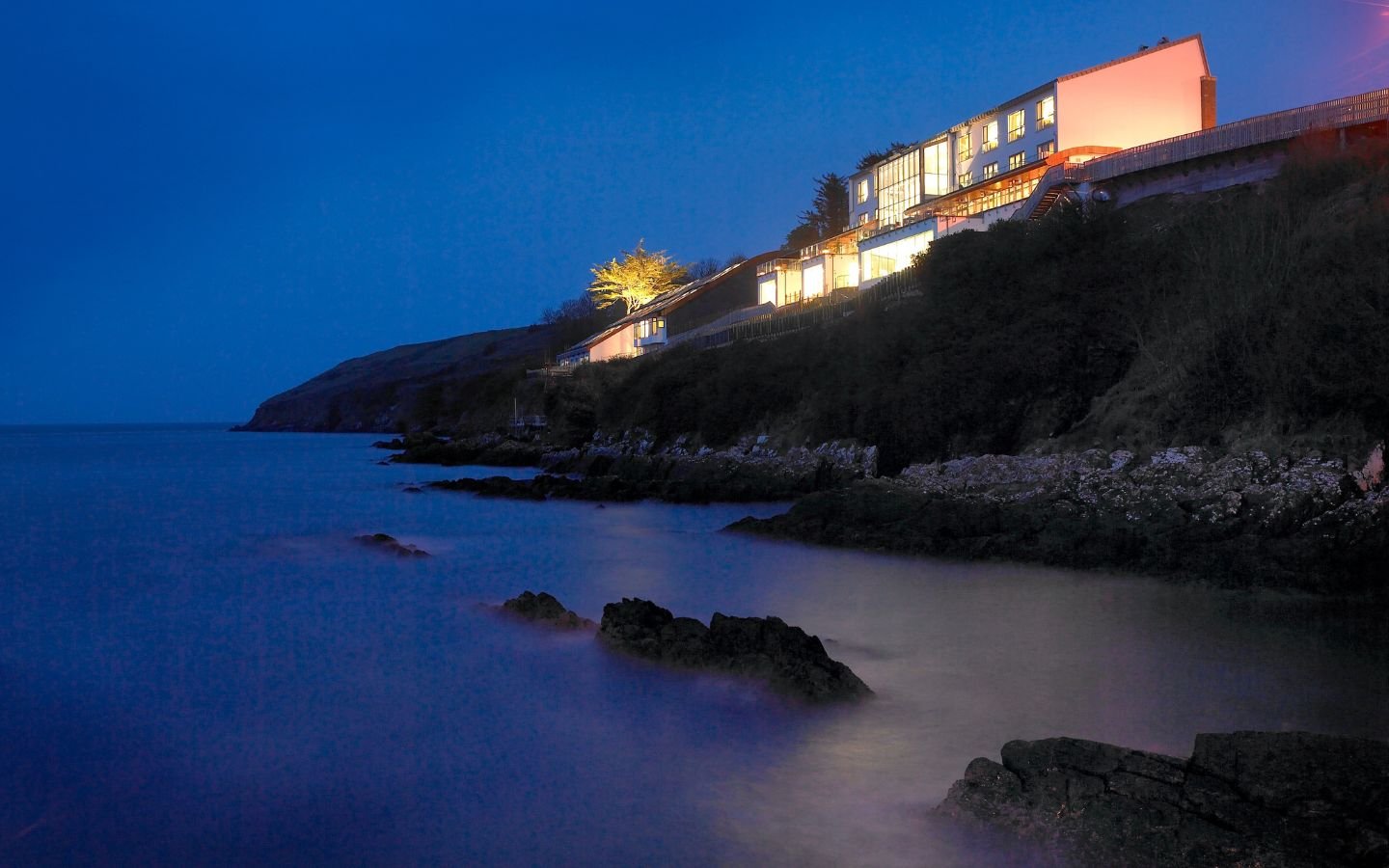
On the southern edge of Ardmore Bay in County Waterford, Cliff House Hotel positions itself firmly in the boutique, destination-led tier of Irish coastal hospitality. Its terraces open directly onto craggy Atlantic-facing rock formations, placing the sea at the centre of the stay rather than the periphery. Recognised in the 2026 La Liste Top Hotels ranking with a score of 93.5 points, it competes on atmosphere and specificity rather than scale.
Where the Building Ends and the Atlantic Begins
The southern Irish coastline between Dungarvan and Youghal is not short of dramatic cliff scenery, but Ardmore Bay concentrates it in a way that makes a hotel's physical relationship to the rock face genuinely consequential. Cliff House Hotel is built into the cliffside itself, meaning the conventional hotel geometry, lobby at grade, rooms stacked vertically, car park in front, is replaced by something more vertical and more exposed. Guests descend through the structure toward the sea rather than approaching it from a safe inland distance. Terraces at multiple levels give way to the raw basalt below, and the horizon is unmediated by a beach promenade or amenity strip. This is architecture that accepts the site's conditions rather than softening them.
That design posture places Cliff House in a specific niche within Irish luxury hospitality. The dominant mode at the country's prestige country-house hotels, properties like Ballyfin, Ashford Castle, or Adare Manor, is heritage restoration: grand interiors, period furniture, landscaped demesnes. Cliff House operates in a different register entirely, one closer to the Scandinavian and Portuguese tradition of placing contemporary architecture in extreme coastal terrain and treating the view as the primary luxury. The small room count reinforces this positioning. This is not a conference-and-spa resort. It is a destination hotel in the older sense: a place you travel specifically to reach, not a base for touring a region.
The Cliff Face as Design Brief
Understanding what makes the Cliff House building unusual requires some context about how coastal hotels typically relate to their settings. The conventional approach insulates guests: picture windows frame the sea from behind glass, terraces are sheltered and furnished to resemble indoor living rooms placed outdoors, and the building's mass sits well back from any genuine exposure. Cliff House inverts this by using the cliff's own geometry as its organising principle. The structure steps down the rock face, so lower-level rooms and terraces are closer to the water, not further from it. The craggy rock formations that would typically be engineered away from a hotel site are here retained as the view's central element.
The interior aesthetic follows from this external logic. Contemporary materials and restrained detailing allow the exterior to dominate rather than competing with it. The approach aligns Cliff House with a cohort of small European coastal properties that treat design discipline as the mechanism for foregrounding landscape, rather than as a statement in itself. In the broader Irish market, this places it in a different conversation from the grand-manor tradition represented by Dromoland Castle, Kilkea Castle, or Castle Leslie Estate, and closer to the sensibility found at smaller coastal properties like Gregans Castle Hotel in the Burren or Liss Ard Estate in West Cork.
Ardmore's Position in the Irish Coastal Circuit
Ardmore itself sits on the Waterford coast in a part of Ireland that receives considerably less tourist traffic than Kerry or Connemara, which is partly a function of infrastructure and partly a function of how the country's coastal identity has been marketed internationally. The Dingle Peninsula and the Ring of Kerry draw visitors on the strength of decades of promotion; Ardmore draws them on the strength of the place itself. The village has a fifth-century monastic site, a well-preserved round tower, and a beach that operates at a human rather than resort scale. The surrounding coastline, covered in part by the Waterford Greenway cycling and walking route, connects the area to Dungarvan and the wider county in ways that reward slower, more deliberate travel.
For guests arriving by car, Ardmore is approximately two hours from Dublin and around 45 minutes from Cork city, making it accessible without feeling like an extension of either urban orbit. That relative remove is part of the proposition. Properties like Ballymaloe House Hotel in nearby Shanagarry have demonstrated that East Cork and the Waterford coast can support serious destination hospitality with a self-contained identity. Cliff House operates on a similar logic, anchored to a specific bay and village rather than positioned as a gateway to elsewhere. See our full Ardmore restaurants guide for context on the wider local food scene.
La Liste Recognition and the Boutique Tier
The 2026 La Liste Leading Hotels ranking assigned Cliff House a score of 93.5 points. La Liste's hotel methodology aggregates professional and guest assessments across service, dining, and overall experience, and a score at this level places Cliff House in company with small, highly regarded properties rather than the large international brands that populate the list's upper tier. For context within Ireland, the properties that compete at this level include Ballyfin Demesne, consistently ranked among Europe's highest-rated small hotels, and Parknasilla Resort and Spa in Kerry. Cliff House's score reflects a property operating at the leading of the boutique segment rather than merely within it.
That recognition matters for a hotel of this size and remoteness because it signals a consistency of standard that visitors from outside Ireland can calibrate against. A guest comparing Irish options against international boutique alternatives, say Aman Venice or The Fifth Avenue Hotel in New York, can use the La Liste score as a shorthand for where Cliff House sits in the global small-hotel conversation.
Planning the Stay
Middle Road, Dysert, Ardmore, Co. Waterford (Eircode P36 DK38) is the physical address, and given the village's scale, arrival is direct once you are in Ardmore itself. The hotel's cliff-integrated layout means that the practical experience of checking in and moving through the building differs from a conventional hotel: expect level changes, and expect those level changes to be part of the spatial experience rather than an inconvenience. Guests oriented toward the sea-facing rooms and terraces will find that the lower the position in the building, the more direct the relationship to the water and rock below.
For guests building a wider Irish itinerary, Cliff House pairs naturally with Cork-based properties like Hotel Isaacs Cork, or with West Cork retreats such as Ballyvolane House. Those combining the Waterford coast with broader Munster exploration might extend north to Cashel Palace or west to Aghadoe Heights Hotel and Spa in Killarney. For a Dublin start or end point, Number 31 offers a comparably design-conscious, boutique-scale base in the capital. Elsewhere in the west, Glenlo Abbey Hotel and Estate, Ballynahinch Castle, Lough Eske Castle in Donegal, and Kilronan Castle Estate and Spa each represent distinct regional alternatives within the premium Irish hotel circuit.
FAQs
What should I expect atmosphere-wise at Cliff House Hotel?
The atmosphere is determined less by interior styling than by the building's physical relationship to Ardmore Bay. If the weather is clear, the terraces and sea-facing rooms deliver an unobstructed connection to the Atlantic that is difficult to replicate in a conventionally sited coastal hotel. If the weather is not clear, which along the Waterford coast is a realistic baseline assumption for much of the year, the same exposure reads differently: the sound and movement of the sea become more present, the interior becomes a more active refuge. The hotel is small enough that the experience feels private rather than managed, and Ardmore village is quiet enough that the surrounding context reinforces rather than dilutes that quality. This is a property suited to guests who want the environment to be the event rather than a backdrop to resort programming.
Which room category should I book at Cliff House Hotel?
Given that the hotel's 93.5-point La Liste score reflects the totality of the experience and that the physical premise of the building is its stepped descent toward the sea, the most coherent approach is to prioritise rooms on the lower levels with direct terrace access to the cliff face. The architecture is specifically designed so that proximity to the rock and water is a function of vertical position within the building. Booking a higher-level room in a property built around downward engagement with the landscape would work against the hotel's central proposition. If price is a consideration, the upper-level rooms still benefit from the refined vantage point, though the intimacy with the seascape is greater the further down the structure you go.
Recognized By


Related editorial
- Best Fine Dining Restaurants in ParisFrom three-Michelin-star icons to the next generation of Parisian chefs pushing boundaries, these are the restaurants that define fine dining in the world's culinary capital.
- Best Luxury Hotels in RomeFrom rooftop terraces overlooking ancient ruins to Michelin-starred hotel dining, these are the luxury hotels that make Rome unforgettable.
- Best Cocktail Bars in KyotoFrom sleek lounges to hidden speakeasies, Kyoto's cocktail scene blends Japanese precision with global influence in ways you won't find anywhere else.
Save or rate Cliff House Hotel on Pearl
Keep this venue in your Pearl passport, rate it after you visit, and track it alongside every other place you collect.