
Hotel in 守山市, Japan
Marriott Lake Biwa (琵琶湖マリオットホテル)
150ptsLakefront Chain Positioning
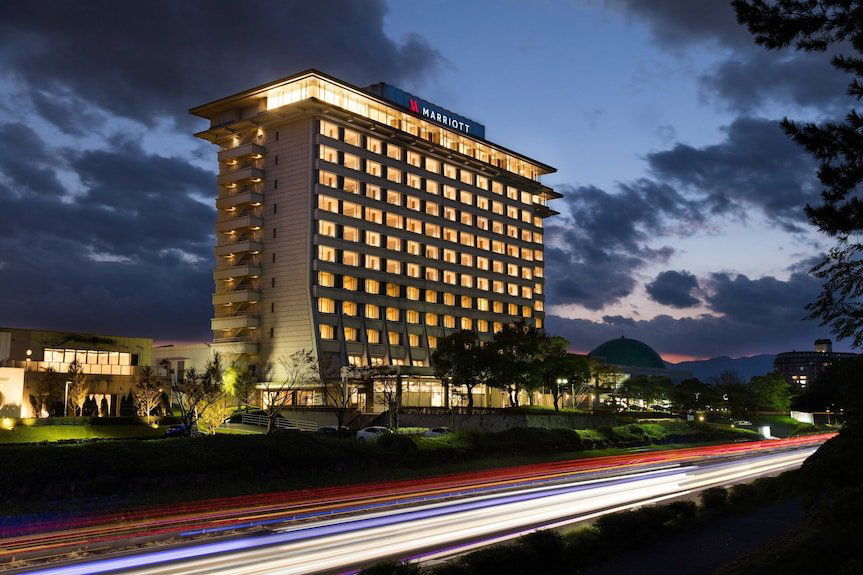
About Marriott Lake Biwa (琵琶湖マリオットホテル)
Marriott Lake Biwa sits on the eastern shore of Japan's largest lake in Moriyama, Shiga Prefecture, offering a lakeside resort format that is rare for international chain hotels in the Kansai region. The property's position between Kyoto and Nagoya places it in a distinct travel corridor, appealing to guests seeking water-facing rooms and access to the broader Biwako area without the density of urban alternatives.
Where the Lake Does the Heavy Lifting
Japan's resort hotel market has long divided along a clear axis: the dense urban properties competing on location and service density, and the rurally-anchored properties competing on landscape access and atmospheric separation. Lake Biwa, at roughly 670 square kilometres the largest freshwater lake in Japan, anchors the second category almost entirely on its own terms. Hotels on its shores trade primarily on the water — the way morning fog sits on the surface in autumn, the unobstructed sightlines west toward the Hira mountain range, the particular quality of late-afternoon light that painters and poets have documented here for centuries. Marriott Lake Biwa, addressed at Imahama-cho in Moriyama, Shiga Prefecture, operates inside that tradition.
The property's position on the lake's southeastern shore places it in Moriyama City, a municipal address that most international travellers will not immediately recognise. That relative anonymity is, structurally speaking, part of the offering. Unlike the ryokan-heavy circuits of Kinosaki or the design-heritage draw of Naoshima, the Biwako area attracts a quieter visitor profile: domestic leisure travellers from Osaka and Nagoya, wedding parties drawn to the lakeside setting, and a growing international segment using Shiga as a slower alternative to Kyoto. Moriyama station on the JR Biwako Line connects to Kyoto in under thirty minutes, which keeps the property accessible without placing it in Kyoto's accommodation scrum.
The Architecture of a Lakefront Position
International chain hotels in Japan's resort circuit have historically struggled with a specific design tension: the Marriott brand vocabulary, developed for urban business travel and American resort formats, does not always translate cleanly to the contemplative aesthetic that Japanese lakeside and onsen destinations have refined over centuries. Properties like Gora Kadan in Hakone or Asaba in Izu have set a specific design register for premium Japanese retreat formats — low-profile architecture, materials that reference local craft, sightlines treated as primary amenity. How an international flag-bearing property navigates that expectation is the critical design question at Moriyama.
Marriott Lake Biwa approaches this through its physical orientation rather than through architectural ideology. The building's relationship to the waterfront is its defining structural decision: rooms positioned to face the lake, public spaces arranged to draw the eye outward, and a lakeside access point that makes the water a functional part of the guest experience rather than a backdrop. This is a different proposition from the self-contained world-building of smaller properties like Zaborin in Hokkaido or ENOWA Yufu in Oita, but it is also a more accessible one. The international brand framework brings with it a legibility , booking systems, loyalty points, service protocols , that many first-time visitors to rural Japan find reassuring.
The distinction matters when comparing Marriott Lake Biwa to the ultra-luxury, low-key cohort represented by properties such as Amanemu in Mie or Araya Totoan in Kaga. Those properties operate in a tier where design, ritual, and editorial cachet are inseparable. Marriott Lake Biwa competes in a wider bracket, where accessibility, facilities breadth, and the direct drama of a lakefront view carry the argument. For guests whose primary requirement is proximity to the lake rather than a curated design statement, that wider bracket is exactly the right one.
The Biwako Context
Understanding what Marriott Lake Biwa offers requires understanding what the Biwako region has become in Japan's domestic travel market. Shiga Prefecture has invested significantly in lakeside infrastructure , cycling routes, water sports facilities, seasonal festivals tied to the lake's ecological calendar. The area around Moriyama and neighbouring Otsu has a concentration of lakefront accommodation ranging from small ryokan to larger resort formats, but very few properties carry international brand recognition. That gap is precisely where a Marriott-flagged property finds its footing: recognisable booking processes, a points programme familiar to Bonvoy members, and facilities that meet a standardised international expectation, combined with a lake access that most urban Marriott properties simply cannot offer.
Seasonally, the lake shifts register considerably. Spring brings cherry blossoms along the shores; summer draws water sports activity and evening cruises; autumn produces the atmospheric mist conditions the lake is photographed for most frequently; winter, when visitor numbers drop, is when the property's interior warmth and the severity of the lake view create the sharpest contrast. Each season changes what the waterfront gives you. Guests who have stayed at comparable lakefront properties in Japan , Fufu Kawaguchiko at Fujikawaguchiko comes to mind as a structural parallel, lake-facing, resort-format, nature-access-led , will find the seasonal logic familiar even if the specific lake is different.
Situating the Property in the Kansai Hotel Market
Kansai's premium hotel offer has expanded rapidly since 2018, with the opening of properties like Hotel The Mitsui Kyoto and the anticipated pipeline of branded luxury entering Osaka ahead of Expo 2025. Within that expanding market, Marriott Lake Biwa occupies a distinct position: it is not competing for the same guest as the Kyoto heritage properties or the urban luxury formats coming to Osaka. Its competition set is the domestic resort tier , properties where the natural setting, rather than the city, is the primary reason to visit. Against peers like Sekitei in Hatsukaichi or Azumi Setoda in Onomichi, it offers a different register: branded reliability at scale, rather than the curated intimacy of smaller independent properties.
For travellers building a Kansai itinerary who want a night or two away from Kyoto's density without committing to the full ryokan format, the property's JR connectivity is logistically clean. Kyoto station to Moriyama is a direct JR Biwako Line run. From Moriyama, Nagoya is also accessible in under an hour, making the property functional as a break point on a wider Kansai-Chubu routing. See our full 守山市 restaurants guide for dining context around the area.
Planning Your Stay
Marriott Bonvoy members can book through the standard loyalty programme infrastructure, which is a practical advantage over independent ryokan that operate on domestic reservation systems requiring Japanese-language navigation. For those building a broader Japan itinerary that includes both urban luxury and nature-access formats, properties like Bvlgari Hotel Tokyo and Aman New York sit at the urban end of the spectrum, while Marriott Lake Biwa occupies the nature-access middle ground in the Kansai region. The autumn season, roughly October through November, is when the lake's atmospheric conditions are at their most photogenic and visitor pressure remains lower than the spring cherry blossom peak.
Frequently Asked Questions
- What's the vibe at Marriott Lake Biwa?
- The property operates in the resort-leisure register rather than the urban-business format that defines most Marriott city properties. If you are arriving from Kyoto, the shift in pace is immediate: the address is residential and lakefront, the orientation is outward toward the water, and the guest profile skews toward couples, families, and domestic leisure travellers rather than corporate traffic. The international brand framework keeps the experience legible for first-time visitors to rural Shiga.
- What's the most popular room type at Marriott Lake Biwa?
- Without specific room configuration data in our records, the general pattern at lakefront resort properties in Japan holds: lake-facing rooms command premium positioning and book faster than alternatives. At comparable properties in the Biwako area and at similar resort formats like Fufu Nikko, waterfront-oriented rooms are the primary differentiating factor. Confirming specific room types and availability directly through the Marriott Bonvoy booking system is advisable, particularly for autumn travel.
- What is Marriott Lake Biwa leading at?
- The property's clearest strength is the combination of direct lake access and international brand infrastructure in a region where most comparable waterfront accommodation operates in the traditional ryokan format. For travellers who want the Lake Biwa setting without navigating a fully Japanese-language booking process or a dress-code-heavy ryokan protocol, the Marriott format provides a practical middle path. The Moriyama location also keeps Kyoto within a short train journey.
- Is Marriott Lake Biwa reservation-only?
- As with all Marriott-branded properties, rooms are booked through the Marriott Bonvoy platform or via standard third-party reservation channels. There is no walk-in culture at resort properties of this format in Japan. For peak periods , Golden Week in late April through early May, the autumn foliage window in October and November, and the summer lake-activity season , advance booking is advisable. Specific booking links and direct contact details are available through the Marriott Bonvoy website.
- Does Marriott Lake Biwa justify its room rates?
- The value equation at lakefront resort properties in Japan is always relative to what the alternative costs. In the Biwako region, the range runs from budget accommodation around Otsu to premium ryokan at the northern shores. Marriott Lake Biwa sits in the mid-to-upper tier of the regional market, where the rate reflects both the brand infrastructure and the lakefront position. Against comparable nature-access properties in the Kansai circuit, the Bonvoy points earning and the standardised service format add practical value for frequent Marriott guests.
- How does Marriott Lake Biwa compare to traditional ryokan alternatives on Lake Biwa?
- The comparison is instructive precisely because these are different products. A traditional ryokan on the lake delivers kaiseki dining, tatami rooms, and a ritual hospitality format rooted in Japanese inn culture. Marriott Lake Biwa delivers familiar international hotel infrastructure with lake access. Neither is a substitute for the other. Travellers who want immersion in Japanese hospitality customs should look at the ryokan tier; those who want a lakefront base with Bonvoy benefits, standard-format dining, and Western-style rooms will find the Marriott format more aligned with their expectations. Properties like Beniya Kofuyuden in Awara represent the ryokan end of that spectrum.
Related editorial
- Best Fine Dining Restaurants in ParisFrom three-Michelin-star icons to the next generation of Parisian chefs pushing boundaries, these are the restaurants that define fine dining in the world's culinary capital.
- Best Luxury Hotels in RomeFrom rooftop terraces overlooking ancient ruins to Michelin-starred hotel dining, these are the luxury hotels that make Rome unforgettable.
- Best Cocktail Bars in KyotoFrom sleek lounges to hidden speakeasies, Kyoto's cocktail scene blends Japanese precision with global influence in ways you won't find anywhere else.
Save or rate Marriott Lake Biwa (琵琶湖マリオットホテル) on Pearl
Keep this venue in your Pearl passport, rate it after you visit, and track it alongside every other place you collect.