
Hotel in 南小国町, Japan
Gekkoujyu Onsen Ryokan (黒川温泉御処 月洸樹)
150ptsForest Onsen Immersion
About Gekkoujyu Onsen Ryokan (黒川温泉御処 月洸樹)
Gekkoujyu Onsen Ryokan sits within Kurokawa Onsen, one of Kyushu's most cohesive hot spring villages, where the architecture reads as deliberately as the bath programme. The ryokan occupies a forested address in Minamioguni-machi, Kumamoto Prefecture, placing guests inside a thermal landscape that has shaped the town's character for generations. For travellers comparing design-led onsen stays across Japan, this is a property that rewards attention to spatial detail.
Into the Forest at Kurokawa
The approach to Gekkoujyu Onsen Ryokan tells you most of what you need to know before you cross the threshold. Kurokawa Onsen, set in a steep river gorge in Minami-Oguni-machi, Kumamoto Prefecture, is one of Kyushu's most coherent hot spring towns: roughly thirty ryokan clustered along the Tanoharu River, almost all of them low-slung, timber-framed, and deliberately restrained in signage and exterior lighting. Arriving at dusk, when cedar smoke drifts from bathhouse chimneys and the gorge path is lit by lanterns rather than floodlights, the atmosphere reads less like a resort district and more like a functioning village that happens to offer exceptional baths. Gekkoujyu, whose name translates loosely as "moonlight tree," positions itself within this setting as a property where architecture reinforces rather than interrupts the surrounding landscape.
That relationship between built form and natural environment is the defining design question in high-end onsen ryokan, and Kurokawa's answer has historically been rigorous: the town enforces informal but widely respected aesthetic guidelines that keep rooflines low, facades in natural timber or plaster, and neon at a minimum. Gekkoujyu operates within those conventions while occupying its own plot with enough separation from neighbouring properties to sustain a sense of seclusion. The compound format, where guest rooms are distributed across distinct structures rather than stacked in a single building, is common in the upper tier of Japanese ryokan and serves a practical purpose: it eliminates corridor noise and ensures that guests move through outdoor or semi-outdoor space between meals, baths, and their rooms, keeping the body calibrated to the environment rather than sealed from it.
The Architecture of Stillness
Japanese ryokan design has evolved considerably over the past two decades, splitting between two camps. One camp has embraced the language of contemporary minimalism: exposed concrete, floor-to-ceiling glazing, and freestanding soaking tubs positioned as sculptural objects. Properties like Zaborin in Kutchan and ENOWA Yufu in Yufu represent this direction, blending traditional hospitality rhythms with architecture that reads as explicitly modern. The other camp maintains fidelity to older craft traditions: hand-planed timber, shoji screens, tatami laid in room-specific proportions, and water features that replicate the logic of natural streams rather than decorative fountains. Gekkoujyu belongs to the second camp, where the design authority lies in the calibration of materials and spatial sequence rather than formal gesture.
The gorge setting amplifies this approach. When your room frames a stand of bamboo or a section of river, the view becomes the primary decorative element and the interior recedes appropriately. This is an architectural argument as much as an aesthetic preference: in ryokan design, the window is the painting, and the room's job is to hold the frame without competing. Properties that understand this tend to have rooms that photograph less dramatically but inhabit more fully, where the quality of light at different hours of the day becomes a guest-specific experience rather than a background condition.
Kurokawa as a destination sits in a different competitive tier from internationally branded luxury. Properties such as Amanemu in Mie or Gora Kadan in Hakone carry global recognition and price accordingly. Kurokawa's thirty-odd properties, including Gekkoujyu, operate within a more contained economy: the town's appeal is collective, built on the tradition of the "nyuto tegata" bath pass that allows guests to visit three different onsen across properties, reinforcing the idea that the destination itself, not any single ryokan, is the primary draw. Gekkoujyu benefits from this ecosystem while offering guests a base with its own architectural coherence.
Baths, Sequence, and the Logic of a Ryokan Stay
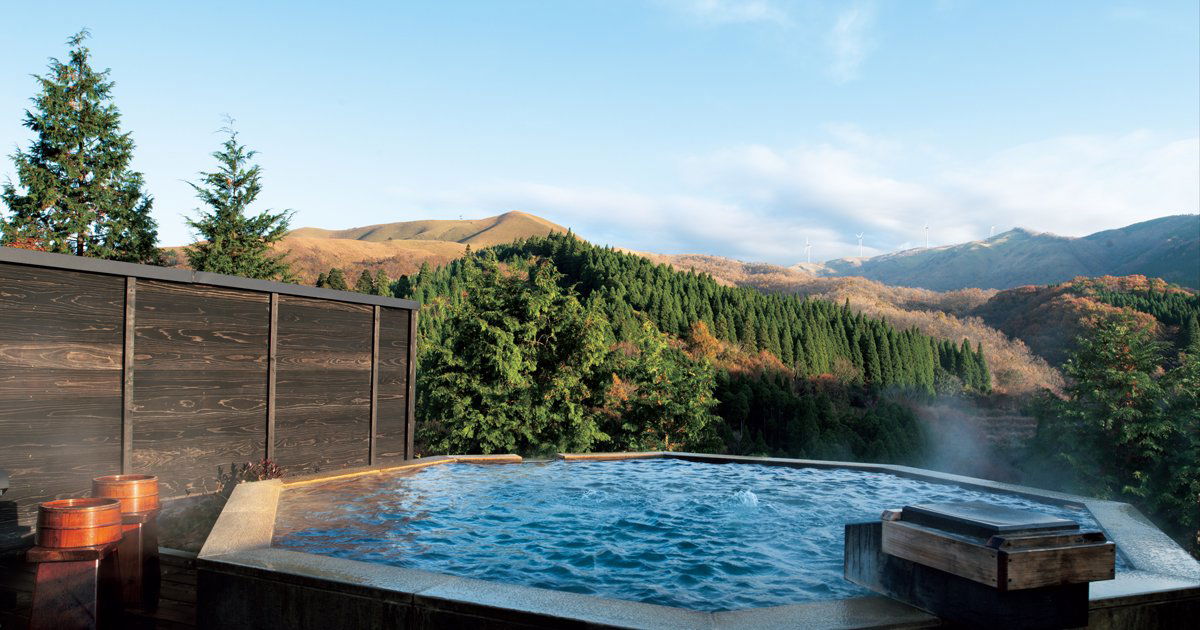
The onsen at any Kurokawa property is the functional centre of the experience, and the quality of the water at Kurokawa is well-documented: mildly alkaline sodium bicarbonate springs, known locally to leave skin notably smooth after repeated soaking, emerge from multiple source wells across the gorge. Outdoor rotenburo baths in the Kurokawa tradition are built directly into hillsides or riverbanks, using natural stone and timber screening rather than tiled enclosures, so the sensation of bathing outdoors here differs materially from the resort-pool aesthetic common in Southeast Asian spa properties.
The ryokan stay format structures time differently from hotel stays. Check-in typically occurs in the late afternoon, dinner is served in-room or in a private dining space in the early evening, and the interval between arrival and the meal is oriented around the first bath. This sequence, repeated across generations of Japanese domestic travel, is the product of a hospitality model where the body's needs rather than the day's schedule set the rhythm. Properties like Asaba in Izu and Nishimuraya Honkan in Kinosaki-cho operate on similar rhythms, having refined this format over decades of operation. Gekkoujyu fits within this tradition, with kaiseki-style meals expected to draw from Kumamoto's local produce calendar.
Reaching Gekkoujyu and Planning the Stay
Minami-Oguni-machi sits in the mountains of northern Kumamoto Prefecture, roughly ninety minutes by car from Kumamoto City and around forty minutes from Aso. The practical route for most international visitors runs through Fukuoka: a Shinkansen connection to Kumamoto Station, then a rental car or local bus service toward Kurokawa. The bus option exists but involves connections; most guests staying in Kurokawa's upper tier arrive by car or private transfer. The mountain road into the gorge is narrow in sections, and arrival in daylight is preferable for first-time visitors.
Kurokawa's peak seasons track Japanese domestic travel patterns: spring cherry blossom periods and autumn foliage both drive high occupancy across the town's properties, with advance booking windows measured in months rather than days during those periods. Midweek visits in January or February offer a different experience: snow on the gorge walls, steam rising from outdoor baths into cold air, and a significant reduction in foot traffic on the lantern-lit paths connecting properties. Those conditions also represent the architecture at its most legible, when the contrast between interior warmth and outdoor winter is sharpest.
For context on the wider Kyushu luxury ryokan tier, the ANA InterContinental Beppu Resort and Spa in Beppu represents the branded international approach to the region's hot spring culture, while properties like Araya Totoan in Kaga illustrate how traditional-format ryokan operate at the upper end of the domestic tier. Gekkoujyu occupies a different position: a property defined by its setting within a coherent onsen town rather than by standalone destination status, which is both its constraint and its particular argument for the kind of traveller who prefers a layered destination over a self-contained resort. Our full 南小国町 restaurants guide covers the broader food scene in the area for those extending their stay beyond the ryokan format.
For comparison across Japan's premium ryokan spectrum, it is useful to look at properties that have pursued architectural distinctiveness as a primary differentiator: Benesse House in Naoshima, Fufu Kawaguchiko, and Bettei Senjuan in Minakami each represent different answers to the question of how built form can intensify rather than dilute a natural setting. Gekkoujyu's answer is site-specific: a forest gorge in Kyushu, rendered in timber and stone, calibrated to the temperature of the water beneath it.
Frequently Asked Questions
- Is Gekkoujyu Onsen Ryokan more formal or casual?
- Kurokawa Onsen sits outside the orbit of urban luxury pricing and international award circuits, which sets a different tone from formal city properties. The ryokan format itself has an inherent structure around mealtimes and bathing etiquette, but the atmosphere at Kurokawa properties tends toward quiet domesticity rather than white-glove formality. Guests are expected to change into yukata robes on arrival and wear them throughout the property, which flattens social signalling and shifts the register toward comfortable rather than ceremonial.
- What room should I choose at Gekkoujyu Onsen Ryokan?
- Without confirmed room category data from the property, the general principle at Kurokawa ryokan applies: rooms with private outdoor baths (kashikiri rotenburo or in-room露天風呂) command a premium and offer a materially different experience from rooms that rely on shared communal baths. For a first visit, the private outdoor bath option is worth the additional cost because the ability to use the bath at any hour, including before dawn or late at night, is central to how the Kurokawa experience is meant to work. Confirm room configuration directly with the property at booking.
- How does Gekkoujyu Onsen Ryokan compare to other ryokan in Kyushu's hot spring destinations?
- Kurokawa Onsen as a town operates on a collective model that distinguishes it from single-property hot spring destinations like Beppu. Gekkoujyu is one of roughly thirty properties sharing the town's gorge infrastructure, which means guests have access to the community bath pass system in addition to whatever onsen the ryokan operates on-site. This positions a stay at Gekkoujyu differently from a stay at an isolated destination ryokan: the value proposition includes the town's cumulative atmosphere and varied spring sources, not only the amenities within the property's own boundary.
Related editorial
- Best Fine Dining Restaurants in ParisFrom three-Michelin-star icons to the next generation of Parisian chefs pushing boundaries, these are the restaurants that define fine dining in the world's culinary capital.
- Best Luxury Hotels in RomeFrom rooftop terraces overlooking ancient ruins to Michelin-starred hotel dining, these are the luxury hotels that make Rome unforgettable.
- Best Cocktail Bars in KyotoFrom sleek lounges to hidden speakeasies, Kyoto's cocktail scene blends Japanese precision with global influence in ways you won't find anywhere else.
Save or rate Gekkoujyu Onsen Ryokan (黒川温泉御処 月洸樹) on Pearl
Keep this venue in your Pearl passport, rate it after you visit, and track it alongside every other place you collect.