
Bar in Vienna, Austria
Espresso Bar
100pts1950s Fitout, Natural Wine

About Espresso Bar
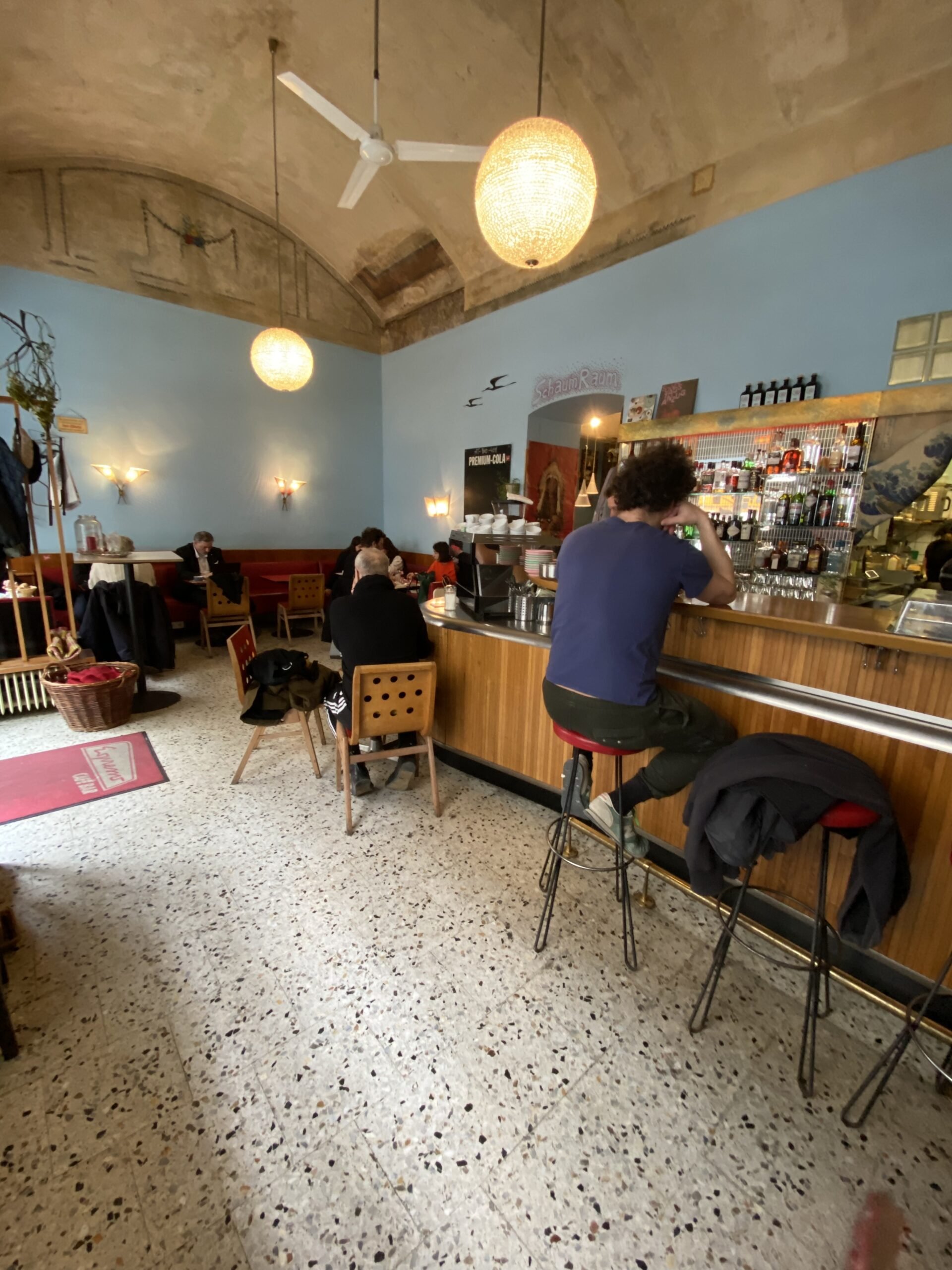
A converted espresso bar on Burggasse, still wearing its original 1950s signage, now operates as one of Vienna's most characterful natural wine destinations. The retro facade sets the scene for a list that skews toward low-intervention producers, accompanied by music programming that keeps the room from feeling like a museum piece.
A 1950s Shell, a Current-Day Wine Argument
Vienna's seventh district, the Neubau, has spent the better part of two decades absorbing the city's appetite for independent retail, design studios, and drinking establishments that resist easy categorisation. Burggasse is one of its main arteries, and the signage outside Espresso Bar tells you something before you even step inside: a period-original 1950s board, the kind that predates corporate identity guidelines and design agencies, marks a room that has decided its aesthetic inheritance is worth keeping. The tension between that mid-century shell and the resolutely contemporary wine programme inside is exactly where the bar's identity lives.
That tension is not accidental. Across European cities, a specific kind of bar has emerged that uses found or inherited spaces — old tabacs, disused pharmacies, former espresso counters — as a container for natural and low-intervention wine lists. The anachronistic setting does a particular kind of editorial work: it signals continuity with a pre-industrial drinking culture while the wine programme argues for a post-industrial one. Espresso Bar sits squarely inside that tradition.
Natural Wine in Vienna's Seventh District Context
Vienna occupies a singular position in European wine culture. It is one of the few capital cities with active wine production within its administrative boundaries, the Gemischter Satz DAC appellation covering field blends grown on the city's northern and western fringes. That local viticultural identity gives Vienna's wine bars a regional anchor that cities like Berlin or London cannot replicate. The better natural wine lists in the city tend to use Austrian producers , from Burgenland's oxidative whites and Pannonian reds to the Wachau and Kremstal , as a spine, branching out toward Jura, Beaujolais, and the Slovenian border as the list becomes more argumentative.
Espresso Bar's programme fits that pattern. The emphasis on natural wines positions it alongside a peer set that includes Eulennest Vinothek, Le Cru, and Champagne Characters , bars that treat the list as a curatorial statement rather than a convenience. What distinguishes Espresso Bar within that set is the deliberate preservation of its original format: the room does not aspire to the stripped-back minimalism of a Kleinod Bar or the refined stemware theatre of a champagne-focused room. It is a bar that looks like it has been serving something since before the word "concept" entered the hospitality vocabulary.
The Intersection of Imported Methods and Local Product
The natural wine movement arrived in Vienna largely through producers and sommeliers who had spent time in France, particularly in the Loire and Burgundy, where low-intervention winemaking had already developed its own critical language and producer networks. What happened next is characteristic of how global techniques interact with indigenous products: Austrian winemakers, working with varieties like Grüner Veltliner, Blaufränkisch, and Welschriesling, applied the same principles of minimal sulphur, native yeast fermentation, and non-filtered bottling to grapes that carry a fundamentally different flavour architecture than their French counterparts. The results are not Burgundy inflected. They are distinctly Pannonian or Danubian in character, with higher acidity structures and a mineral register shaped by loess, schist, and crystalline bedrock rather than limestone.
A bar like Espresso Bar, by stacking its list toward these producers, is making an argument about that intersection: that imported methodology, when applied to local raw material with genuine regional identity, produces something more interesting than either a faithful imitation of French natural wine or a conventional Austrian commercial bottling. For the reader coming from outside Vienna, this is the list's primary intellectual interest, and it is worth arriving with some prior knowledge of Austrian appellations to navigate it productively. For the Viennese regular, the list functions as a live index of which producers are currently making the most compelling argument.
The Room and the Music
The physical space reinforces the programme's logic. Old espresso bars were public rooms in the truest sense: neighbourhood anchors where the ambient noise was the point, not an obstacle. The music at Espresso Bar is noted as a deliberate curatorial element, which places it in a tier of bars where sound programming is treated with the same intentionality as the wine list. This is less common than it should be. Most wine bars default to ambient playlists that serve as acoustic wallpaper; bars that treat music as a complementary signal to the room's overall argument are operating at a different register of hospitality. The result is a room that feels active rather than static, which matters in a city where the Kaffeehaus tradition has always treated the bar as a place of extended, unhurried residence.
Vienna's bar culture has historically split between grand coffee house formality and neighbourhood Beisl informality. The natural wine bar as a category sits in an interesting third position: it carries the intellectual seriousness of the Kaffeehaus without its ceremonial service codes, and the neighbourhood familiarity of the Beisl without its beer-and-schnapps default. Espresso Bar, given its address and its inherited aesthetic, lands closer to the Beisl end of that spectrum in atmosphere, while the wine programme maintains the Kaffeehaus register of considered choice. For visitors comparing it to the more polished end of Vienna's bar circuit , [25hours Hotel Vienna at MuseumsQuartier](https://www.enprimeurclub.com/bars/25hours-hotel-vienna-at-museumsquartier-vienna-bar) or [Bar Tabacchi](https://www.enprimeurclub.com/bars/bar-tabacchi-vienna-bar) , the register is deliberately rougher, and that is the point.
Placing It in a Wider Austrian Picture
Vienna's bar culture is only one layer of Austria's drinking geography. The country's range runs from the beer hall formality of [Augustiner Bräu Mülln in Salzburg](https://www.enprimeurclub.com/bars/augustiner-brau-mulln-salzburg-bar) to the wine-focused programme at [Carinthia Weinbar in Velden am Wörthersee](https://www.enprimeurclub.com/bars/carinthia-weinbar-velden-am-worthersee-bar), from the historic cellars of [Landhauskeller in Graz](https://www.enprimeurclub.com/bars/landhauskeller-graz-bar) to the lakeside calm of [Achen Lake in Eben Am Achensee](https://www.enprimeurclub.com/bars/achen-lake-eben-am-achensee-bar) and the alpine setting of [Hotel Schwarzer Adler Innsbruck](https://www.enprimeurclub.com/bars/hotel-schwarzer-adler-innsbruck-innsbruck-bar). For a different kind of contrast, the engineering spectacle of [Red Bull Hangar-7 in Himmelreich](https://www.enprimeurclub.com/bars/red-bull-hangar7-himmelreich-bar) sits at the opposite end of the atmosphere spectrum. Espresso Bar belongs to none of those registers. It is a specific Vienna phenomenon: the low-threshold neighbourhood wine room where the list is doing the heavy intellectual lifting.
Within the seventh district itself, comparisons with [Amerlingbeisl](https://www.enprimeurclub.com/bars/amerlingbeisl-vienna-bar) and [Alte Donau](https://www.enprimeurclub.com/bars/alte-donau-vienna-bar) are instructive for understanding where Espresso Bar sits on the local spectrum. The neighbourhood supports a range of drinking atmospheres; Espresso Bar's decision to anchor on natural wine rather than on Viennese brewing or spirits culture is a choice that narrows the audience somewhat but deepens the offering for those who arrive with an interest in the category.
Planning a Visit
Burggasse 57 is within walking distance of the MuseumsQuartier and the Volkstheater U-Bahn station, making it a natural late-evening stop after the city's museum circuit or a first port of call before moving further into Neubau's bar concentration. Given the format, the room likely rewards mid-week visits when the natural wine crowd is more inclined toward extended conversation about what is on the list. No booking information is available in the public record, suggesting walk-in access, which fits the neighbourhood-bar format. For context on the wider city drinking scene, the [EP Club Vienna guide](https://www.enprimeurclub.com/cities/vienna) covers the full range of categories and price points. Those travelling with an interest in how the natural wine format has been executed in a very different cultural register might also consider [Bar Leather Apron in Honolulu](https://www.enprimeurclub.com/bars/bar-leather-apron-honolulu) as a useful transatlantic comparison point.
Frequently Asked Questions
What's the must-try drink at Espresso Bar?
The emphasis here is wine rather than cocktails: the programme focuses on natural and low-intervention bottles, which places it in the same curatorial tier as Eulennest Vinothek and Le Cru within Vienna's wine bar circuit. The most productive approach is to ask whoever is pouring what is currently interesting from Austrian producers , Burgenland reds and skin-contact whites tend to be the most distinctive expressions of local raw material filtered through natural wine methodology.
What's the standout thing about Espresso Bar?
The combination of an intact 1950s espresso bar fitout on a Neubau side street, a natural wine list that takes Austrian provenance seriously, and deliberate music programming makes it one of the more coherent atmospheric propositions in Vienna's seventh district. It does not operate at the price point or formality level of Vienna's hotel bars, which is the point: it sits in the neighbourhood wine room category and executes that format with a level of curatorial intention that distinguishes it from the generic wine-by-the-glass offer found across the city.
Recognized By

Similar venues by awards
Related editorial
- Best Fine Dining Restaurants in ParisFrom three-Michelin-star icons to the next generation of Parisian chefs pushing boundaries, these are the restaurants that define fine dining in the world's culinary capital.
- Best Luxury Hotels in RomeFrom rooftop terraces overlooking ancient ruins to Michelin-starred hotel dining, these are the luxury hotels that make Rome unforgettable.
- Best Cocktail Bars in KyotoFrom sleek lounges to hidden speakeasies, Kyoto's cocktail scene blends Japanese precision with global influence in ways you won't find anywhere else.
Save or rate Espresso Bar on Pearl
Keep this venue in your Pearl passport, rate it after you visit, and track it alongside every other place you collect.