
Bar in Toronto, Canada
SAKU (sushi & taco)
100ptsCross-Format Counter Compression
About SAKU (sushi & taco)
On Queen Street West, where Toronto's counter-dining culture keeps colliding with its appetite for genre-blurring menus, SAKU positions itself at an intersection that's becoming harder to ignore: sushi and tacos sharing the same kitchen, the same table, the same moment. The address alone — 478 Queen St W — places it inside one of the city's most format-diverse dining corridors, where the physical space shapes the experience as much as anything on the plate.
Queen Street West has a particular quality in the early evening: the light drops fast, the storefronts shift from retail to neon, and the dining rooms that line it start to feel less like restaurants and more like stage sets. The block around 478 Queen St W sits in a stretch where the built environment does a lot of editorial work. Spaces here tend to be narrow, tall-ceilinged, and stripped back — the bones of older commercial buildings repurposed into formats that reward close-quarters dining. It's the kind of address where the physical container shapes the social contract between kitchen and guest.
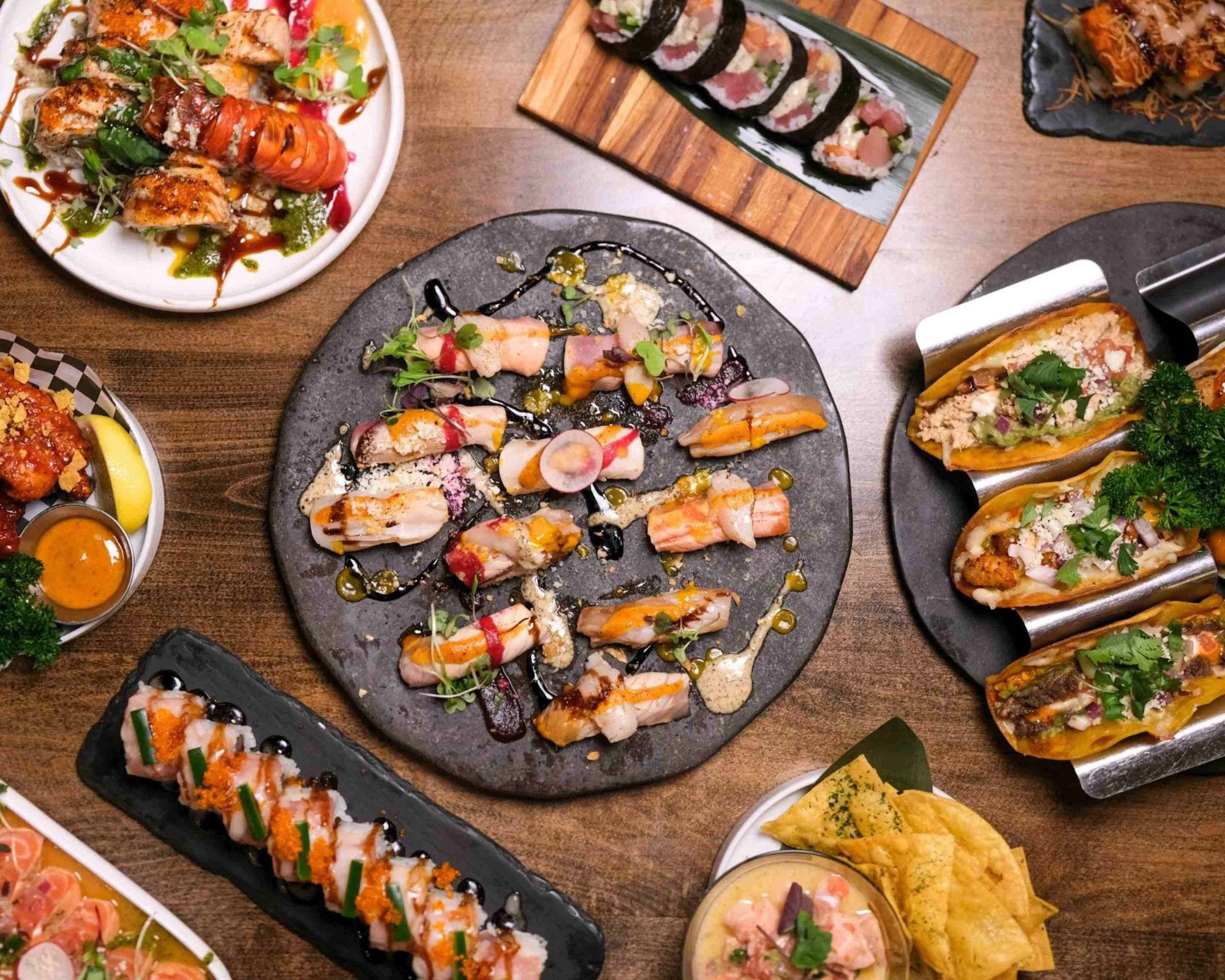
SAKU (sushi and taco) operates inside this corridor with a concept that Toronto's Queen West scene has quietly been rehearsing for years: two formats that share almost no culinary DNA brought into the same room and asked to make sense of each other. The Japanese counter tradition and the Mexican street-taco format both prize precision and directness — a tight construction, a clean finish, nothing extraneous. In that sense, the pairing is less eccentric than it first appears.
What the Space Does
Toronto's most interesting counter-format restaurants have understood something that larger dining rooms often miss: compression creates intensity. When the distance between the kitchen and the guest collapses, attention sharpens. The architectural logic of a sushi counter , linear, exposed, ordered , forces a kind of focus that a 60-cover dining room dissipates. Queen West has a long history of operators working inside small footprints and turning that constraint into a format feature rather than an apology.
SAKU's address on Queen West places it within walking distance of several bars and restaurants that have made spatial design a deliberate editorial statement. Across the Toronto bar scene, venues like Bar Raval have demonstrated how a physically considered interior , every surface, every seat placement , becomes the first argument the venue makes to its guests. Bar Mordecai operates on a similar logic, using a compressed, deliberately designed room to signal program seriousness. The physical decisions these spaces make are not decorative; they define the tier of experience on offer.
At SAKU, the sushi-and-taco format implies a specific kind of room: one that doesn't fully commit to the minimalism of a traditional Japanese counter, but also doesn't lean into the rough-edged casualness of a taqueria. That middle register is architecturally harder to execute than either extreme, and how the space resolves it tells you a great deal about what the operators are actually trying to do.
The Format Argument
Toronto has been a testing ground for genre-crossing food formats for over a decade, and Queen West has hosted more than its share of experiments. The city's dining culture is notably permissive about category blending , a function, in part, of a restaurant-going population that moves fluidly between high-formality omakase and casual ramen counters within the same week. That fluency has made the city more tolerant of formats that would read as confused in more tradition-bound markets.
The sushi-taco pairing, specifically, has a longer North American history than its novelty framing suggests. Nikkei cuisine , the fusion of Japanese and Latin American technique that emerged from Japanese immigration to Peru and Brazil , has a documented lineage going back generations. What contemporary operators in cities like Toronto are doing sits at a more casual register than formal Nikkei restaurants, but it draws on a real cross-cultural tradition rather than inventing one from scratch. The soy-citrus-chili axis that runs through both Japanese and Mexican pantries gives the format more internal coherence than a surface reading implies.
Queen West's dining corridor includes enough format diversity that SAKU's dual focus reads as a considered position rather than an outlier. The street now contains wine bars, izakayas, natural wine-focused restaurants, and several counter-format operations across different cuisine categories. Bar Pompette has staked out a European wine-bar identity a short distance away, and Civil Liberties has built a reputation around serious cocktail programming. The corridor rewards specificity and penalizes vagueness , which is why format clarity at SAKU matters more than it would in a less competitive stretch of the city.
Placing SAKU in the Toronto Counter Scene
Toronto's counter-dining category has expanded significantly in the past five years, splitting broadly into two tiers. The upper tier runs from formal omakase operations in Yorkville and the financial district through to tasting-menu counters where seats are allocated months in advance. The lower tier encompasses ramen counters, fast-casual Japanese operations, and the growing number of street-food-influenced formats that have moved into permanent retail space. SAKU's Queen West address and its dual sushi-taco format position it closer to the lower tier in terms of formality , but the format specificity and the deliberateness of the concept place it in a more considered bracket than a simple fast-casual read would suggest.
For visitors moving between Toronto's bar and restaurant scene in a single evening, the Queen West stretch is practical: the density of options means a meal at SAKU can be preceded or followed by cocktail programming nearby without requiring a cab. Our full Toronto restaurants guide maps the city's dining corridors in more detail, including Queen West's positioning relative to Kensington Market, Ossington, and the King West strip.
Across Canada, operators are working through similar format questions in different urban registers. Atwater Cocktail Club in Montreal has built a specific program identity in a city with a different relationship to counter culture. Botanist Bar in Vancouver operates in a luxury hotel context where the spatial brief is entirely different. Further afield, Humboldt Bar in Victoria, Missy's in Calgary, Bearfoot Bistro in Whistler, Grecos in Kingston, and Bar Leather Apron in Honolulu each illustrate how format specificity and spatial identity function differently depending on the market size and guest expectations of their respective cities. What they share with SAKU is the recognition that a clear concept, clearly housed, does more work than a broad menu in a generic room.
Know Before You Go
- Address
- 478 Queen St W, Toronto, ON M5V 2B2
- Cuisine Format
- Sushi and tacos, counter-influenced dining
- Neighbourhood
- Queen Street West, Toronto , a dense dining and bar corridor
- Booking
- Contact details not currently listed , walk-in or check Google Maps for current hours and contact information
- Getting There
- Accessible via TTC streetcar on Queen Street West; Osgoode station (Line 1) is a short walk east
Frequently Asked Questions
- What should I expect atmosphere-wise at SAKU?
- Queen West dining rooms in this stretch tend toward compact, energetic environments rather than hushed formality. The sushi-and-taco format implies an accessible, social register , closer to a lively counter experience than a quiet tasting room. Toronto's counter-dining scene, particularly in the Queen West corridor, tends to price accessibly relative to formal omakase operations in Yorkville or the financial district.
- What drink is SAKU famous for?
- Specific drink program details are not confirmed in our current data. The sushi-taco format historically pairs well with Japanese highballs, sake, and citrus-forward cocktails , formats that appear across Toronto's bar scene from Bar Raval to Bar Pompette. Checking directly with the venue for current beverage programming is advisable before visiting.
- What is SAKU leading at?
- The format argument , combining a Japanese counter tradition with Mexican street-taco influences , is the clearest editorial position SAKU holds on Queen West. In a corridor that rewards specificity, a dual-format concept with genuine culinary logic (the soy-citrus-chili axis that runs through both traditions) is a more considered bet than a broad menu would be. Award data is not currently confirmed.
- What is the leading way to book SAKU?
- Phone and website details are not currently listed in our database. The most reliable approach is to search directly for current contact information on Google Maps or Instagram, where the venue may maintain an active presence. Walk-in availability on Queen West counters can vary significantly by time of week.
- Is SAKU suitable for solo diners, and how does it compare to other solo dining options on Queen West?
- Counter-format operations on Queen West are generally among the more accommodating settings for solo dining in Toronto, where a single seat at a bar or counter carries no social awkwardness and often delivers a more engaged experience than a table for one in a larger room. SAKU's sushi-and-taco format suggests a counter or bar-adjacent seating arrangement that would sit comfortably within that tradition. For confirmed seating details, contact the venue directly.
More bars in Toronto
- Bar NeonBar Neon sits on Bloor St W in Toronto's west end, a neighbourhood bar suited to casual evenings and small groups. Detailed menu and hours data is limited, so verify before making a special trip. For groups of four or more, check capacity ahead of time — nearby options like Bar Raval and Civil Liberties offer more confirmed space and documented menus.
- 111 Queen St E111 Queen St E sits on a busy stretch of downtown Toronto where convenience is the main draw. It pulls in a local, foot-traffic crowd rather than destination-driven diners. Easy to access and easy to book, but if you are planning a dedicated outing, Toronto's more focused bar and dining spots will reward the effort more.
- 156 ONEFIVESIX156 ONEFIVESIX on Queen Street West is an easy walk-in stop for a low-key drink in one of Toronto's most bar-dense neighbourhoods. Booking is simple and the atmosphere reads as mid-tempo and conversational. Food program details are unconfirmed — if the kitchen is a priority, Bar Pompette or Civil Liberties are safer choices nearby.
- 4th and 74th and 7 on College Street is an easy-to-book neighbourhood bar in Dovercourt Village, suited to a low-key date night in a walkable part of Toronto. Public data on the programme is limited, but the location is strong and the lack of crowds makes it a friction-free option. Best for regulars who know what they are returning for rather than first-timers seeking a mapped-out evening.
- After SevenAfter Seven sits on Stephanie Street in Toronto's Kensington-adjacent west end, with easy booking making it a low-friction option for a date night or spontaneous evening out. Venue details are limited, so confirm hours and format before committing. Check our full Toronto bars guide for alternatives if you want more certainty before you book.
Related editorial
- Best Fine Dining Restaurants in ParisFrom three-Michelin-star icons to the next generation of Parisian chefs pushing boundaries, these are the restaurants that define fine dining in the world's culinary capital.
- Best Luxury Hotels in RomeFrom rooftop terraces overlooking ancient ruins to Michelin-starred hotel dining, these are the luxury hotels that make Rome unforgettable.
- Best Cocktail Bars in KyotoFrom sleek lounges to hidden speakeasies, Kyoto's cocktail scene blends Japanese precision with global influence in ways you won't find anywhere else.
Save or rate SAKU (sushi & taco) on Pearl
Keep this venue in your Pearl passport, rate it after you visit, and track it alongside every other place you collect.