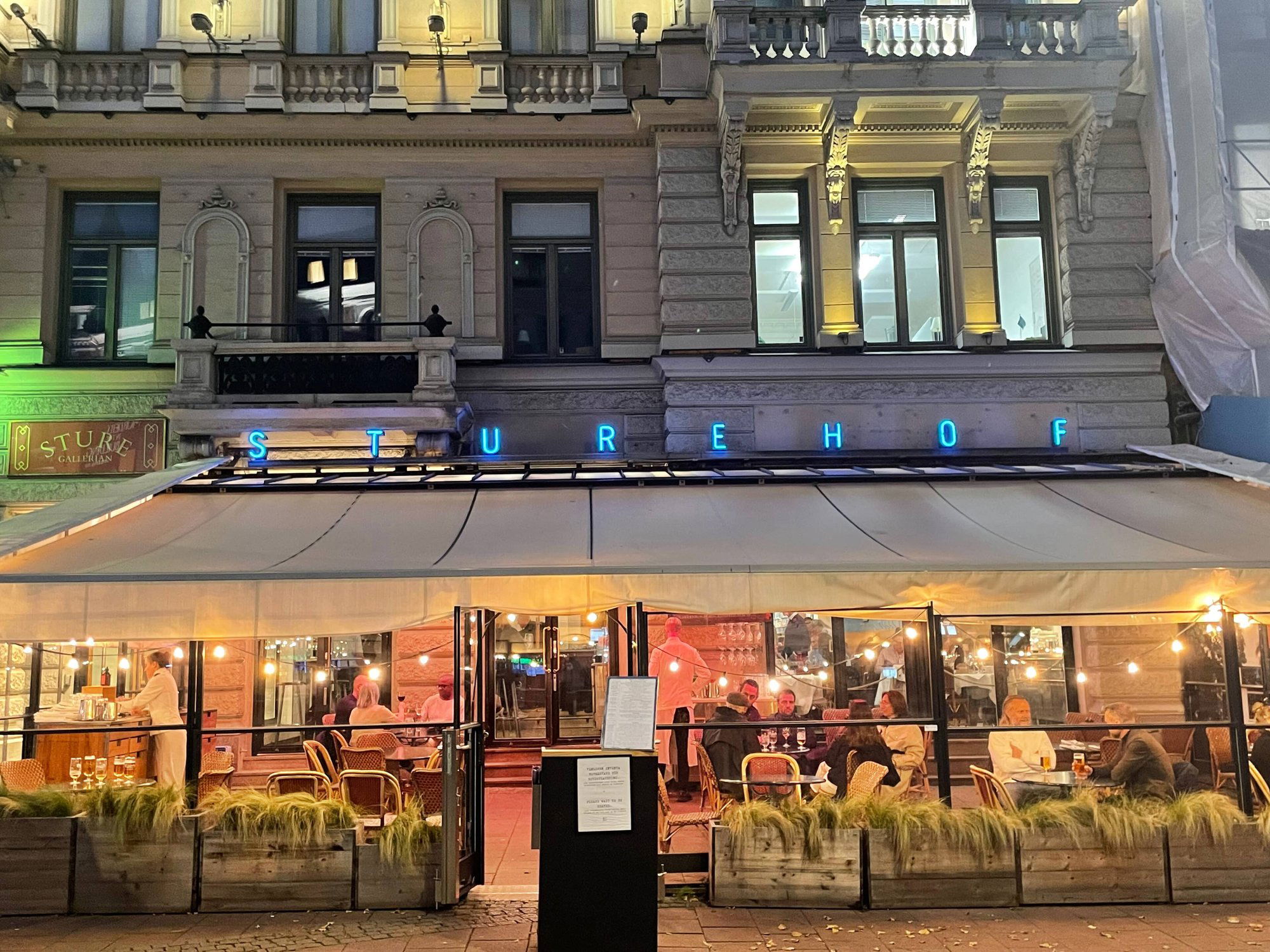
    Bar in Stockholm, Sweden

    Sturehof

    100pts

    Stureplan Seafood Brasserie

    Sturehof, Bar in Stockholm

    About Sturehof

    Sturehof occupies a particular position in Stockholm's dining hierarchy: a grand brasserie address on Stureplan that has served as the neighbourhood's social anchor for well over a century. The kitchen runs on Swedish seafood tradition while the bar programme holds its own in a city whose cocktail culture has matured considerably. Few rooms in Stockholm carry this combination of institutional weight and continued relevance.

    Stureplan's Permanent Fixture

    Stureplan is Stockholm's most self-conscious intersection, the kind of address where the buildings themselves seem aware of being watched. The mushroom-shaped shelter at the square's centre has functioned as a meeting point for generations, and Sturehof, at number 2, has been one of its principal anchors since the late nineteenth century. Grand brasseries of this type — high ceilings, dark wood, a long bar visible from the entrance — exist in most European capitals, but Stockholm's version has survived intact while many peers in other cities have been dismantled or converted into something trendier. Walking in, the architecture does the work: the room signals that this is a place with a settled sense of its own identity, not one still searching for it.

    That physical confidence matters in a city where restaurant concepts cycle at pace. Stockholm's dining scene has spent the better part of two decades generating international attention through New Nordic cooking, but the brasserie format has run parallel to that story without being subsumed by it. Sturehof belongs to that older current, a place where the frame of reference is Swedish seafood and bourgeois European service rather than foraged ingredients and tasting menus. The two traditions co-exist in this city without much friction, and Sturehof's endurance suggests the demand for the classic format has never gone away.

    The Bar Programme in Context

    Stockholm's cocktail culture has undergone a recognisable shift over the past decade. The city moved from an era of high-priced, limited-format drinking rooms toward a more confident, technically grounded bar scene with a distinct local character. Venues like Tjoget established that Stockholm could sustain a serious spirits-forward programme, while Lucy's Flower Shop and A Bar Called Gemma explored looser, more personality-driven formats. Röda Huset sits in a different register again, closer to the natural wine-led bar model that has spread across northern Europe.

    Sturehof's bar operates within a different logic from any of these. It is not a destination cocktail programme in the specialist sense: the room is too large, the clientele too varied, and the format too much a product of the brasserie tradition for that kind of focused technical identity. What it offers instead is something that specialist bars often lack: the capacity to serve a very good classic cocktail to someone who has just arrived from the theatre, to a regular who has been sitting on the same stool for twenty years, and to a business dinner table that needs no ceremony about it. The breadth is the point. In a city whose premium bar scene has increasingly specialised, a room that can absorb all of those demands without compromising on execution represents its own form of programme discipline.

    The drinks list leans on Scandinavian aquavit and Swedish spirits alongside the international classics that any brasserie bar of this calibre should carry. Aquavit remains the lens through which Swedish drinking culture is most accurately read: its caraway and dill register, its affinity with cured fish, its role as a ritual drink at seasonal gatherings. A bar at Sturehof's address would be failing its context if it treated aquavit as a novelty rather than a foundation. The category has also grown in craft ambition across Sweden and the wider Nordic region, giving bartenders at established venues more interesting raw material to work with than was available even ten years ago.

    Seafood as the Kitchen's Centre of Gravity

    Swedish brasserie cooking pivots on seafood, and Sturehof's kitchen has operated within that tradition long enough to treat it as a given rather than a positioning statement. Herring preparations, gravlax, crayfish in season, shellfish from the west coast , these are not novelties on this menu but structural elements. The west coast of Sweden, particularly the waters around Gothenburg and the Bohuslän archipelago, produces shellfish and crustaceans that rank among the most highly regarded in Europe for their sweetness and salinity. The supply chain from those waters into Stockholm's established restaurants is a well-worn route.

    Sweden's crayfish season in August carries near-ceremonial weight in the culture, and a room like Sturehof is one of the places where that ritual plays out in an urban restaurant setting, rather than at a private party or summer house. For visitors unfamiliar with the tradition, the sight of a dining room engaged in that kind of seasonal collective behaviour is an education in how food functions socially in Sweden in ways that a tasting menu counter cannot provide. For context on similar coastal-seafood traditions operating at different scales across Sweden, Vyn Restaurant in Östra Nöbbelöv and Koster Islands in Tjärno offer points of comparison in less urban settings.

    Where Sturehof Sits in the Stockholm Restaurant Picture

    Stockholm's dining options now span a wider range than at any previous point. The New Nordic wave produced a generation of restaurants oriented around tasting menus, sourcing transparency, and a specific aesthetic of restraint. That cohort has since diversified: some moved toward more relaxed formats, others maintained their fine-dining position, a few closed. Alongside them, a parallel track of neighbourhood restaurants, wine bars, and casual kitchens has grown significantly. Sturehof's position in this picture is as the durable anchor at the formal brasserie end, a category that Stockholm has never had in great numbers. The city does not have a Parisian density of grand brasserie addresses, which makes the ones that exist more load-bearing for visitors and locals who want that experience.

    For a broader view of where Stockholm's drinking and dining scene is moving, our full Stockholm restaurants guide maps the current picture across neighbourhoods and categories. Outside the capital, the Swedish food and drink picture extends across formats and regions: Dorsia Hotel and Restaurant in Gothenburg operates within that city's own grand-address tradition, while Ölkaféet in Malmö, Ångbryggeriet in Piteå, and Bageriet Mat and Bar in Visby each represent distinct regional nodes in the country's drinking culture. For a point of reference outside Scandinavia that shares Sturehof's commitment to a serious bar programme within a broader hospitality format, Bar Leather Apron in Honolulu offers an interesting parallel in how a technically grounded bar operation can anchor a room with a wider identity.

    Know Before You Go

    Address: Stureplan 2, 114 35 Stockholm, Sweden

    Getting there: Stureplan sits a short walk from Östermalmstorg metro station on the red line. The square is a reference point that most Stockholm residents can direct you to without a map.

    When to visit: August is crayfish season in Sweden, when the ritual of the kräftskiva (crayfish party) moves into restaurant settings. Sturehof's position as an established brasserie makes it one of the natural venues for that experience. Weekday lunches tend to be quieter than evening service.

    Booking: Advance reservations are advisable, particularly for Friday and Saturday evenings and during the August crayfish period. The bar area may accommodate walk-ins more readily than the main dining room.

    Dress code: Smart casual is the practical standard for a room of this type and address, though Stockholm dining culture is generally less formal than equivalent brasseries in Paris or London.

    Frequently Asked Questions

    What should I try at Sturehof?

    The kitchen's strongest territory is Swedish seafood: herring preparations, shellfish from the west coast, and seasonal dishes anchored in the Scandinavian brasserie tradition. If you are visiting in August, the crayfish is the structural choice. The bar is the place to engage with aquavit in proper context, either as a shot alongside food or in a classic mixed format.

    Why do people go to Sturehof?

    Sturehof carries a dual function in Stockholm: it is a serious restaurant address on one of the city's most prominent squares, and it is also a social institution with more than a century of operation behind it. People go for the seafood, for the room, and for the specific kind of dependable brasserie experience that few other addresses in Stockholm can provide at this scale.

    How far ahead should I plan for Sturehof?

    For weekend evenings, booking at least a week in advance is a reasonable minimum. During the crayfish season in August, demand is noticeably higher and earlier reservations are advisable. If you have a specific date or party size that matters to you, two to three weeks ahead is safer for Stockholm's more established dining addresses generally.

    Who is Sturehof leading for?

    The room works across a wide range of visits: business dinners that need a neutral-but-serious setting, visitors who want a thorough introduction to Swedish seafood without the constraint of a tasting menu format, and anyone who finds the specialist bar and hyper-conceptual restaurant formats exhausting and wants a room that functions without ceremony. Stureplan's central position makes it practical as a meeting point before or after other plans in the neighbourhood.

    Is Sturehof suitable for a standalone bar visit rather than a full dinner?

    The brasserie format means the bar can function independently of the dining room, and Stureplan's position as a central gathering point in Stockholm makes it a practical stop for drinks without a full meal. The aquavit selection gives the bar a specifically Swedish character that distinguishes it from Stockholm's newer cocktail venues. That said, the bar operates within the rhythm of a busy restaurant rather than as a programme-led destination, so it rewards a different kind of visit from specialist bars like Tjoget or Lucy's Flower Shop.

    Keep this place

    Save or rate Sturehof on Pearl

    Keep this venue in your Pearl passport, rate it after you visit, and track it alongside every other place you collect.