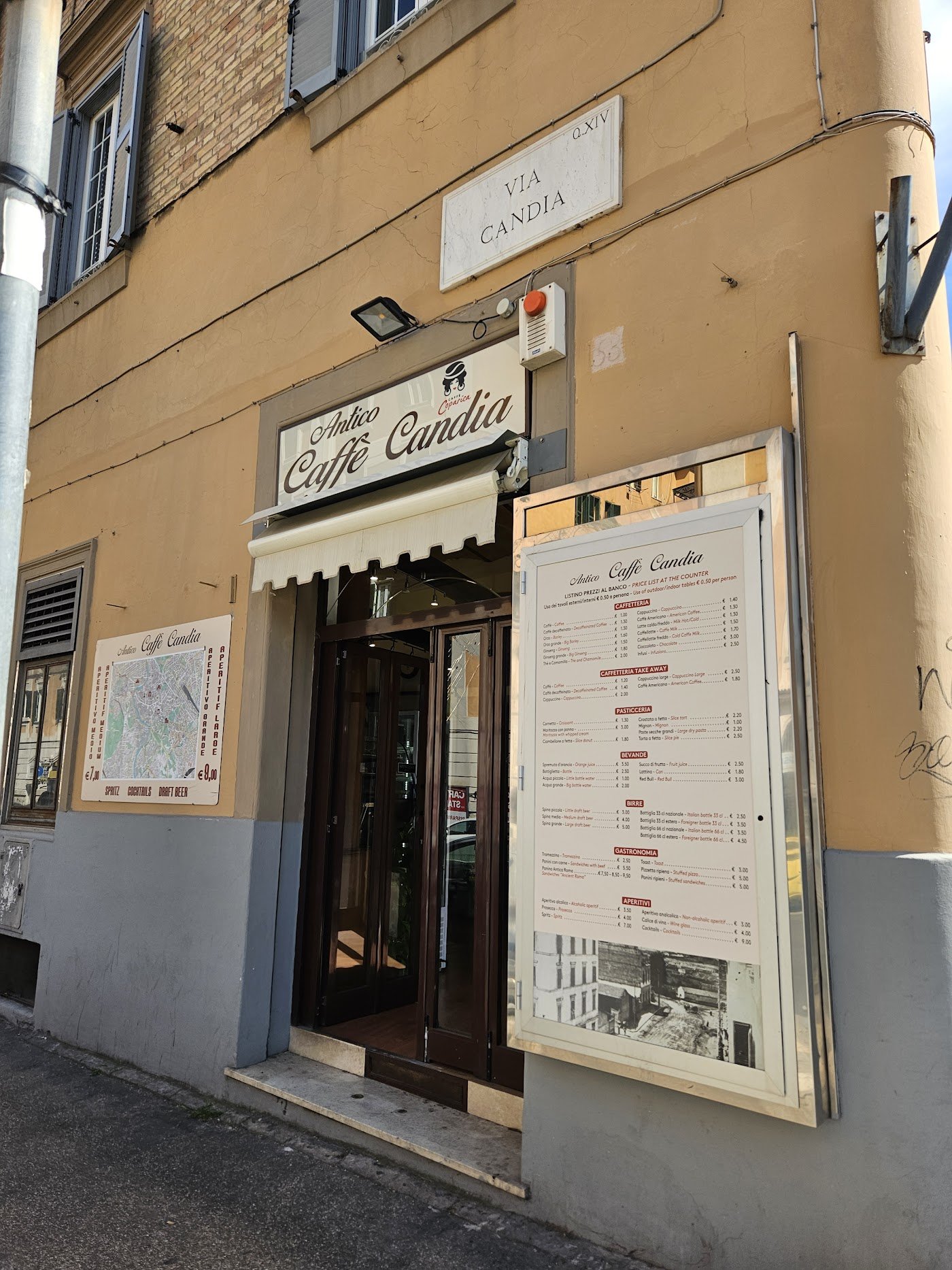
Antico Caffè Candia
Trionfale, Rome
Bar in Rome, Italy
 Book with Pearl
The Read
Price
$10–20per person
Why go
Antico Caffè Candia is worth considering as a practical morning café stop near Prati, especially if convenience matters more than a destination wine or cocktail program. Treat it as an easy neighborhood option, not a special-occasion booking; for aperitivo, date-night ambience, or a deeper bar list, compare it with Il Sorpasso, Jerry Thomas Speakeasy, or Bar at Villa Laetitia.
About Antico Caffè Candia
For a Rome morning or early-day plan, Antico Caffè Candia opens at 6:15 AM, closes at 1:30 PM Monday through Saturday, is closed on Sunday, and has a casual dress code. It is a direct early-day stop rather than a venue for evening service or a special-occasion format.
A short daytime stop in Rome, not a full evening plan
Antico Caffè Candia makes the clearest case when your schedule needs an early Rome stop and the hours fit: 6:15 AM–1:30 PM Monday through Saturday, with Sunday closed. A tasting-menu, chef, awards, wine-list, cocktail-program, seating, price, or detailed menu information is not available, so planning is best approached practically and time-based. Its value lies in its schedule and casual positioning.
First-timers should not read it as a replacement for a more detailed Rome dining or drinking plan. For a broader night-out shortlist, use Our full Rome bars guide. If the day needs restaurants rather than a brief daytime stop, Our full Rome restaurants guide is the better planning route; for stays in the city, use Our full Rome hotels guide.
Who should choose it
Choose this if early timing in Rome matters and a casual setting fits the plan. Skip it if the brief is an aperitivo program, a serious by-the-glass wine comparison, a cocktail focus, or a date-night room with a particular atmosphere. For a different kind of Rome plan, you may want to compare it with options such as Il Sorpasso, Jerry Thomas Speakeasy, or Bar at Villa Laetitia.
Planning details
- Hours
- Monday: 6:15 AM–1:30 PM · Tuesday: 6:15 AM–1:30 PM
- Location
- Via Candia, 153, 00192 Roma RM, Italy
- Phone
- +39 06 4542 5379
The take
The Take
The Vibe
Antico Caffè Candia reads like a neighbourhood institution: small, attentive and quietly reassuring. The space leans on Roman caffè tradition rather than tourist spectacle, with a marble counter that functions as a communal fulcrum and a steady tempo set by morning rituals. Regulars shape the room: familiar faces, a barista who anticipates orders, and a rhythm that privileges consistency over novelty. The overall effect is charming and intimate, a relaxed local caffè where repetition and ritual are the point of pride.
Best For
This is a spot built for short, habitual visits: morning espressos, a pastry and the small exchange that anchors a day. It suits solo customers and locals who drop in repeatedly, and it works as a casual meet-up for friends who prefer a low-key, reliable setting. Because the place is sustained by neighbourhood loyalty rather than tourist traffic, it delivers steady quality across the day, especially in the morning, rather than a menu built for destination dining.
Ordering Tips
Order like a local: stand at the counter for a quick espresso and let the rhythm of the room dictate timing. The pastry case earns mention, so pair a coffee with something from the display. Expect service to be efficient and familiar, the barista often knows orders by sight, and lean into the communal counter rather than looking for a prolonged table service experience.
Venue details
Ambiance
Cozy and relaxed with timeless Italian café charm and a modern vibe.
Tags
Vibe
Best For
Experience
Format
View
Accessibility
At the Bar
- Late Night
- Closes by 10pm
Know before you go
Know Before You Go
- Getting there
- Via Candia, 153, 00192 Roma RM, Italy
Planning details
Hours
- Monday
- 6:15 AM–1:30 PM
- Tuesday
- 6:15 AM–1:30 PM
- Wednesday
- 6:15 AM–1:30 PM
- Thursday
- 6:15 AM–1:30 PM
- Friday
- 6:15 AM–1:30 PM
- Saturday
- 6:15 AM–1:30 PM
- Sunday
- Closed
Location
Via Candia, 153, 00192 Roma RM, Italy · Directions
Also consider
Also Consider
- Banana Republic Roma, Notable alternative
- Il Sorpasso, Notable alternative
- Music Inn, Notable alternative
- Jerry Thomas Speakeasy, Notable alternative
- Bar at Villa Laetitia, Notable alternative
Bar context
How it compares in Rome
Antico Caffè Candia is the practical pick if you are already near Via Candia and want a simple café stop with minimal planning. Il Sorpasso is the stronger cross-shop when the brief shifts toward a more deliberate food-and-drink outing, while Jerry Thomas Speakeasy is the better fit for readers prioritising a cocktail-led night rather than daytime convenience.
For ambience, Bar at Villa Laetitia is the more occasion-oriented choice. Music Inn makes more sense when the plan is built around music or a later evening, while Banana Republic Roma is better treated as another casual Rome bar option to compare by current opening times and location.
The value call is simple: choose Antico Caffè Candia for ease and neighborhood utility; choose the peers above when the experience itself is the point. If you cannot make this location work, start with Il Sorpasso for a more rounded food-and-drink plan or Bar at Villa Laetitia for a calmer, more polished setting.
Around this place
Discover more on Pearl
Unlock the full Antico Caffè Candia guide in Pearl, including awards, comparisons, FAQs, planning details, and nearby places.
Compare Antico Caffè Candia
| Venue | Location | Awards |
|---|---|---|
| Antico Caffè Candia | Rome | No published awards |
| Banana Republic Roma | Rome | No published awards |
| Il Sorpasso | Rome | No published awards |
| Music Inn | Rome | No published awards |
| Jerry Thomas Speakeasy | Rome | 2025 World's 50 Best Bars · #98Top 500 Bars 2025 · #1742019 World's 50 Best Bars · #502017 World's 50 Best Bars · #332016 World's 50 Best Bars · #332015 World's 50 Best Bars · #212014 World's 50 Best Bars · #282013 World's 50 Best Bars · #19 |
| Bar at Villa Laetitia | Rome | No published awards |


How Antico Caffè Candia Rome compares with similar nearby venues.
FAQ
Frequently Asked Questions
Does Antico Caffè Candia have outdoor seating?
Check before you go if outdoor seating matters, because information on outdoor seating is not available. It is in Rome, has a casual dress code, and its hours are 6:15 AM–1:30 PM Monday through Saturday, with Sunday closed.
What's the crowd like at Antico Caffè Candia?
Information on the crowd is not available, so it is safest not to assume a particular scene. The hours point to an early-day planning window in Rome: 6:15 AM–1:30 PM Monday through Saturday, closed Sunday.
Is Antico Caffè Candia good for a date?
Only consider it if a casual, early-day Rome stop fits the plan. Details about atmosphere, seating, drinks, or evening service are not available, so it is not possible to suggest it as a polished date-night choice.
Does Antico Caffè Candia have happy hour deals?
Happy hour deals are not available. Its hours end at 1:30 PM Monday through Saturday, and the venue is closed on Sunday, so plan around a daytime visit rather than a late-day drinks stop.