
Bar in Paris, France
Apicius
100ptsHaute Cuisine Classicism
About Apicius
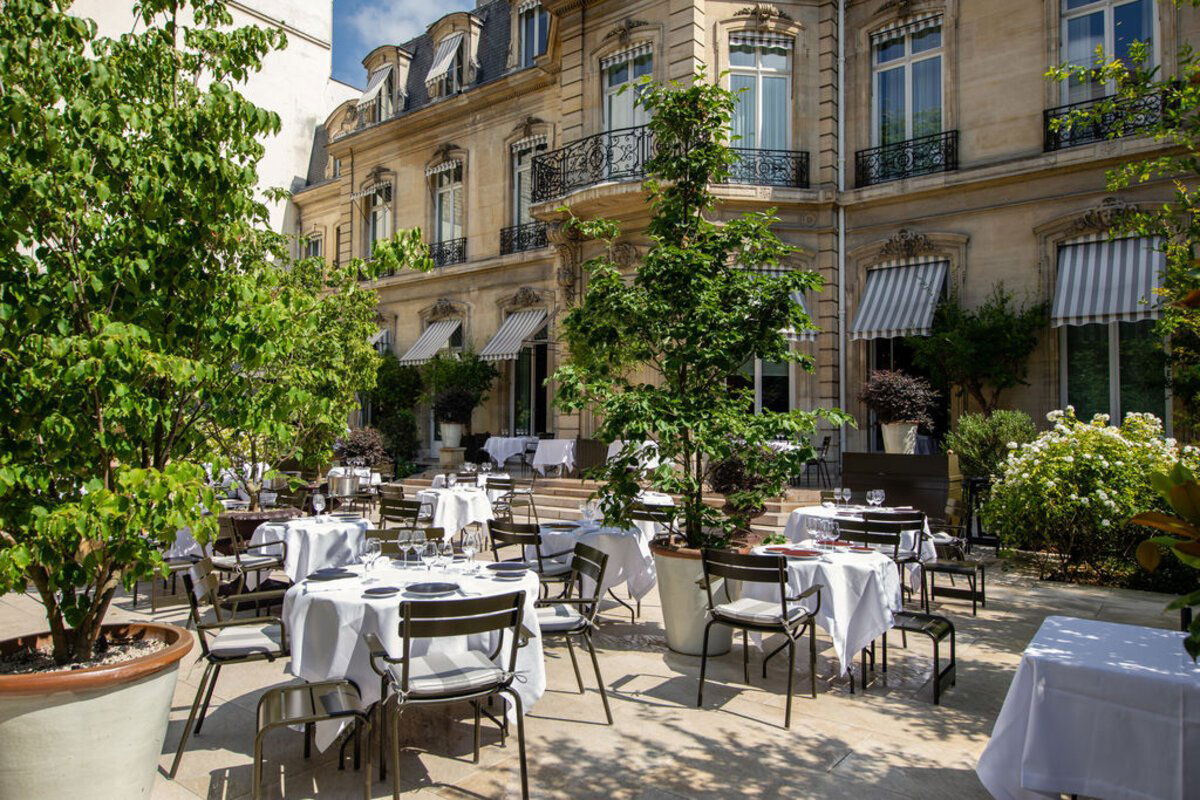
Apicius occupies a stately hôtel particulier on Rue d'Artois in Paris's 8th arrondissement, placing it among the capital's most architecturally considered dining rooms. The address operates in a tier where the physical setting carries as much weight as the plate, drawing a clientele that treats the meal as occasion rather than convenience. For Paris dining at that register, the room itself is the first argument.
The 8th Arrondissement and the Weight of French Fine Dining
The Rue d'Artois sits a short walk from the Avenue des Champs-Élysées, in a quarter of Paris where Haussmann-era stone facades and discreet brass plaques still signal ambition more reliably than any neon sign. The 8th arrondissement carries a particular burden in French culinary history: it is home to some of the most formally structured restaurant rooms in the country, where the architecture of a meal, its sequence, pacing, and ceremony, is understood to be as important as what arrives on the plate. Apicius, at 20 Rue d'Artois, occupies this context directly.
Grand French dining in this neighbourhood operates within a long tradition of palatial interiors repurposed as restaurant rooms. The area's dining culture descends from the 19th-century concept of the grand restaurant as civic institution, where the room itself communicated status and seriousness. That tradition remains legible today across the 8th's higher-end addresses, and any serious restaurant here is measured against it, whether it chooses to honour or gently subvert the format.
What the Address Signals
Paris's premium dining geography is not uniform. The city's Michelin-starred restaurants distribute across multiple arrondissements, each with its own culinary character: the 1st and 7th tend toward classic haute cuisine; the 11th and 10th have absorbed much of the contemporary bistronomie movement; the 6th retains its literary-café identity. The 8th, by contrast, remains the arrondissement of ceremony. Restaurants here draw on an international clientele, proximity to luxury retail and major hotels, and a dining room culture that expects a full evening's commitment rather than a quick sitting.
That positioning shapes the competitive peer set. An address in this quarter places a restaurant in direct comparison with rooms that have held Michelin recognition for decades, where wine lists run to thousands of references and where the brigade-to-cover ratio is notably high. For the reader planning a Paris evening in this register, the 8th is where that specific experience is most consistently available. For a broader survey of where Paris dining sits across all price points and styles, the full Paris restaurants guide maps the city's range in more detail.
The Cultural Architecture of Classic French Service
French haute cuisine carries a specific cultural grammar that places it apart from other European fine dining traditions. The brigade system, codified largely in the late 19th century, introduced a division of labour in the kitchen that made large-scale, technically precise cooking reproducible across service. The dining room counterpart, the brigade de salle, brought an equivalent rigour to service: each role from sommelier to chef de rang carried defined responsibilities, and the orchestration of a table through multiple courses was understood as a skilled performance in its own right.
This tradition has evolved, and the contemporary version in Paris's leading rooms tends to be less stiff than its early-20th-century form, but the underlying architecture remains. Guests at the upper tier of Parisian restaurants are still receiving something closer to a structured ceremony than a casual meal. The sequence of amuse-bouche, entrée, plat, fromage, and dessert is not merely habitual; it reflects a philosophy about how flavour should develop across an evening, how the palate moves from light to rich and back again, and how time at the table is itself part of what is being offered.
Paris's bar scene has developed its own rhythm around this dining culture. Aperitif culture is strong in the city, and several of the capital's better cocktail addresses serve as natural pre-dinner stops for guests heading to formal restaurants in the surrounding arrondissements. Danico and Bar Nouveau both operate in formats well-suited to that role: considered, technically sound, and calibrated to a clientele that will be sitting down to a long dinner. Candelaria, in the Marais, takes a different register, with a mezcal-forward list that reads as counterpoint to the evening's formality. Buddha Bar occupies its own category: large-format, atmospheric, and designed for a different kind of evening altogether.
French Fine Dining Beyond Paris
The tradition represented by an address like Apicius does not exist in isolation from the broader French dining geography. The country's restaurant culture distributes its formal ambition widely: Lyon has long claimed a rival culinary capital status, with a bouchon tradition that runs in parallel to Parisian haute cuisine and a serious higher-end tier of its own. La Maison M. in Lyon reflects that city's confidence in its own register. Bordeaux, whose wine culture anchors its restaurant identity, is represented by addresses like Bar Casa Bordeaux. Toulouse, Strasbourg, and Montpellier each carry their own culinary signatures, readable in venues such as Coté Vin in Toulouse, Au Brasseur in Strasbourg, and Papa Doble in Montpellier. Even outside France, the country's culinary influence extends: Le Café de la Fontaine in La Turbie sits on the French Riviera at the edge of that tradition. Further afield, venues like Bar Leather Apron in Honolulu demonstrate how French-influenced bar and dining culture has travelled.
Planning a Visit
Restaurants at this level in the 8th arrondissement are typically reservation-only, and booking well in advance is standard practice for the quarter's more formal addresses, particularly for weekend evenings or tables for larger groups. The nearest Metro access is generally via the Charles de Gaulle-Étoile or Saint-Philippe du Roule stations, both within comfortable walking distance of the Rue d'Artois. Dress expectations at upper-tier restaurants in this arrondissement tend toward smart formal, in keeping with the room's register; it is worth checking directly with the venue for any specific guidelines.
The broader planning question for a visit to this part of Paris is one of sequencing. The 8th rewards an unhurried approach: an aperitif at one of the neighbourhood's bars or hotel lounges, a long table at the restaurant itself, and the option to extend the evening in an area that remains active well past a standard dinner sitting. Those arriving from outside Paris should note that Charles de Gaulle Airport connects to the city by RER B, with journey times to central stations typically running under 45 minutes from the terminal.
Frequently Asked Questions
- What is the leading thing to order at Apicius?
- The venue data currently available does not include specific menu details or signature dishes, and generating dish recommendations without a verified source would misrepresent what the kitchen is actually serving. For current menu information, contacting the restaurant directly or consulting a recent review from a named publication is the most reliable route. What can be said with confidence is that restaurants at this address and price tier in the 8th arrondissement typically operate a seasonal tasting menu format alongside a more flexible à la carte, with wine pairing offered as a structured option.
- What makes Apicius worth visiting?
- Its address at 20 Rue d'Artois places it within one of Paris's most consistently serious dining quarters, where the formal traditions of French service and kitchen discipline remain operative rather than nostalgic. For a reader specifically seeking the kind of extended, ceremony-aware dinner that the 8th arrondissement has historically delivered, that positioning is itself an argument. Verified award or rating data for this venue is not currently in our database, so any claim to Michelin recognition or peer-set ranking should be confirmed via a current source before booking.
- Is Apicius reservation-only?
- Walk-in dining at this level in the 8th arrondissement is structurally unusual; the format, room size, and brigade logistics of upper-tier Parisian restaurants make advance booking the operating assumption. Specific booking methods and lead times for Apicius are not confirmed in the current venue data. Reaching the restaurant directly for reservation details is the appropriate step, and for high-demand dates, significantly more notice than a few days is advisable.
- What is the leading use case for Apicius?
- The address suits an occasion where the formal structure of a French fine dining evening is itself part of what is being sought: a dinner where the room, the service sequence, and the time commitment are features rather than inconveniences. Business dining, celebration meals, and visits by guests who have a specific interest in the classical French dining tradition are the most natural fits. Those seeking a looser, more spontaneous evening would be better served by the city's bistronomie tier, which is well-represented across the 10th and 11th arrondissements.
- How does Apicius fit within the history of French gastronomy's classical tradition?
- The name Apicius itself carries considerable cultural weight: Marcus Gavius Apicius was a Roman gastronome of the first century CE whose name became attached to the oldest surviving collection of Latin recipes, the De Re Coquinaria. French restaurants bearing that name are invoking a lineage that connects contemporary haute cuisine to its deepest historical roots in the codification of serious cooking. In Paris, where the language of classical gastronomy was largely defined during the 19th century by figures such as Carême and Escoffier, that reference is received with a particular literacy. A restaurant operating under this name in the 8th arrondissement is situating itself within that long arc deliberately.
Related editorial
- Best Fine Dining Restaurants in ParisFrom three-Michelin-star icons to the next generation of Parisian chefs pushing boundaries, these are the restaurants that define fine dining in the world's culinary capital.
- Best Luxury Hotels in RomeFrom rooftop terraces overlooking ancient ruins to Michelin-starred hotel dining, these are the luxury hotels that make Rome unforgettable.
- Best Cocktail Bars in KyotoFrom sleek lounges to hidden speakeasies, Kyoto's cocktail scene blends Japanese precision with global influence in ways you won't find anywhere else.
Save or rate Apicius on Pearl
Keep this venue in your Pearl passport, rate it after you visit, and track it alongside every other place you collect.