
Bar in New York City, United States
Morimoto
100ptsJapanese-American Fusion at Scale
About Morimoto
Morimoto occupies a cavernous Chelsea address at 88 10th Ave that helped define the neighborhood's transition from meatpacking industrial to destination dining. The space trades in theatrical Japanese-American design, where the architecture does as much work as the menu. It sits in a tier of Japanese-inflected restaurants where spectacle and technique are expected to coexist.
When Chelsea Was Still Deciding What It Wanted to Be
When Morimoto opened on West 10th Avenue in the early 2000s, the blocks around it were still negotiating their identity. The High Line had not yet opened. The galleries were arriving but the restaurants had not caught up. A large-format Japanese restaurant at that address, in a space designed to seat hundreds, was a statement about what downtown Manhattan dining could absorb. Two decades later, the address is surrounded by the kind of destination restaurants and bars that Morimoto helped signal were possible in Chelsea. It did not create the neighborhood, but it arrived early enough to be part of the argument.
A Room That Earns Its Own Attention
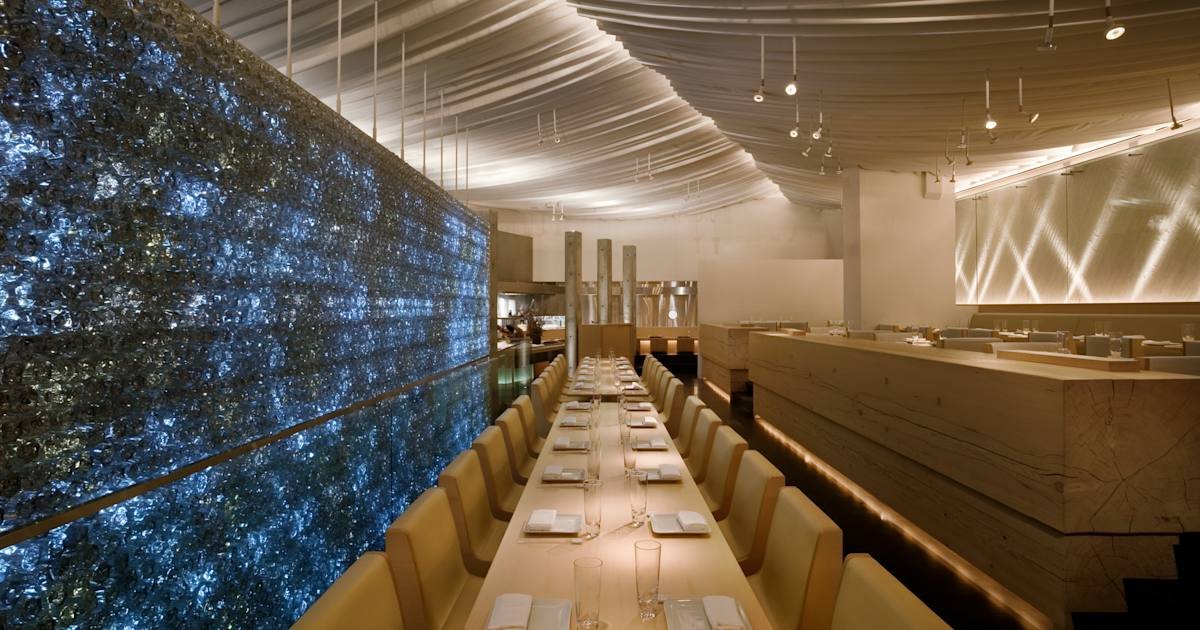
The design of large Japanese restaurants in New York tends to split between austere minimalism and theatrical excess. Morimoto lands firmly in the second category, and the space rewards that commitment. The dining room at 88 10th Ave runs deep, with high ceilings and a material palette that plays light against organic forms. Translucent panels, curved surfaces, and layered lighting create a room that shifts in mood as the evening progresses. At lunch the space reads almost corporate; by 9pm the same geometry takes on a different weight entirely.
This is the kind of room where the table assignment matters. Positions along the perimeter offer a better vantage point on the full volume of the space, which is worth experiencing at least once. The bar area functions as a separate atmosphere, drawing a crowd that arrives specifically for drinks rather than as a warm-up to the dining room. That split between bar energy and dining-room energy is characteristic of large destination restaurants in this part of the city, and Morimoto manages the divide without one undermining the other.
Japanese-American Technique at Scale
The broader category Morimoto inhabits is Japanese-American fusion at a serious technical level, a format that became commercially dominant in New York during the 1990s and early 2000s and has since bifurcated. One branch moved toward stripped-down omakase counters with minimal western influence; the other maintained the Japanese-American fusion premise but raised the execution. Morimoto occupies the latter position, where the menu covers sashimi and cooked preparations alongside plates that draw from both culinary traditions without treating either as secondary.
In the current New York market, this positioning places Morimoto in a mid-to-upper tier that includes restaurants charging comparable prices for Japanese-influenced menus with full bar programs and large dining rooms. The competitive set is different from the city's eight-seat omakase counters that book out months in advance. Morimoto is accessible in a way those counters are not, which is not a weakness in the format but a different proposition entirely.
The Bar Program and the Neighborhood After Dark
Chelsea and the adjacent West Village have developed one of the denser concentrations of serious cocktail bars in Manhattan. Morimoto's bar program sits within that context as a destination in its own right, with Japanese spirits and sake playing a more prominent role than in comparable large-format restaurant bars. For guests who want to extend the evening, the surrounding neighborhood offers a range of options across different styles. Angel's Share in the East Village maintains its reputation for precision Japanese-influenced cocktails, and Attaboy NYC on the Lower East Side is the standard reference for bespoke low-volume bar work in the city.
For guests traveling from elsewhere and building a broader itinerary, it is worth noting how the Japanese-inflected cocktail category extends across American cities. Kumiko in Chicago and Bar Leather Apron in Honolulu represent two different regional expressions of the same Japanese spirits tradition that Morimoto draws from in its beverage program. Further afield, Jewel of the South in New Orleans, Julep in Houston, and ABV in San Francisco each anchor a local cocktail scene with comparable seriousness. Internationally, The Parlour in Frankfurt on the Main and Allegory in Washington, D.C. show how the technically rigorous bar format translates across different cities and contexts.
Back in New York, the surrounding neighborhood also contains Superbueno and Amor y Amargo, each occupying distinct niches in the city's cocktail geography. The full picture of where to drink in New York, including venues within walking distance of Morimoto's Chelsea address, is covered in our full New York City restaurants guide.
How the Space Changes the Meal
Large-format destination restaurants in New York carry a specific risk: the room can overwhelm the food, reducing a serious menu to set dressing for a social occasion. Morimoto avoids this in part because the cuisine has enough technical specificity to hold attention independent of the atmosphere. The sashimi preparations in particular occupy a different register from the cooked dishes, which means the menu offers two distinct modes of engagement rather than a single consistent tone. Guests who approach Morimoto as a sashimi-forward meal in a theatrical room will have a different experience than those who move through the cooked preparations as the primary focus.
The dining room's size also means that unlike smaller Japanese restaurants in New York where the pace is set by the kitchen and the counter format enforces a single rhythm, Morimoto allows for a longer, more variable evening. Tables linger without pressure. The space absorbs noise without becoming uncomfortable. These are not incidental qualities in a city where mid-size restaurants often feel either too quiet or too loud; the acoustic engineering of the room is part of what the address delivers.
Know Before You Go
Address: 88 10th Ave, New York, NY 10011
Neighborhood: Chelsea, Manhattan
Format: Large-format Japanese-American restaurant with full bar program
Leading for: Groups, celebrations, or solo dining at the bar; guests who want serious Japanese technique in a room designed for an extended evening
Booking: Reservations recommended; the bar area typically accepts walk-ins
Nearby: Walking distance from the High Line and Hudson Yards; accessible from multiple subway lines serving the West 14th St corridor
Frequently Asked Questions
What is Morimoto known for?
Morimoto occupies a specific position in New York's Japanese-American dining category: a large-format restaurant at a Chelsea address that combines high-level sashimi and cooked preparations with a theatrical dining room. It sits in an upper tier of Japanese-influenced restaurants where both the food and the physical space are expected to perform. The restaurant has been part of the Chelsea dining scene since the early 2000s, predating much of the neighborhood's current restaurant density.
What's the leading thing to order at Morimoto?
Without confirmed current menu data, specific dish recommendations would be unreliable. What the format consistently delivers is a contrast between the raw preparations, which reflect Japanese technique at a serious level, and the cooked dishes, which draw more heavily from the Japanese-American fusion tradition. Guests who have done research on current menu specifics before arriving will be better positioned than those relying on general descriptions. Check the current menu directly with the restaurant before visiting.
Is Morimoto a good choice for a group dinner in New York?
The dining room at 88 10th Ave is sized and structured to accommodate groups without the constraints that affect smaller Japanese restaurants in the city. The high ceilings, acoustic management, and varied seating configurations make it a practical choice for parties of six or more who want a Japanese-inflected menu in a room that can handle conversation across a large table. The bar program also provides a natural starting point before moving to the dining room, which matters for groups arriving at different times.
More bars in New York City
- (SUB)MERCER(SUB)MERCER occupies a basement address on Mercer Street in SoHo, positioning it as a deliberate destination rather than a drop-in. The subterranean format tends to keep ambient noise lower than street-level alternatives, making it a reasonable call for groups of four or more. Book ahead for weekends and confirm group capacity directly with the venue.
- 1 OR 81 OR 8 on DeKalb Avenue is a low-key Fort Greene bar that works best for two people on a weeknight when the room is quiet enough for conversation. Walk-ins are easy, no advance planning required. If a specialist cocktail program is your priority, Attaboy or Amor y Amargo offer more defined experiences — but for a neighbourhood drink without the fuss, this delivers.
- 230 Fifth Rooftop Bar230 Fifth is the easiest rooftop bar in Midtown to walk into, and the Empire State Building views justify the trip. The crowd skews groups and tourists, and the drinks are solid rather than craft-focused. Go early on a weekday for the best version of the experience; after 9 PM on weekends it tips firmly into party-group territory.
- 4 Charles Prime Rib4 Charles Prime Rib is a compact, reservation-required West Village dining room built around a focused prime rib format. It works well for dates and pairs but is too small for groups of four or more. Booking is easy relative to Manhattan peers, and the narrow menu signals a kitchen that executes one thing consistently well.
- 44 & X Hell's KitchenA low-key Hell's Kitchen neighborhood bar-restaurant that earns its place for easy weeknight dates and pre-theatre dinners. Booking is simple, the room is intimate enough for conversation, and there's no dress pressure. Not a cocktail destination, but a reliable, pressure-free option in Midtown West when you want comfort over spectacle.
- 58-22 Myrtle Ave58-22 Myrtle Ave is a low-key Ridgewood neighborhood spot that rewards return visits more than first impressions. Easy to get into, with no reservation headaches, it suits regulars looking for an unpretentious room rather than a structured cocktail program. If a strong drinks list or kitchen ambition matters to you, look to Attaboy or Amor y Amargo instead.
Related editorial
- Best Fine Dining Restaurants in ParisFrom three-Michelin-star icons to the next generation of Parisian chefs pushing boundaries, these are the restaurants that define fine dining in the world's culinary capital.
- Best Luxury Hotels in RomeFrom rooftop terraces overlooking ancient ruins to Michelin-starred hotel dining, these are the luxury hotels that make Rome unforgettable.
- Best Cocktail Bars in KyotoFrom sleek lounges to hidden speakeasies, Kyoto's cocktail scene blends Japanese precision with global influence in ways you won't find anywhere else.
Save or rate Morimoto on Pearl
Keep this venue in your Pearl passport, rate it after you visit, and track it alongside every other place you collect.