
Bar in New York City, United States
M. Wells
100ptsOffal-Forward Québécois
About M. Wells
M. Wells operates out of Long Island City, Queens, where the industrial waterfront fringe of New York has quietly supported a dining culture that Manhattan rarely replicates. The restaurant draws on a Québécois-inflected, nose-to-tail sensibility in a neighbourhood that rewards the deliberate trip across the bridge. It is the kind of place that makes sense only once you have been there.
Vernon Boulevard and the Geography of Serious Eating
Long Island City sits across the East River from Midtown, close enough to see the skyline and far enough to operate by different rules. Vernon Boulevard, the commercial spine running along the Queens waterfront, has accumulated a small cluster of restaurants and bars that do not answer to Manhattan's foot-traffic logic. Diners who make the trip on the N, W, or 7 train to Queensboro Plaza, or the ferry from Midtown, arrive with intention. That intentionality changes how a room functions. Restaurants on Vernon Boulevard tend to be less performative than their counterparts in the West Village or the Lower East Side; the audience has already committed before walking through the door.
M. Wells, at 50-04 Vernon Boulevard, entered this neighbourhood context early enough to help define it. The address places it in a stretch of Long Island City that still reads as post-industrial rather than gentrified, which is exactly the kind of setting where an ambitious, unconventional kitchen can establish itself without the pressure of a neighbourhood identity already formed around fine dining.
What the Québécois Tradition Brought to Queens
The cooking at M. Wells draws heavily on the Québécois tradition of generous, often offal-forward, unapologetically fatty preparations rooted in French provincial cooking filtered through a North American winter sensibility. That lineage is relatively uncommon in New York. The city has a handful of French-adjacent restaurants operating at high price points, and a much larger population of bistro formats, but the specific register of Québécois cooking — where organ meats are treated as a point of pride rather than a challenge, where portions carry a certain weight, and where the wine list is likely to feature natural and minimal-intervention bottles alongside conventional selections — occupies a narrow lane.
Across New York's broader dining scene, that narrow lane matters because it positions M. Wells against neither the grand French houses of the Upper East Side nor the casual French-inflected bistros of Brooklyn. It sits in its own comparative tier, alongside a small number of restaurants where the cooking is rooted in a specific regional tradition outside France's metropolitan centres, executed with professional seriousness.
The Industrial Room and What It Does to a Meal
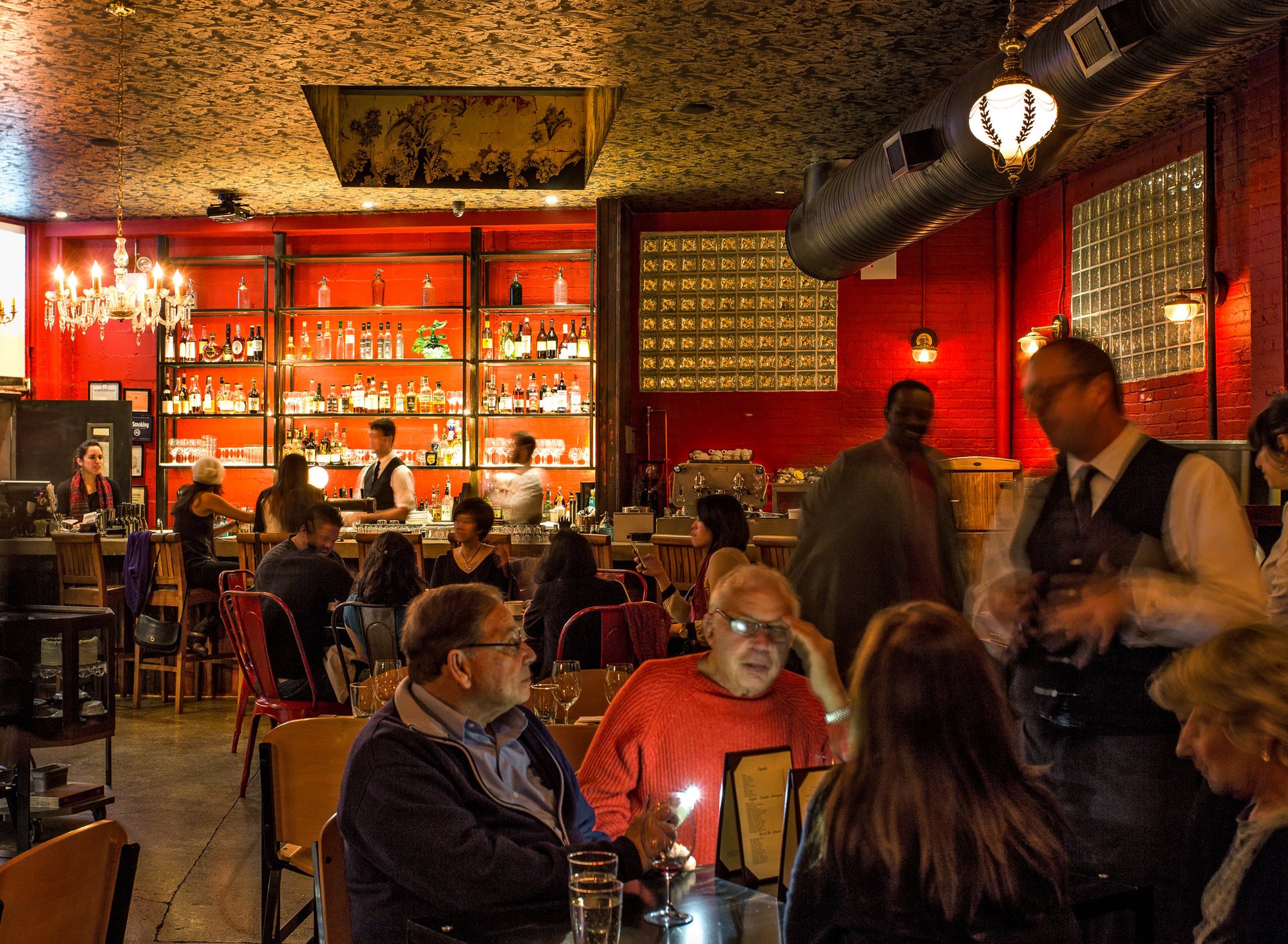
Dining rooms in converted industrial spaces carry a specific kind of pressure: they tend toward either austere minimalism or deliberate clutter, with very few landing somewhere more interesting. The Long Island City setting, surrounded by warehouses and transit infrastructure, means that the room at M. Wells does not need to conjure an atmosphere imported from another context. The neighbourhood provides the frame. Exposed surfaces and high ceilings are not decorative choices so much as honest statements about what the building was before the kitchen moved in.
This matters for how a meal reads. The cooking at M. Wells, which tends toward richness and density, sits more comfortably in an unsentimental industrial room than it would in a space designed to signal refinement through soft furnishings and low lighting. The physical context and the culinary register are coherent with each other in a way that Manhattan venues, working against more expensive and more decorated real estate, rarely achieve.
Where M. Wells Sits in the Outer Borough Dining Argument
The question of whether the outer boroughs have collectively outgrown their status as alternatives to Manhattan dining is well past the point of debate in New York food writing. Queens in particular has long held a stronger claim than its press coverage suggested: Flushing's Chinese regional cooking, Jackson Heights' South Asian and Latin American depth, and Astoria's Greek infrastructure all predate the current moment of attention. Long Island City, by contrast, developed its dining identity later, and around a smaller number of serious independent restaurants rather than a cuisine-specific community.
M. Wells belongs to that later, smaller category. It is not part of a neighbourhood corridor with multiple similar venues; it is a destination in a neighbourhood that has several good reasons to visit but not yet the critical mass that defines Flushing or Jackson Heights. That isolation, in dining terms, means the restaurant carries more weight as a reason to cross the river than it would if it were surrounded by obvious alternatives. Visitors who consult our full New York City restaurants guide will find that the outer borough argument now extends well beyond a handful of trophy destinations.
Drinks, Program, and the Neighbourhood Bar Question
Long Island City does not have the cocktail infrastructure of the Lower East Side or the East Village. Visitors planning an evening around M. Wells will not find, within easy walking distance, the kind of dedicated cocktail bars that have defined New York's bar culture over the past fifteen years. Manhattan's programs at venues like Attaboy NYC and Angel's Share , both operating at the technical and historical edge of the city's cocktail scene , require a separate trip. So does Amor y Amargo, which operates as one of the more rigorous amaro-focused programs in the country, and Superbueno, which has built a distinct identity around Latin American spirits and formats.
For comparison, serious cocktail programs in other American cities , Kumiko in Chicago, ABV in San Francisco, Jewel of the South in New Orleans, Julep in Houston, Allegory in Washington, D.C., and Bar Leather Apron in Honolulu , all demonstrate the same pattern: destination-quality bar programs cluster in specific urban nodes, not in proximity to any given restaurant. International visitors will find similar dynamics at The Parlour in Frankfurt on the Main. A meal at M. Wells is better planned as the anchor of an evening rather than as one stop in a multi-venue bar crawl.
Know Before You Go
- Address: 50-04 Vernon Boulevard, Long Island City, NY 11101
- Neighbourhood: Long Island City, Queens , industrial waterfront corridor
- Getting There: N/W train to Queensboro Plaza or 7 train to Vernon Blvd-Jackson Ave; NYC Ferry Astoria route stops nearby
- Booking: Reservation details not confirmed in our database , check current availability directly with the venue
- Price Range: Not confirmed in our database
- Hours: Not confirmed in our database , verify before travelling
- Context: Plan M. Wells as a standalone destination; cocktail bars and late-night options are limited within walking distance in Long Island City
Frequently Asked Questions
What is M. Wells leading at?
M. Wells has built its reputation on Québécois-inflected cooking that takes offal and rich, dense preparations seriously , a register with few direct peers in New York City. The outer-borough setting in Long Island City reinforces a sensibility that prioritises the cooking over atmosphere management. For specific current menu strengths, check recent coverage from named New York publications before visiting.
What is the signature drink at M. Wells?
The venue's specific drink program is not confirmed in our database. The Québécois culinary tradition that informs the kitchen tends to pair well with natural and minimal-intervention wines, and that register has been associated with M. Wells in food press coverage. For confirmed current drinks, consult the venue directly or check recent editorial references from named New York food publications.
Do they take walk-ins at M. Wells?
Walk-in policy is not confirmed in our database. Given Long Island City's comparatively lower foot traffic relative to Manhattan dining corridors, walk-in availability may be more accessible than at comparable Manhattan restaurants, but this cannot be verified without current venue confirmation. Booking ahead remains the prudent approach for any serious dinner plan in New York City.
Is M. Wells better for first-timers or repeat visitors?
The cooking at M. Wells works on both visits, but the specific register , offal-forward, Québécois-inflected, operating in a post-industrial Queens room rather than a curated Manhattan setting , reads more clearly on a return visit once the context is established. First-timers benefit from arriving with some familiarity with the Québécois tradition rather than expecting a standard French-American bistro format. Either way, the trip across the river is the first commitment the venue asks of you.
How does M. Wells fit within the broader Queens dining scene compared to other serious New York restaurants?
M. Wells occupies a distinct position within Queens dining: it is not part of a cuisine-specific community corridor (as Flushing or Jackson Heights are) but rather a standalone destination built around a specific culinary tradition , Québécois cooking with a nose-to-tail orientation , that has almost no direct peers in the five boroughs. That specificity is what separates it from the borough's immigrant-cuisine anchors and from Manhattan's French restaurants operating at higher price points. Visitors treating it as a starting point for exploring outer-borough dining will find the contrast with neighbourhood formats like those in Astoria or Sunnyside instructive.
More bars in New York City
- (SUB)MERCER(SUB)MERCER occupies a basement address on Mercer Street in SoHo, positioning it as a deliberate destination rather than a drop-in. The subterranean format tends to keep ambient noise lower than street-level alternatives, making it a reasonable call for groups of four or more. Book ahead for weekends and confirm group capacity directly with the venue.
- 1 OR 81 OR 8 on DeKalb Avenue is a low-key Fort Greene bar that works best for two people on a weeknight when the room is quiet enough for conversation. Walk-ins are easy, no advance planning required. If a specialist cocktail program is your priority, Attaboy or Amor y Amargo offer more defined experiences — but for a neighbourhood drink without the fuss, this delivers.
- 230 Fifth Rooftop Bar230 Fifth is the easiest rooftop bar in Midtown to walk into, and the Empire State Building views justify the trip. The crowd skews groups and tourists, and the drinks are solid rather than craft-focused. Go early on a weekday for the best version of the experience; after 9 PM on weekends it tips firmly into party-group territory.
- 4 Charles Prime Rib4 Charles Prime Rib is a compact, reservation-required West Village dining room built around a focused prime rib format. It works well for dates and pairs but is too small for groups of four or more. Booking is easy relative to Manhattan peers, and the narrow menu signals a kitchen that executes one thing consistently well.
- 44 & X Hell's KitchenA low-key Hell's Kitchen neighborhood bar-restaurant that earns its place for easy weeknight dates and pre-theatre dinners. Booking is simple, the room is intimate enough for conversation, and there's no dress pressure. Not a cocktail destination, but a reliable, pressure-free option in Midtown West when you want comfort over spectacle.
- 58-22 Myrtle Ave58-22 Myrtle Ave is a low-key Ridgewood neighborhood spot that rewards return visits more than first impressions. Easy to get into, with no reservation headaches, it suits regulars looking for an unpretentious room rather than a structured cocktail program. If a strong drinks list or kitchen ambition matters to you, look to Attaboy or Amor y Amargo instead.
Related editorial
- Best Fine Dining Restaurants in ParisFrom three-Michelin-star icons to the next generation of Parisian chefs pushing boundaries, these are the restaurants that define fine dining in the world's culinary capital.
- Best Luxury Hotels in RomeFrom rooftop terraces overlooking ancient ruins to Michelin-starred hotel dining, these are the luxury hotels that make Rome unforgettable.
- Best Cocktail Bars in KyotoFrom sleek lounges to hidden speakeasies, Kyoto's cocktail scene blends Japanese precision with global influence in ways you won't find anywhere else.
Save or rate M. Wells on Pearl
Keep this venue in your Pearl passport, rate it after you visit, and track it alongside every other place you collect.