
Bar in New York City, United States
Lilia
100ptsPasta-Forward Italian Precision
About Lilia
Lilia occupies a converted garage on Union Avenue in Williamsburg, where Italian-American pasta cookery is treated as a serious discipline rather than a casual backdrop. The room draws a cross-section of Brooklyn regulars and destination diners who plan weeks ahead, and the meal moves on its own unhurried schedule. It belongs to a narrow tier of New York Italian that earns sustained critical attention without a hotel address or Midtown postcode.
The Room Before the Food
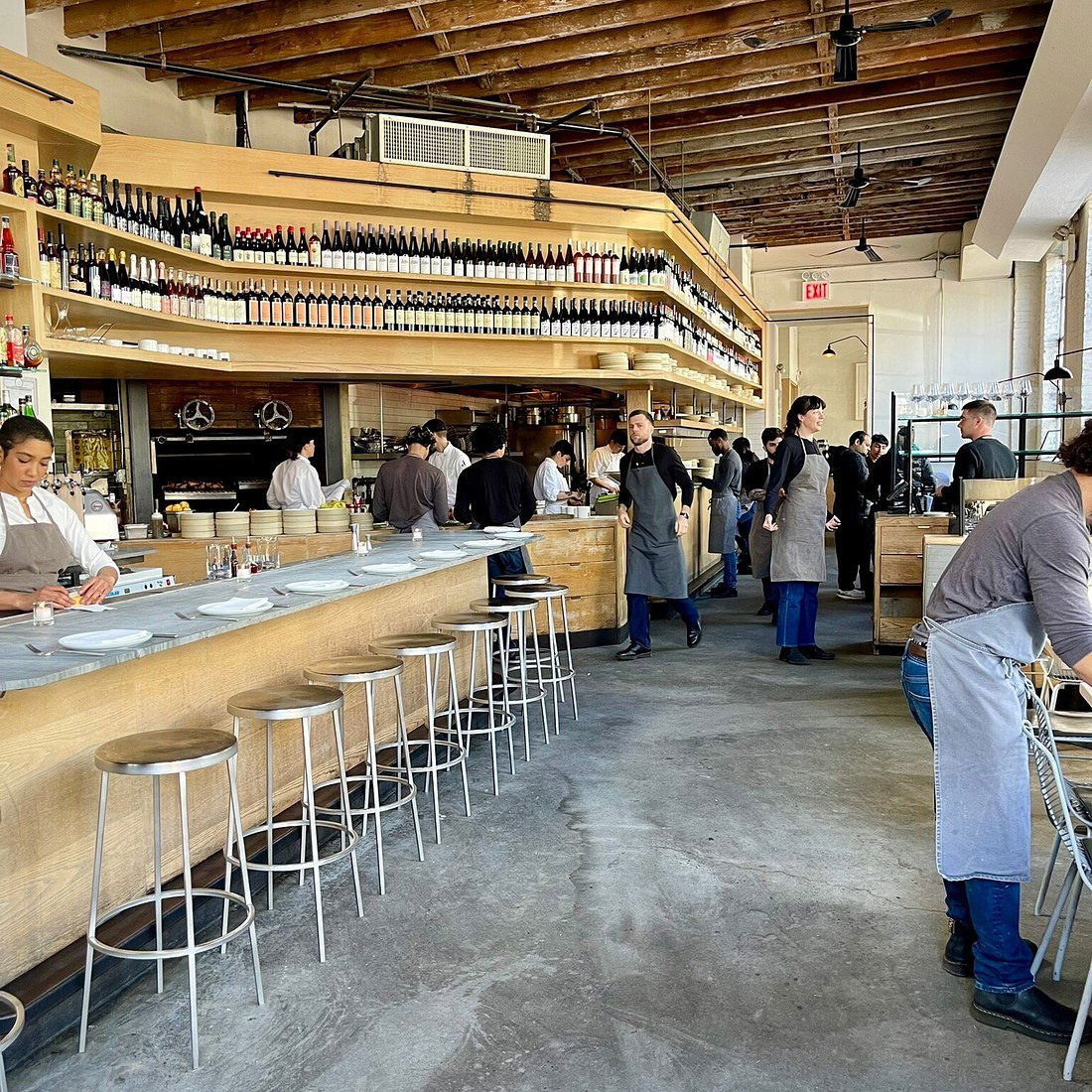
Union Avenue in Williamsburg does not signal destination dining. The block is industrial in posture, the building a former auto body shop with high ceilings and wide windows that admit more light than warmth. Approaching Lilia, the architecture reads as functional renovation rather than designed atmosphere: exposed structure, a wood-fired setup visible from the dining floor, tables arranged without theatrical staging. The room earns its reputation through what happens at the tables, not what surrounds them, which is a particular kind of statement in a city where room design often does considerable narrative work.
That restraint sets the register for the meal itself. New York Italian dining has bifurcated sharply in recent years: one lane runs toward red-sauce nostalgia performed with knowing irony, the other toward ingredient-precise pasta programs that take their cues from central and southern Italian regional cooking. Lilia operates in the second lane, and the room's plainspokenness reinforces the point before a dish arrives.
How the Meal Moves
The ritual at Lilia follows a tempo that New Yorkers trained on quick table turns will notice immediately: it does not rush. The meal is structured to accumulate rather than accelerate, with pasta as the gravitational center rather than a course to be cleared between a starter and a protein. This is not unusual in Italian dining at home, but it runs against the grain of most American restaurant pacing, where pasta tends to occupy a middle slot bracketed by abbreviated courses on either side.
Here, pasta is the point. The menu builds toward it and around it, and the kitchen's evident technical investment in dough, shape, and sauce gives those dishes a weight that justifies the sequencing. The broader principle at work is one that defines the most serious Italian-American pasta programs in the city: treating pasta not as a vehicle for protein or as comfort-food shorthand, but as a craft category with its own rules of texture, seasoning, and composition. New York has perhaps a dozen restaurants operating at this level of pasta focus, and Lilia sits in the upper portion of that group.
The pace also creates space for the wine program, which is organised around Italian producers and pairs with the menu's southern and central Italian reference points. The room supports a longer meal without pressure, which is a logistical detail worth noting for anyone accustomed to the 90-minute slot that defines much of the city's mid-range Italian dining.
Williamsburg as a Dining Address
Brooklyn's dining map has been recalibrated substantially over the past decade. Williamsburg in particular now functions as a legitimate destination for the kind of serious, critically recognised restaurant that once required a Manhattan address to attract both press attention and a city-wide customer base. Lilia's placement on Union Avenue is part of a broader pattern: several of New York's most closely watched Italian and American cooking programs have embedded in Brooklyn, where real estate allows for larger rooms and a different operational scale than Midtown or the West Village permit.
For visitors arriving from elsewhere in New York City, the L train to Lorimer Street or the G train to Metropolitan Avenue both place the restaurant within walking distance. The booking situation deserves direct attention: demand for tables runs considerably ahead of supply. Reservations open on a set schedule and move quickly, and walk-in availability is limited. Planning two to three weeks ahead is a reasonable baseline expectation, though the window can extend further on weekends. This is not incidental to the restaurant's reputation; it is part of the signal that defines its position in the market.
For a broader orientation to the New York dining scene, including comparable Italian programs and the full range of the city's food and drink offerings, our full New York City restaurants guide maps the relevant categories and neighbourhoods.
The Italian Context
Italian cooking in New York carries more accumulated weight than in almost any other American city. The red-sauce canon established in the mid-twentieth century created a baseline expectation that contemporary chefs either work within or work explicitly against. The restaurants that have attracted sustained critical attention in the past decade tend to occupy a more technically specific position: regional sourcing logic, pasta shapes tied to actual Italian geography, and a resistance to the cream-and-porcini shorthand that once defined American perceptions of Italian fine dining.
Lilia belongs to this current. Its sustained recognition in New York food criticism places it alongside a small cohort of pasta-focused restaurants that take the discipline seriously at the production level. The comparison set is narrow because the standard is demanding: getting pasta right at restaurant scale, consistently, across service, requires investment in dough, equipment, and kitchen discipline that many kitchens at this price tier do not maintain.
The city also offers strong drinking programs adjacent to this kind of cooking. If the evening begins or ends with cocktails, Williamsburg's bar scene has deepened considerably. Further afield, programs like Amor y Amargo on the East Side and Attaboy NYC on the Lower East Side represent the kind of serious, format-driven cocktail work that pairs well with this register of dining. For spirit-forward drinking with a distinct editorial sensibility, Superbueno in the West Village and Angel's Share in the East Village each represent specific New York drinking traditions worth knowing. The pattern of taking drinks seriously as part of a longer evening out is one that connects New York to a wider set of cities: comparable commitment shows up at Kumiko in Chicago, ABV in San Francisco, Allegory in Washington, D.C., Jewel of the South in New Orleans, Julep in Houston, Bar Leather Apron in Honolulu, and The Parlour in Frankfurt on the Main.
Planning the Visit
Lilia is located at 567 Union Avenue, Brooklyn, NY 11211. Reservations are the operative variable: securing a table requires advance planning, and the booking process rewards those who check availability on the day reservations open rather than approaching it casually. The meal is leading treated as the primary commitment of an evening rather than one stop among several; the pacing works in favour of a longer sitting, and the neighbourhood offers enough before and after the meal to support it. Dress is casual to smart-casual in practice, consistent with Williamsburg's general register.
Frequently Asked Questions
What do regulars order at Lilia?
Lilia's identity is anchored in its pasta program, and regulars tend to orient their ordering around those dishes rather than treating them as one course among equals. The kitchen's focus on pasta as a craft discipline means the house-made shapes and their specific sauces are where the technical investment is most visible. Beyond pasta, the menu follows an Italian coastal logic, with fish and vegetable preparations that complement rather than compete with the central course.
What makes Lilia worth visiting?
In a New York Italian dining scene crowded with red-sauce nostalgia and trend-driven small plates, Lilia represents a specific and sustained commitment to pasta as a serious cooking category. The restaurant has held critical attention across several years without significant reinvention, which in a city where restaurant cycles are compressed is a meaningful signal. The Brooklyn address keeps it accessible without the premium pricing that a comparable Manhattan room would impose, and the unhurried pace makes it a meal rather than a transaction.
How far ahead do you need to book Lilia, and is there any way to get a table on shorter notice?
Lilia operates in the tier of New York restaurants where demand structurally exceeds capacity, and reservations typically require two to three weeks of advance planning at minimum, with weekend slots extending further. Walk-in availability exists but is unpredictable; arriving early in service or during the week improves the odds. The restaurant's sustained critical profile, rather than a single viral moment, drives its booking difficulty, which means the demand is consistent rather than seasonal.
More bars in New York City
- (SUB)MERCER(SUB)MERCER occupies a basement address on Mercer Street in SoHo, positioning it as a deliberate destination rather than a drop-in. The subterranean format tends to keep ambient noise lower than street-level alternatives, making it a reasonable call for groups of four or more. Book ahead for weekends and confirm group capacity directly with the venue.
- 1 OR 81 OR 8 on DeKalb Avenue is a low-key Fort Greene bar that works best for two people on a weeknight when the room is quiet enough for conversation. Walk-ins are easy, no advance planning required. If a specialist cocktail program is your priority, Attaboy or Amor y Amargo offer more defined experiences — but for a neighbourhood drink without the fuss, this delivers.
- 230 Fifth Rooftop Bar230 Fifth is the easiest rooftop bar in Midtown to walk into, and the Empire State Building views justify the trip. The crowd skews groups and tourists, and the drinks are solid rather than craft-focused. Go early on a weekday for the best version of the experience; after 9 PM on weekends it tips firmly into party-group territory.
- 4 Charles Prime Rib4 Charles Prime Rib is a compact, reservation-required West Village dining room built around a focused prime rib format. It works well for dates and pairs but is too small for groups of four or more. Booking is easy relative to Manhattan peers, and the narrow menu signals a kitchen that executes one thing consistently well.
- 44 & X Hell's KitchenA low-key Hell's Kitchen neighborhood bar-restaurant that earns its place for easy weeknight dates and pre-theatre dinners. Booking is simple, the room is intimate enough for conversation, and there's no dress pressure. Not a cocktail destination, but a reliable, pressure-free option in Midtown West when you want comfort over spectacle.
- 58-22 Myrtle Ave58-22 Myrtle Ave is a low-key Ridgewood neighborhood spot that rewards return visits more than first impressions. Easy to get into, with no reservation headaches, it suits regulars looking for an unpretentious room rather than a structured cocktail program. If a strong drinks list or kitchen ambition matters to you, look to Attaboy or Amor y Amargo instead.
Related editorial
- Best Fine Dining Restaurants in ParisFrom three-Michelin-star icons to the next generation of Parisian chefs pushing boundaries, these are the restaurants that define fine dining in the world's culinary capital.
- Best Luxury Hotels in RomeFrom rooftop terraces overlooking ancient ruins to Michelin-starred hotel dining, these are the luxury hotels that make Rome unforgettable.
- Best Cocktail Bars in KyotoFrom sleek lounges to hidden speakeasies, Kyoto's cocktail scene blends Japanese precision with global influence in ways you won't find anywhere else.
Save or rate Lilia on Pearl
Keep this venue in your Pearl passport, rate it after you visit, and track it alongside every other place you collect.