
Bar in New York City, United States
Jongro BBQ
100pts32nd Street Table-Side Fire
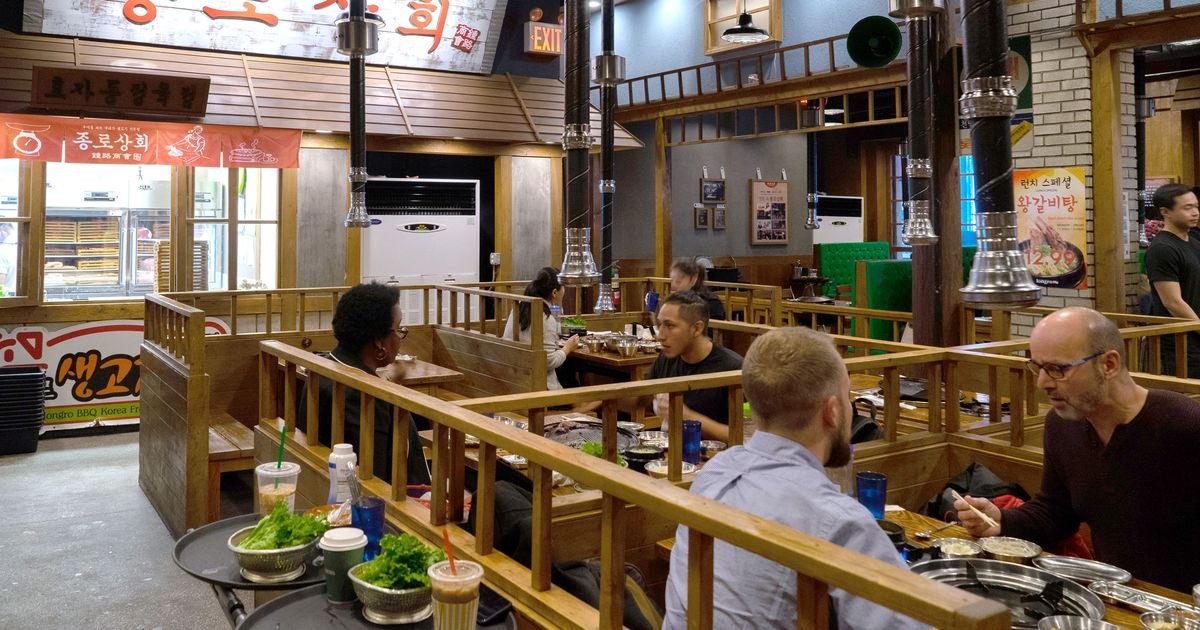
About Jongro BBQ
Jongro BBQ occupies the second floor of 22 W 32nd Street in the heart of Koreatown, where Manhattan's most concentrated strip of Korean dining has operated continuously since the 1980s. The restaurant draws regulars for table-side charcoal grilling in a format that rewards groups and extended evenings. It sits within one of New York's few dining corridors that genuinely runs around the clock.
K-Town's Second Floor and What It Represents
Manhattan's 32nd Street Korean corridor has been running without interruption since Korean-owned businesses began consolidating there in the early 1980s. The block between Fifth and Sixth Avenues is now the most vertically dense stretch of Korean dining in New York, with restaurants stacked across multiple floors of the same buildings, sharing foot traffic with karaoke rooms, bakeries, and late-night pojangmacha-style snack counters. Jongro BBQ sits on the second floor of 22 W 32nd Street, which positions it within that stacking logic — accessible by elevator or stairs, removed from the street-level noise, and operating on the assumption that diners come with time to spend rather than somewhere else to be.
That second-floor format is not incidental. Korean barbecue as a dining tradition rewards length. The charcoal or gas grill embedded in each table means the meal is a continuous process: meat ordered in sequence, banchan replenished, beer or soju poured between rounds. The room functions less like a conventional restaurant service and more like a structured gathering with food as the organizing principle. Jongro BBQ's placement within Koreatown's layered infrastructure makes it a representative example of how that tradition transplants into a dense urban environment.
The Collaboration That Runs Table-Side Service
Korean barbecue's service model demands a specific kind of floor coordination that most Western dining formats do not require. At venues where grill management is handled table-side by staff rather than entirely by diners, the dynamic between the person running the grill and the person taking orders becomes a distinct operational pairing. The grill attendant controls timing: when to lay the first cut, when to turn, when to move cooked meat to the resting corner of the grate before it tightens. The server reading the table manages pacing, banchan timing, and drink rhythm. When those two roles are in sync, the meal has a momentum that feels effortless. When they are not, the experience fragments.
This kind of front-of-house collaboration is more visible in Korean barbecue than in almost any other format. It is not orchestrated from a kitchen pass — it happens in real time, at the table, in front of the guest. Koreatown venues that have maintained longevity in New York have typically done so by developing a floor team fluent in that rhythm, treating grill management as a skilled position rather than a secondary task. The format itself makes the team dynamic legible to anyone paying attention.
Where Jongro BBQ Sits in the Koreatown Tier
New York's Koreatown has developed a loose internal hierarchy over decades. At one end sit the utilitarian spots optimized for speed and low cover counts, carrying limited banchan selections and shorter menus. At the other end are venues that have invested in ventilation systems, premium charcoal sourcing, and a wider range of cuts including marbled short rib grades and specialty offal. Jongro BBQ operates toward the more structured middle of that range, with a Koreatown address that carries the implicit credential of operating in New York's most established Korean dining district.
For context, the surrounding corridor competes not just internally but against a broader New York dining public that now treats Korean barbecue as a mainstream format rather than a specialist one. That shift has been consistent since at least the mid-2010s, with groups that previously would not have considered a Koreatown dinner now making it a deliberate choice. The audience at venues like Jongro BBQ has consequently broadened, while the format itself has remained largely stable , a sign that the kitchen and floor team are calibrating for a wider range than the original neighborhood regulars alone.
Reading the Room: Groups, Timing, and the Koreatown Clock
One of Koreatown's structural advantages in New York is its hours. The 32nd Street corridor operates later than almost any other dining district in Manhattan, with several venues running past 2 a.m. on weekends and many anchored by 24-hour neighbors that keep foot traffic moving through the night. This gives Jongro BBQ a temporal context that shapes who walks in and when. Early evening tends toward work groups and pre-theater overflow from the Midtown adjacency. Later sittings attract a different composition: post-show diners, late workers, and groups that have come specifically for the format.
That timing flexibility is a concrete practical advantage. In a city where many kitchens close by 10 p.m. and last seating policies are enforced strictly, a Koreatown address implicitly signals availability at hours when alternatives have narrowed. For groups trying to coordinate around varied schedules, that operational window matters. It is one of the reasons Koreatown as a district has retained a loyal repeat-visitor base beyond the Korean-American community it originally served.
For broader New York dining context, including restaurant and bar recommendations across neighborhoods, see our full New York City restaurants guide. Among Manhattan's bar programs, Angel's Share in the East Village and Attaboy NYC on the Lower East Side represent the city's more technically focused cocktail operations, while Amor y Amargo and Superbueno each anchor distinct neighborhood drinking cultures. Beyond New York, comparable venue-specific coordination can be found at Kumiko in Chicago, ABV in San Francisco, Allegory in Washington, D.C., Jewel of the South in New Orleans, Julep in Houston, Bar Leather Apron in Honolulu, and The Parlour in Frankfurt on the Main.
Planning Your Visit
Jongro BBQ is located at Address: 22 W 32nd Street, 2nd Floor, New York, NY 10001, in the core of Koreatown between Fifth and Sixth Avenues, reachable from the 34th Street-Herald Square or 33rd Street subway stations. Format: Table-side Korean barbecue; suited to groups of three or more who want to graze across multiple rounds. Timing: The corridor runs late, making this a viable option for sittings well past the standard Manhattan service window. Booking: Contact the venue directly or check current availability through walk-in, as booking policies are not confirmed in available data. Budget: Price range is not confirmed in current data; expect Koreatown mid-range Korean barbecue pricing, typically per-person costs that scale with meat selection and drink orders.
Frequently Asked Questions
What's the must-try cocktail at Jongro BBQ?
Jongro BBQ's drink program centers on the conventions of Korean barbecue dining rather than a cocktail-forward format. Soju and beer, often consumed as a combined somaek, are the drinks most naturally paired with charcoal-grilled meats in this context. If you're looking for a dedicated cocktail program in New York, venues like Angel's Share or Attaboy NYC operate in that register; Jongro BBQ's drink list is leading approached as a complement to the grill rather than a destination in its own right.
Why do people go to Jongro BBQ?
The draw is the format as much as the food: table-side grilling in a Koreatown setting that has operated as New York's primary Korean dining district for over four decades. The second-floor location on 32nd Street places it inside a corridor that runs later than most of Manhattan, making it a practical choice for groups looking to eat past standard service hours. The price point sits within Koreatown's established mid-range, which tends to offer more coverage per person than comparable group dining formats elsewhere in Midtown.
Is Jongro BBQ suitable for large groups unfamiliar with Korean barbecue?
Korean barbecue as a format is particularly accessible for groups new to the tradition, because the table-side grill structure makes the progression of the meal visible and interactive rather than opaque. At venues in the Koreatown corridor, floor staff are generally practiced at managing the grill for tables that prefer assistance, which removes the technical uncertainty for first-timers. Jongro BBQ's location on 32nd Street places it in New York's most established Korean dining district, where that kind of service fluency has developed over decades of serving a broad audience.
More bars in New York City
- (SUB)MERCER(SUB)MERCER occupies a basement address on Mercer Street in SoHo, positioning it as a deliberate destination rather than a drop-in. The subterranean format tends to keep ambient noise lower than street-level alternatives, making it a reasonable call for groups of four or more. Book ahead for weekends and confirm group capacity directly with the venue.
- 1 OR 81 OR 8 on DeKalb Avenue is a low-key Fort Greene bar that works best for two people on a weeknight when the room is quiet enough for conversation. Walk-ins are easy, no advance planning required. If a specialist cocktail program is your priority, Attaboy or Amor y Amargo offer more defined experiences — but for a neighbourhood drink without the fuss, this delivers.
- 230 Fifth Rooftop Bar230 Fifth is the easiest rooftop bar in Midtown to walk into, and the Empire State Building views justify the trip. The crowd skews groups and tourists, and the drinks are solid rather than craft-focused. Go early on a weekday for the best version of the experience; after 9 PM on weekends it tips firmly into party-group territory.
- 4 Charles Prime Rib4 Charles Prime Rib is a compact, reservation-required West Village dining room built around a focused prime rib format. It works well for dates and pairs but is too small for groups of four or more. Booking is easy relative to Manhattan peers, and the narrow menu signals a kitchen that executes one thing consistently well.
- 44 & X Hell's KitchenA low-key Hell's Kitchen neighborhood bar-restaurant that earns its place for easy weeknight dates and pre-theatre dinners. Booking is simple, the room is intimate enough for conversation, and there's no dress pressure. Not a cocktail destination, but a reliable, pressure-free option in Midtown West when you want comfort over spectacle.
- 58-22 Myrtle Ave58-22 Myrtle Ave is a low-key Ridgewood neighborhood spot that rewards return visits more than first impressions. Easy to get into, with no reservation headaches, it suits regulars looking for an unpretentious room rather than a structured cocktail program. If a strong drinks list or kitchen ambition matters to you, look to Attaboy or Amor y Amargo instead.
Related editorial
- Best Fine Dining Restaurants in ParisFrom three-Michelin-star icons to the next generation of Parisian chefs pushing boundaries, these are the restaurants that define fine dining in the world's culinary capital.
- Best Luxury Hotels in RomeFrom rooftop terraces overlooking ancient ruins to Michelin-starred hotel dining, these are the luxury hotels that make Rome unforgettable.
- Best Cocktail Bars in KyotoFrom sleek lounges to hidden speakeasies, Kyoto's cocktail scene blends Japanese precision with global influence in ways you won't find anywhere else.
Save or rate Jongro BBQ on Pearl
Keep this venue in your Pearl passport, rate it after you visit, and track it alongside every other place you collect.