
Bar in New York City, United States
Empire Diner
100ptsPre-War Chrome Counter
About Empire Diner
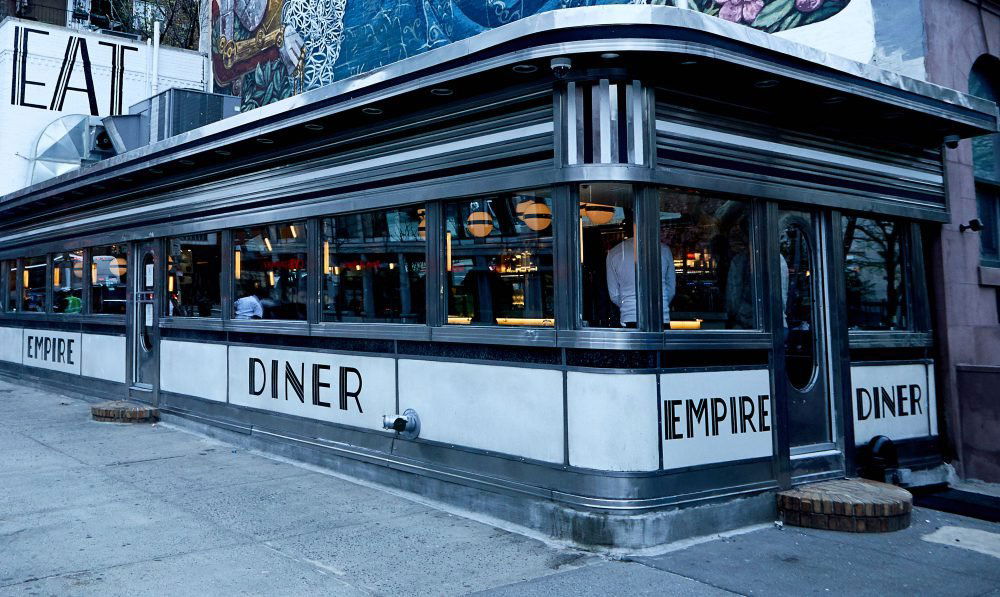
Empire Diner occupies a 1929 chrome-and-enamel dining car at 210 Tenth Avenue in Chelsea, one of the few surviving examples of classic American diner architecture still operating in Manhattan. The address has fed the neighbourhood through multiple cultural shifts, from the gallery boom of the 1980s to the High Line era. For visitors tracing the city's all-day dining tradition, it remains a fixed point on the west side grid.
A Chrome Counter on Tenth Avenue
The west side of Chelsea has been through several identities: meatpacking warehouses, artists' studios, gallery corridors, and now the High Line tourist circuit. Through most of that transformation, the corner of Tenth Avenue and 21st Street has held a constant — a 1929 stainless-steel dining car that reads, depending on your mood, as a time capsule or a provocation. American diner architecture of this period was deliberately theatrical: the chrome cladding, the neon signage, the counter stools arranged to face an open kitchen. Empire Diner is one of the few remaining examples of that format still functioning in Manhattan, which gives it a documentary weight that goes beyond whatever is on the plate.
Chelsea's dining scene has moved decisively upmarket over the past decade. The arrival of the High Line in 2009 accelerated a process that was already underway: rents climbed, a number of neighbourhood standbys closed, and the restaurants that replaced them positioned themselves for gallery-crowd and tourist spending. Against that pattern, an all-day diner operating out of a pre-war dining car occupies an increasingly unusual position — less a heritage curiosity than a structural contrast to the tasting-menu and craft-cocktail formats that now dominate the surrounding blocks.
The Diner Format in a City That Has Nearly Abandoned It
New York's relationship with the classic American diner has grown complicated. The laminated-menu, fluorescent-lit Greek-American diner , once a neighbourhood institution from the Bronx to Bay Ridge , has been closing at a steady rate since the 2000s, squeezed by commercial rent increases and shifting dining habits. What remains tends to fall into two camps: unreconstructed survivors in outer-borough residential neighbourhoods, and self-conscious revivals in prime Manhattan zip codes that play with diner aesthetics while pricing and curating for a different clientele. Empire Diner sits in that second camp, though its physical structure pre-dates the revival conversation entirely.
The all-day format that defines the diner tradition , breakfast through late night, counter service alongside booth seating, a menu that spans eggs and burgers and pie without hierarchy , carries specific logistical appeal in a city where single-occasion dining rooms dominate. For the neighbourhood visitor who wants to eat at 11am or at 10pm without navigating a reservation window, that flexibility is itself a form of curation. Several Chelsea-area venues have moved toward tighter service windows and advance-booking requirements; the diner counter, by contrast, remains structurally accessible in ways that tasting-menu formats are not.
What the Address Implies About the Drink Side
The editorial angle that matters here is not simply what arrives on the plate but how the venue approaches the drink program in a neighbourhood where cocktail bars have become increasingly serious. Chelsea and the adjacent West Village have produced some of New York's more technically rigorous bar programs in recent years. [Superbueno](https://www.enprimeurclub.com/bars/superbueno-new-york-city), operating nearby, represents the Latin-influenced craft cocktail tier that has expanded across lower Manhattan. [Amor y Amargo](https://www.enprimeurclub.com/bars/amor-y-amargo) on East 6th Street built its entire identity around bitters-focused, low-ABV construction , a format that positioned it within a very specific subset of the New York bar scene. Further east, [Angel's Share](https://www.enprimeurclub.com/bars/angels-share) in the East Village remains one of the city's most durable examples of the Japanese-inflected precision bar. [Attaboy NYC](https://www.enprimeurclub.com/bars/attaboy-nyc) on Eldridge Street operates without a printed menu, working from guest preference , a format that requires a different kind of front-of-house depth.
Beyond New York, the broader category of bars that have built identity around curation depth rather than volume includes [Kumiko in Chicago](https://www.enprimeurclub.com/bars/kumiko), [ABV in San Francisco](https://www.enprimeurclub.com/bars/abv), [Jewel of the South in New Orleans](https://www.enprimeurclub.com/bars/jewel-of-the-south-new-orleans), [Julep in Houston](https://www.enprimeurclub.com/bars/julep-houston), [Allegory in Washington, D.C.](https://www.enprimeurclub.com/bars/allegory), [Bar Leather Apron in Honolulu](https://www.enprimeurclub.com/bars/bar-leather-apron-honolulu), and [The Parlour in Frankfurt on the Main](https://www.enprimeurclub.com/bars/the-parlour-frankfurt-on-the-main). The question for a diner format operating in a city where that peer set is active is how the wine and drink side holds up against the neighbourhood's rising baseline. A chrome counter and a historic address earn attention; what keeps repeat visitors coming is what happens in the glass alongside the plate.
The American diner's traditional drink program , drip coffee, milkshakes, domestic beer, a short wine list , is not where the category has historically competed. What defines the more considered revival formats is a willingness to apply the same sourcing rigour to the cellar as to the kitchen. A short wine list at a diner-format venue can be editorially coherent if it is built around producers that match the venue's character: American wines from smaller appellations, natural or low-intervention producers, selections that read as considered without requiring sommelier guidance to decode. The alternative , a generic list of recognisable labels priced for ease of procurement rather than quality , tends to undercut whatever the kitchen is doing.
Chelsea's Dining Geography
Tenth Avenue between 20th and 23rd Streets is not a dining-destination strip in the way that the Meatpacking District three blocks south has become. The gallery concentration along the avenues between 20th and 27th Streets brings a specific daytime and early-evening crowd: collectors, dealers, art handlers, and the tourists who follow the High Line south from 34th Street. The Long Island Bar in Brooklyn and Dirty French in the Lower East Side represent the two poles of the New York brasserie-adjacent format , one a preserved neighbourhood bar, the other a French bistro inflected for Manhattan spending levels. Empire Diner sits in a different register, one that draws on the physical heritage of American roadside dining rather than European bistro tradition.
For visitors building a Chelsea itinerary, the practical geography is direct: the address at 210 Tenth Avenue places it a short walk from the High Line's 23rd Street access point and within the cluster of major galleries on West 21st and 22nd Streets. The surrounding blocks are not dense with alternatives at the diner price point, which gives the venue a logistical role that pure food quality alone would not guarantee. See our full New York City restaurants guide for broader context on the city's west side dining geography.
Planning Your Visit
Empire Diner operates at 210 Tenth Avenue, Chelsea, Manhattan. The venue's all-day diner format makes it one of the more walk-in-accessible options in a neighbourhood that increasingly skews toward reservations. Current hours, booking options, and pricing are leading confirmed directly with the venue before visiting, as operational details for this address have shifted across different tenants and operating periods.
Quick reference: 210 10th Ave, New York, NY 10011 , Chelsea, Manhattan , all-day diner format , walk-in accessibility varies; confirm hours before visiting.
Frequently Asked Questions
What is Empire Diner known for?
Empire Diner is known primarily for its 1929 stainless-steel dining car structure, one of the few surviving examples of pre-war American diner architecture still operating in Manhattan. The Tenth Avenue address in Chelsea has given it a long presence through the neighbourhood's gallery-era and High Line transformations, making it a reference point in conversations about New York's all-day dining tradition. Its recognition rests on physical heritage and neighbourhood continuity rather than award-circuit credentials.
What's the leading thing to order at Empire Diner?
Because the venue database does not include confirmed menu details or signature dishes for the current operation, EP Club cannot recommend specific dishes without risking inaccuracy. The diner format historically centres on all-day American classics , eggs, burgers, sandwiches, pie , but current menus and any seasonal changes are leading verified directly with the venue before visiting.
Can I walk in to Empire Diner?
The diner format is structurally more walk-in-friendly than the reservation-heavy restaurants that dominate Chelsea's current dining scene. That said, peak hours on weekends , particularly brunch service , can create waits at counter-format venues across Manhattan regardless of booking policy. Confirming current hours and any booking options directly with the venue before visiting is advisable, particularly if you are travelling from outside the neighbourhood.
How does Empire Diner fit into New York's broader diner and all-day dining scene?
Empire Diner occupies a specific position in New York's all-day dining category: it combines a pre-war physical structure with a Chelsea address that has tracked the neighbourhood's shift from industrial to gallery to High Line-adjacent. Classic Greek-American diners have been closing across Manhattan for two decades, leaving the surviving all-day counter formats increasingly concentrated either in outer-borough residential areas or in self-conscious Manhattan revivals. Empire Diner's 1929 dining car gives it an architectural credential that most revival formats lack, placing it in a small peer set of venues where the room itself carries part of the editorial argument.
More bars in New York City
- (SUB)MERCER(SUB)MERCER occupies a basement address on Mercer Street in SoHo, positioning it as a deliberate destination rather than a drop-in. The subterranean format tends to keep ambient noise lower than street-level alternatives, making it a reasonable call for groups of four or more. Book ahead for weekends and confirm group capacity directly with the venue.
- 1 OR 81 OR 8 on DeKalb Avenue is a low-key Fort Greene bar that works best for two people on a weeknight when the room is quiet enough for conversation. Walk-ins are easy, no advance planning required. If a specialist cocktail program is your priority, Attaboy or Amor y Amargo offer more defined experiences — but for a neighbourhood drink without the fuss, this delivers.
- 230 Fifth Rooftop Bar230 Fifth is the easiest rooftop bar in Midtown to walk into, and the Empire State Building views justify the trip. The crowd skews groups and tourists, and the drinks are solid rather than craft-focused. Go early on a weekday for the best version of the experience; after 9 PM on weekends it tips firmly into party-group territory.
- 4 Charles Prime Rib4 Charles Prime Rib is a compact, reservation-required West Village dining room built around a focused prime rib format. It works well for dates and pairs but is too small for groups of four or more. Booking is easy relative to Manhattan peers, and the narrow menu signals a kitchen that executes one thing consistently well.
- 44 & X Hell's KitchenA low-key Hell's Kitchen neighborhood bar-restaurant that earns its place for easy weeknight dates and pre-theatre dinners. Booking is simple, the room is intimate enough for conversation, and there's no dress pressure. Not a cocktail destination, but a reliable, pressure-free option in Midtown West when you want comfort over spectacle.
- 58-22 Myrtle Ave58-22 Myrtle Ave is a low-key Ridgewood neighborhood spot that rewards return visits more than first impressions. Easy to get into, with no reservation headaches, it suits regulars looking for an unpretentious room rather than a structured cocktail program. If a strong drinks list or kitchen ambition matters to you, look to Attaboy or Amor y Amargo instead.
Related editorial
- Best Fine Dining Restaurants in ParisFrom three-Michelin-star icons to the next generation of Parisian chefs pushing boundaries, these are the restaurants that define fine dining in the world's culinary capital.
- Best Luxury Hotels in RomeFrom rooftop terraces overlooking ancient ruins to Michelin-starred hotel dining, these are the luxury hotels that make Rome unforgettable.
- Best Cocktail Bars in KyotoFrom sleek lounges to hidden speakeasies, Kyoto's cocktail scene blends Japanese precision with global influence in ways you won't find anywhere else.
Save or rate Empire Diner on Pearl
Keep this venue in your Pearl passport, rate it after you visit, and track it alongside every other place you collect.