
Bar in New York City, United States
Cipriani Downtown
100ptsOld-World Italian Continuity
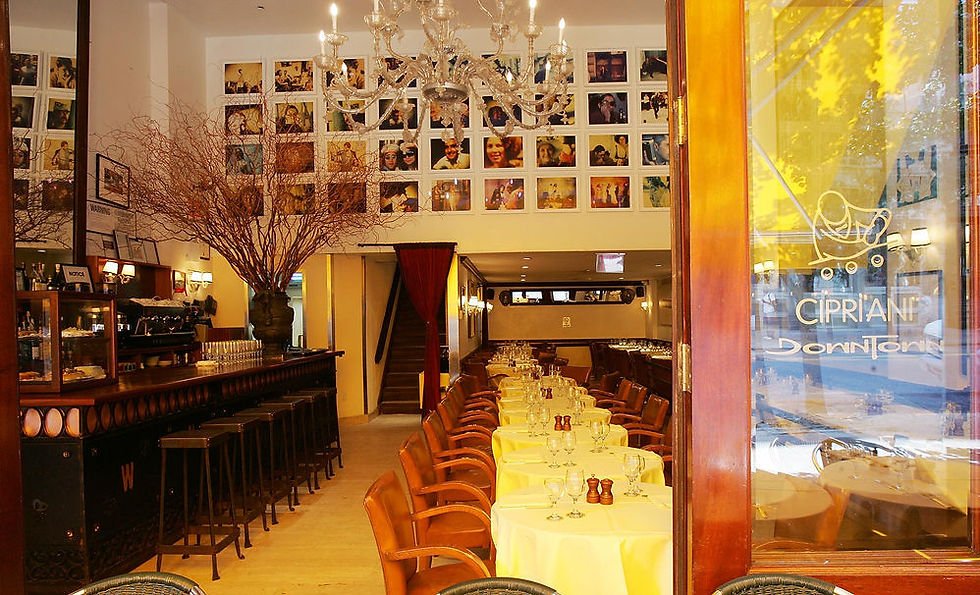
About Cipriani Downtown
Cipriani Downtown occupies a former Soho warehouse at 376 West Broadway, where the Venetian-American dining tradition that made the Cipriani name plays out across a room that has defined New York power lunching for decades. The menu reads as a primer in the Harry's Bar canon — Bellinis, carpaccio, risotto, pasta — executed at a scale and consistency that few Italian restaurants in the city attempt.
A Room That Does the Work Before the Food Arrives
West Broadway in Soho has been through several commercial lives, but the address at 376 has remained fixed in a particular kind of New York dining identity: large, loud in the right register, and unmistakably European in its bones. Cipriani Downtown occupies a converted warehouse space where the ceiling height and the acoustics do as much for the atmosphere as any kitchen output. Approaching the entrance, the scale of the room announces itself immediately. Inside, the proportions recall the grand Venetian dining rooms that the Cipriani family has built its reputation on across decades and multiple continents — a lineage that traces back to Harry's Bar in Venice, established in 1931 and a reference point for a specific school of Italian-American hospitality.
In New York, where Italian restaurants range from neighbourhood red-sauce institutions to modern tasting-counter formats, Cipriani Downtown occupies its own tier: the transatlantic grand cafe, where the room and the ritual matter as much as the plate. That category has become thinner in recent years as dining culture has pulled toward informality, which makes spaces like this one read more deliberately than they once did.
What the Menu Reveals About the Restaurant
The Cipriani menu structure is a study in restraint through familiarity. It does not reach for novelty or chase seasonal micro-trends. Instead, it maintains a fixed vocabulary drawn from the Harry's Bar canon: carpaccio in its original form (the dish was created at the Venice original), Bellinis as a house statement, risottos, fresh pasta, and a selection of secondi built around fish and veal. That consistency is an editorial choice, not a default. It signals to the room that the restaurant is not trying to impress with technique or surprise — it is trying to deliver a known quantity at a reliable level.
That approach carries risks in a city where critical attention gravitates toward the new. But it also builds a different kind of loyalty. The menu functions as a contract with a repeat-visitor base that arrives knowing what it wants and expects to find it. For a first-time visitor, the architecture of the menu offers a clear reading guide: the antipasti section, led by the carpaccio, is where the kitchen's precision is most legible. The pasta dishes occupy the centre of gravity , the kind of direct, butter-finished preparations that Venetian cooking has always prioritised over complexity. The secondi are conventional in structure, leaning toward classical Italian-French crossover territory.
Pricing at Cipriani Downtown sits in the upper-mid tier of Soho dining, which itself runs considerably above the New York average. The expectation is for a three-course experience with wine, and the room is sized and staffed for that format rather than quick-turn covers.
Soho's Dining Position and Where Cipriani Fits
Soho has never settled into a single dining identity. It contains some of the city's most expensive restaurant real estate alongside deeply local neighbourhood spots, and the gap between them has widened as rents have climbed. In that context, Cipriani Downtown represents the end of the market that operates on brand legacy and room experience rather than chef-driven narrative or experimental programming. Its peer set is not Dirty French on the Lower East Side or the small, operator-driven rooms that have defined downtown dining ambition over the past decade. It competes instead with a handful of other New York institutions where the draw is a combination of address, room scale, and a menu that delivers consistent classics.
For visitors building a broader picture of downtown Manhattan's drinking and dining options, the neighbourhood around West Broadway connects to a range of bar programming. Superbueno operates a few blocks east with a serious mezcal and agave-forward format, while Amor y Amargo on East 6th Street runs one of the city's most focused bitter-spirits programs. Both represent the opposite end of the scale from Cipriani in terms of format and price, but together they map the range of what downtown Manhattan's independent beverage scene looks like. Further afield in lower Manhattan, Angel's Share in the East Village has maintained its reputation for precise Japanese-influenced cocktail work for decades, and Attaboy NYC on Eldridge Street operates a no-menu, guest-led format that represents a distinct strand of New York bar culture.
Readers interested in how other cities handle premium cocktail programming will find useful comparisons in our coverage of Bar Leather Apron in Honolulu, Jewel of the South in New Orleans, Julep in Houston, Kumiko in Chicago, ABV in San Francisco, Allegory in Washington, D.C., and The Parlour in Frankfurt on the Main.
For a fuller read on how Cipriani Downtown sits within New York's broader restaurant scene, see our full New York City restaurants guide.
Know Before You Go
Know Before You Go
- Address: 376 West Broadway, New York, NY 10012
- Neighbourhood: Soho, Lower Manhattan
- Format: Grand-room Italian restaurant, full table-service
- Price tier: Upper-mid to premium; budget for a three-course experience with wine
- Reservations: Strongly advised, particularly for weekend lunch and evening service
- Walk-ins: Possible at the bar or for early seatings on quieter weeknights; not reliable for prime-time slots
- Dress code: Smart casual is the baseline; the room skews toward business and occasion dressing
- Leading timing: Weekend lunch captures the full room atmosphere; weekday dinner tends to be calmer
Frequently Asked Questions
- What is the leading thing to order at Cipriani Downtown?
- The carpaccio is the most direct point of reference for what the Cipriani name stands for , the dish originates from Harry's Bar in Venice and has been part of the menu since the restaurant's early iterations. Beyond that, the fresh pasta and risotto sections are where the kitchen's consistency is most apparent. The Bellini is the obvious drink order, and it functions as much as a ritual as a cocktail choice.
- What should I know about Cipriani Downtown before I go?
- This is not a chef-driven tasting-menu restaurant or a cocktail-bar-with-food format. It is a large, table-service Italian room with a fixed menu vocabulary and a client base that returns for reliability rather than novelty. Pricing sits at the upper end of Soho dining, and the expectation is a full-service, multi-course meal. Booking ahead is advisable, particularly on weekends.
- Do they take walk-ins at Cipriani Downtown?
- Walk-in availability depends on the day and time. The bar area typically offers more flexibility than the main dining room, and early seatings on quieter weeknights are a reasonable option. For weekend lunch or peak dinner hours, a reservation is the practical approach , the room is large but fills accordingly, and the clientele tends to book in advance.
- Is Cipriani Downtown better for first-timers or repeat visitors?
- First-timers get the most from the room itself and from working through the core menu , carpaccio, pasta, a Bellini , as an introduction to the Harry's Bar tradition in a New York setting. Repeat visitors tend to use it differently: as a known quantity for business meals or occasions where the room's consistency and address matter more than discovery. Both modes work, but they are genuinely different experiences of the same space.
- How does Cipriani Downtown compare to other Cipriani locations in New York City?
- The Cipriani group operates several New York addresses, each positioned slightly differently. The Downtown location is the most Soho-inflected in character: the room carries a fashion-and-media-adjacent clientele and a more casual weekday energy than the Midtown or event-space formats the brand also operates. For diners whose priority is the full grand-room experience with a strong neighbourhood identity, the West Broadway address is the most representative of what downtown Manhattan Cipriani dining looks like across its roughly three decades at that location.
More bars in New York City
- (SUB)MERCER(SUB)MERCER occupies a basement address on Mercer Street in SoHo, positioning it as a deliberate destination rather than a drop-in. The subterranean format tends to keep ambient noise lower than street-level alternatives, making it a reasonable call for groups of four or more. Book ahead for weekends and confirm group capacity directly with the venue.
- 1 OR 81 OR 8 on DeKalb Avenue is a low-key Fort Greene bar that works best for two people on a weeknight when the room is quiet enough for conversation. Walk-ins are easy, no advance planning required. If a specialist cocktail program is your priority, Attaboy or Amor y Amargo offer more defined experiences — but for a neighbourhood drink without the fuss, this delivers.
- 230 Fifth Rooftop Bar230 Fifth is the easiest rooftop bar in Midtown to walk into, and the Empire State Building views justify the trip. The crowd skews groups and tourists, and the drinks are solid rather than craft-focused. Go early on a weekday for the best version of the experience; after 9 PM on weekends it tips firmly into party-group territory.
- 4 Charles Prime Rib4 Charles Prime Rib is a compact, reservation-required West Village dining room built around a focused prime rib format. It works well for dates and pairs but is too small for groups of four or more. Booking is easy relative to Manhattan peers, and the narrow menu signals a kitchen that executes one thing consistently well.
- 44 & X Hell's KitchenA low-key Hell's Kitchen neighborhood bar-restaurant that earns its place for easy weeknight dates and pre-theatre dinners. Booking is simple, the room is intimate enough for conversation, and there's no dress pressure. Not a cocktail destination, but a reliable, pressure-free option in Midtown West when you want comfort over spectacle.
- 58-22 Myrtle Ave58-22 Myrtle Ave is a low-key Ridgewood neighborhood spot that rewards return visits more than first impressions. Easy to get into, with no reservation headaches, it suits regulars looking for an unpretentious room rather than a structured cocktail program. If a strong drinks list or kitchen ambition matters to you, look to Attaboy or Amor y Amargo instead.
Related editorial
- Best Fine Dining Restaurants in ParisFrom three-Michelin-star icons to the next generation of Parisian chefs pushing boundaries, these are the restaurants that define fine dining in the world's culinary capital.
- Best Luxury Hotels in RomeFrom rooftop terraces overlooking ancient ruins to Michelin-starred hotel dining, these are the luxury hotels that make Rome unforgettable.
- Best Cocktail Bars in KyotoFrom sleek lounges to hidden speakeasies, Kyoto's cocktail scene blends Japanese precision with global influence in ways you won't find anywhere else.
Save or rate Cipriani Downtown on Pearl
Keep this venue in your Pearl passport, rate it after you visit, and track it alongside every other place you collect.