
Bar in New York City, United States
BONDST
100ptsDowntown Japanese Precision
About BONDST
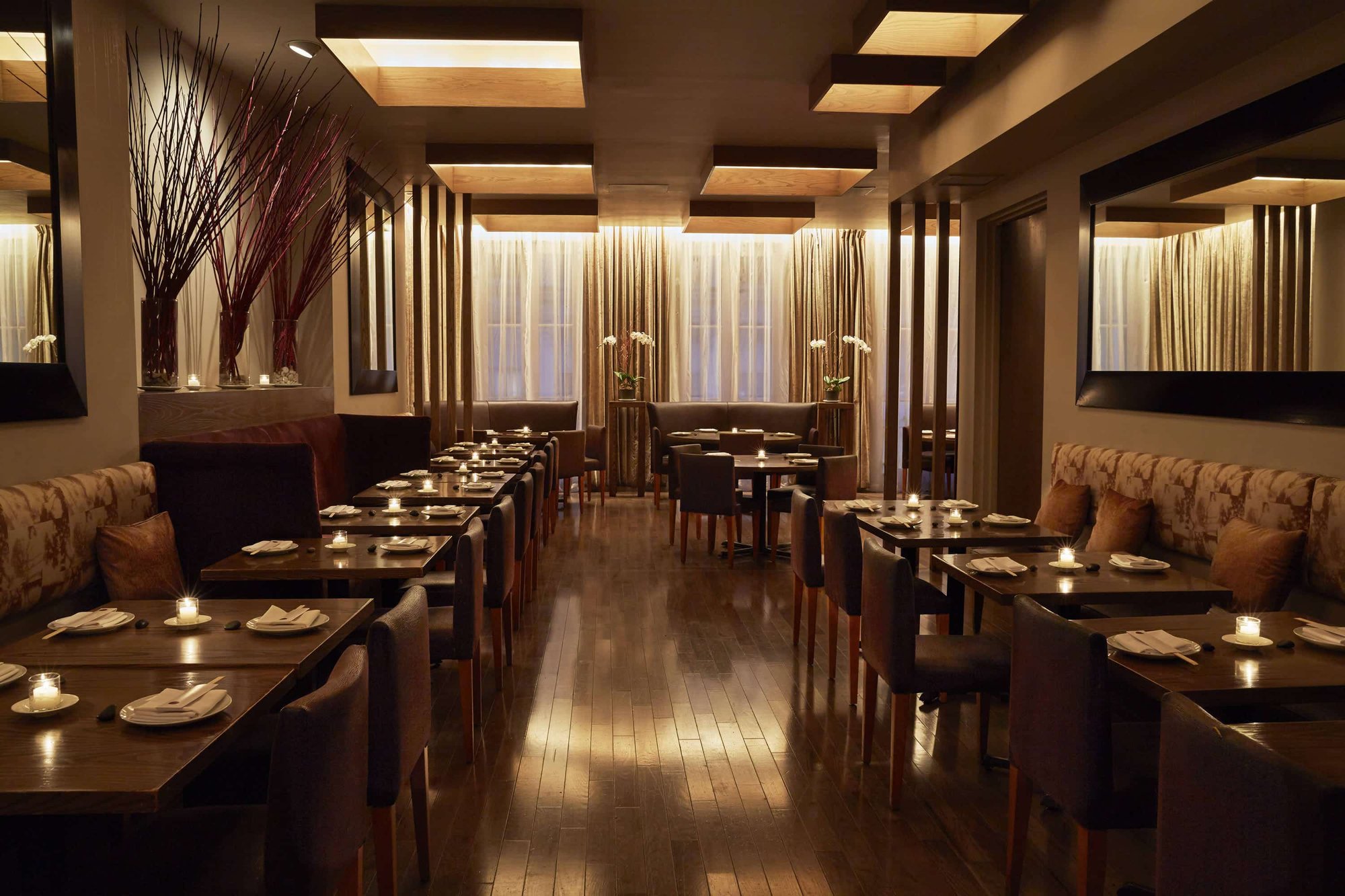
BONDST on Bond Street in NoHo occupies a tier of New York Japanese-influenced dining where the room does as much work as the kitchen. The address places it at the intersection of downtown cool and considered cooking, drawing a crowd that treats the space as a destination in itself. Booking ahead is advisable for evening sittings.
The Room as Opening Statement
Bond Street in NoHo has always functioned as one of New York's more deliberately curated blocks, the kind of address where the architecture makes a claim before you've crossed the threshold. BONDST, at number 6, fits that register. The building's proportions and the relative quiet of the street position the experience somewhere between the loud downtown dining rooms of the Meatpacking District and the more reserved, reservation-only counters further uptown. The address itself is a signal: NoHo in this stretch draws a crowd that has already decided where it stands on the spectrum between scene and substance, and expects both.
In New York's broader Japanese-influenced dining category, the split between high-volume sushi chains and serious omakase counters has sharpened considerably over the past decade. BONDST sits in a middle register that has become harder to occupy well: dinner-forward, design-conscious, and pitched at a table-service format rather than the counter intimacy that defines the city's Michelin-tracked omakase circuit. That positioning requires a room that can carry the weight, and on Bond Street, the physical environment has historically done that work.
Japanese Influence in Downtown New York
Downtown Manhattan's relationship with Japanese cuisine runs through several distinct phases. The East Village and NoHo corridors absorbed early waves of Japanese-American dining in the 1990s and early 2000s, when the format was still being negotiated between izakaya informality, sushi-bar ritual, and the city's appetite for sleek, drink-forward rooms. That negotiation produced a cohort of restaurants where the beverage program carried as much identity as the food, and where the aesthetic of the space was as considered as any plate that came out of the kitchen.
BONDST belongs to that lineage. The broader downtown Japanese dining scene in New York has since fragmented, with omakase-only formats commanding premium pricing on the upper end, fast-casual concepts absorbing the volume segment, and a smaller number of full-service, design-led rooms holding the middle. That middle is where the drinks list, the room's energy, and the consistency of the kitchen matter most, because the format doesn't have the drama of an omakase sequence or the accessibility of a counter where you eat and leave. It asks the guest to commit to an evening.
The Drinks Program and What It Signals
In restaurants of this type, the wine list and cocktail program are rarely afterthoughts. Downtown New York dining rooms that survive across multiple decades typically do so because they've built a beverage identity that can sustain a guest through a long evening, particularly in a format where the food is meant to be paced and shared rather than consumed in a single decisive sequence.
The broader trend in New York's Japanese-influenced dining has moved toward sake programs with genuine depth: regional classifications, seasonal releases, and the kind of producer specificity that mirrors the conversation happening in natural wine circles. That conversation has also reached the cocktail side, where bars in the Japanese-American tradition have shifted from novelty to craft. Nearby on the downtown spectrum, [Angel's Share](https://www.enprimeurclub.com/bars/angels-share) in the East Village set a baseline for Japanese cocktail culture in the city that still informs how serious programs in this genre are evaluated. Further afield, [Kumiko in Chicago](https://www.enprimeurclub.com/bars/kumiko) has built one of the most discussed Japanese-inspired beverage programs in the country, applying the kind of curatorial precision to spirits and mixology that serious sommeliers bring to a cellar.
For a room operating in BONDST's register, the expectation is a wine list that moves between Old World European and Japanese-adjacent pairing logic, supplemented by a cocktail program that knows the difference between a Japanese whisky highball done correctly and one done for effect. Across American cities, the bar programs most consistent with that standard, from [Attaboy NYC](https://www.enprimeurclub.com/bars/attaboy-nyc) in Manhattan to [ABV in San Francisco](https://www.enprimeurclub.com/bars/abv), share a commitment to technique over novelty. The same standard applies in rooms where the food program leans Japanese.
NoHo in Context
Bond Street occupies a position in the downtown dining conversation that Great Jones Street and Lafayette Street bracket on either side. The neighbourhood has fewer restaurant clusters than the West Village or the East Village proper, which gives individual addresses more definition. A room like BONDST doesn't compete with the density of Soho's restaurant corridor; it operates as a destination rather than a walk-in choice, which changes how the evening is framed from the guest's side.
That destination logic extends to the wider New York drink scene. Guests moving through the neighbourhood before or after a meal might track toward [Amor y Amargo](https://www.enprimeurclub.com/bars/amor-y-amargo) on East 6th Street for a serious amaro-focused program, or to [Superbueno](https://www.enprimeurclub.com/bars/superbueno-new-york-city) for the kind of Latin-inflected cocktail work that has made that address a reference point in its own right. The geography is walkable, and the editorial logic of the neighbourhood rewards treating the evening as a sequence rather than a single stop. For a wider map of where to eat and drink across the city, the [EP Club New York City guide](https://www.enprimeurclub.com/cities/new-york-city) covers the full range of neighbourhoods and formats.
Against the national reference set for Japanese-influenced and design-led bar programs, the peer conversation extends to rooms like [Bar Leather Apron in Honolulu](https://www.enprimeurclub.com/bars/bar-leather-apron-honolulu), [Jewel of the South in New Orleans](https://www.enprimeurclub.com/bars/jewel-of-the-south-new-orleans), [Julep in Houston](https://www.enprimeurclub.com/bars/julep-houston), [Allegory in Washington, D.C.](https://www.enprimeurclub.com/bars/allegory), and [The Parlour in Frankfurt on the Main](https://www.enprimeurclub.com/bars/the-parlour-frankfurt-on-the-main), all of which have built identities around curation depth and format discipline rather than volume or spectacle.
Planning Your Visit
Know Before You Go
- Address: 6 Bond St, New York, NY 10012
- Neighbourhood: NoHo, Downtown Manhattan
- Booking: Reservations are advisable for evening sittings; the address draws a consistent crowd that does not rely on walk-in availability
- Getting There: Closest subway access via Bleecker Street (6 train) or Broadway-Lafayette (B/D/F/M trains), both within a short walk
- Format: Full table service; suited to a paced, multi-course evening rather than a quick single-dish stop
- Current details: Confirm hours and booking via the venue directly, as operational specifics are subject to change
Frequently Asked Questions
What drink is BONDST famous for?
BONDST operates in the Japanese-influenced downtown New York dining tradition where the beverage program is part of the room's identity. That tradition, shaped in part by the standards set by venues like Angel's Share in the East Village, places Japanese whisky, sake, and precision cocktails at the centre of the drinks offer. Specific current menu details should be confirmed directly with the venue.
What is the main draw of BONDST?
The combination of address and format is the primary draw. Bond Street in NoHo carries a particular weight in downtown Manhattan's dining geography, and BONDST has occupied that address as a design-conscious, full-service room in a segment where few competitors hold the same ground. The evening format, where the room, the drinks program, and the Japanese-influenced food are all expected to work together, positions it as a destination rather than a walk-in.
Do I need a reservation for BONDST?
For evening sittings, a reservation is advisable. Rooms at this address and format tier in downtown Manhattan do not typically absorb large walk-in volumes at peak hours. Contact the venue directly to confirm current booking availability and policy, as specifics can change.
How does BONDST compare to other Japanese-influenced dining in downtown New York?
Downtown Manhattan's Japanese dining options now span a wide range, from fast-casual counter formats to premium omakase-only rooms tracked by Michelin. BONDST's full-service, design-led format places it in a smaller middle category that prioritises the room experience and a considered drinks program alongside the food. That category has fewer direct competitors in NoHo specifically, making the address itself a distinguishing factor within the downtown dining conversation.
More bars in New York City
- (SUB)MERCER(SUB)MERCER occupies a basement address on Mercer Street in SoHo, positioning it as a deliberate destination rather than a drop-in. The subterranean format tends to keep ambient noise lower than street-level alternatives, making it a reasonable call for groups of four or more. Book ahead for weekends and confirm group capacity directly with the venue.
- 1 OR 81 OR 8 on DeKalb Avenue is a low-key Fort Greene bar that works best for two people on a weeknight when the room is quiet enough for conversation. Walk-ins are easy, no advance planning required. If a specialist cocktail program is your priority, Attaboy or Amor y Amargo offer more defined experiences — but for a neighbourhood drink without the fuss, this delivers.
- 230 Fifth Rooftop Bar230 Fifth is the easiest rooftop bar in Midtown to walk into, and the Empire State Building views justify the trip. The crowd skews groups and tourists, and the drinks are solid rather than craft-focused. Go early on a weekday for the best version of the experience; after 9 PM on weekends it tips firmly into party-group territory.
- 4 Charles Prime Rib4 Charles Prime Rib is a compact, reservation-required West Village dining room built around a focused prime rib format. It works well for dates and pairs but is too small for groups of four or more. Booking is easy relative to Manhattan peers, and the narrow menu signals a kitchen that executes one thing consistently well.
- 44 & X Hell's KitchenA low-key Hell's Kitchen neighborhood bar-restaurant that earns its place for easy weeknight dates and pre-theatre dinners. Booking is simple, the room is intimate enough for conversation, and there's no dress pressure. Not a cocktail destination, but a reliable, pressure-free option in Midtown West when you want comfort over spectacle.
- 58-22 Myrtle Ave58-22 Myrtle Ave is a low-key Ridgewood neighborhood spot that rewards return visits more than first impressions. Easy to get into, with no reservation headaches, it suits regulars looking for an unpretentious room rather than a structured cocktail program. If a strong drinks list or kitchen ambition matters to you, look to Attaboy or Amor y Amargo instead.
Related editorial
- Best Fine Dining Restaurants in ParisFrom three-Michelin-star icons to the next generation of Parisian chefs pushing boundaries, these are the restaurants that define fine dining in the world's culinary capital.
- Best Luxury Hotels in RomeFrom rooftop terraces overlooking ancient ruins to Michelin-starred hotel dining, these are the luxury hotels that make Rome unforgettable.
- Best Cocktail Bars in KyotoFrom sleek lounges to hidden speakeasies, Kyoto's cocktail scene blends Japanese precision with global influence in ways you won't find anywhere else.
Save or rate BONDST on Pearl
Keep this venue in your Pearl passport, rate it after you visit, and track it alongside every other place you collect.