
Bar in New York City, United States
Becco
100ptsItalian Cellar Depth
About Becco
A Theatre District institution on Restaurant Row, Becco has served Italian-American classics on West 46th Street for decades. The wine program is the draw for serious drinkers: a carefully assembled list that punches above the restaurant's informal register. Pre-theatre crowds fill the room early, but the kitchen runs late enough to reward those who linger.
Restaurant Row and the Rhythm of West 46th Street
West 46th Street between Eighth and Ninth Avenues has operated as a dining corridor since the 1970s, when the block's concentration of Italian, French, and Greek kitchens earned it the name Restaurant Row. The format has always been the same: pre-theatre efficiency, generous portions, and wine lists priced to move before curtain. Becco sits squarely inside that tradition at number 355, a room that has absorbed several decades of Broadway crowds without fundamentally changing its proposition. The address is a block from the heart of the Theatre District, and the kitchen's rhythm reflects that geography — early seatings fill fast, the room is loud in the way that confident, well-fed rooms tend to be, and the service keeps time with the show schedules across the street.
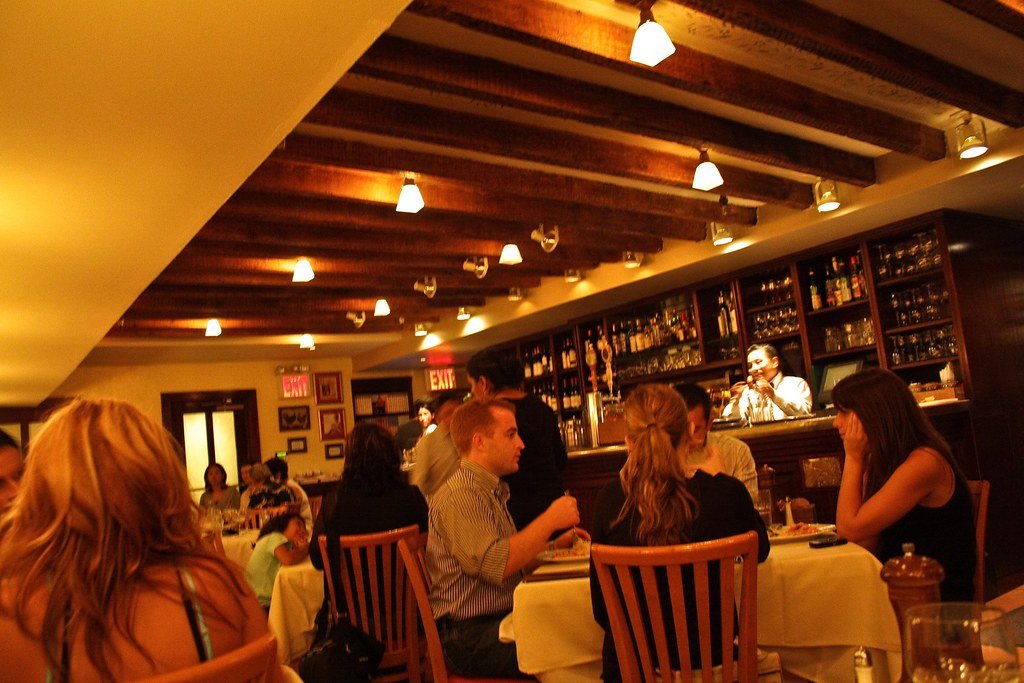
The physical experience of arriving on the block is particular to this stretch of Midtown: the sidewalk feels narrower than the foot traffic warrants, restaurant signs compete for eyeline, and the general noise level rises as the dinner hour approaches. Becco's interior follows the warm, wood-heavy template common to Italian-American establishments of its generation — practical without being stark, comfortable without demanding attention.
The Wine Program: Where Becco Earns Its Reputation
In a neighbourhood built around getting diners in and out before an eight o'clock curtain, wine lists tend to be functional at leading. Becco's cellar takes a different position. The restaurant has maintained an Italian-focused list that goes considerably deeper than its Theatre District peers, with regional coverage that spans Piedmont, Tuscany, Veneto, and the south in a way that reflects genuine curation rather than distributor defaults.
Italian wine lists of this depth are uncommon at the price point associated with Restaurant Row dining. The selection rewards readers who know the difference between entry-level Barolo and producer-specific bottlings from Serralunga or La Morra, and the structure of the list makes those distinctions navigable. For drinkers who treat the wine as a reason to visit rather than an accompaniment to the theatre schedule, Becco occupies a different competitive tier than its immediate neighbours , closer, in that respect, to the Italian lists at white-tablecloth rooms further downtown than to the perfunctory selections typical of this block.
The broader context here is worth noting. New York's Italian wine scene has become more sophisticated over the past fifteen years, with sommeliers and importers pushing lesser-known appellations , Etna, Aglianico del Vulture, Cerasuolo di Vittoria , into rooms that once served nothing south of Chianti. Becco's list reflects some of that evolution. Whether you are choosing between a Vermentino and a Fiano or looking for a Langhe Nebbiolo that bridges the gap before committing to a full Barolo, the depth is there to support the conversation.
For readers whose primary interest is cocktails and bar culture, New York offers a parallel world of serious programs: Amor y Amargo on East 6th Street is the city's most focused amaro and bitter-spirits destination, while Angel's Share in the East Village pioneered the Japanese-influenced precision bar format that defined a generation of NYC drinking. Attaboy NYC operates on the guest-led, no-menu model, and Superbueno represents the current wave of Latin-inflected bar programs. These are different rooms serving different purposes, but they triangulate where serious drinking in New York happens , and Becco's wine program positions it as a legitimate participant in that conversation, just from the Italian table wine side rather than the cocktail side.
Comparable seriousness in wine-focused bar and restaurant programs exists in other American cities. Kumiko in Chicago and ABV in San Francisco both operate with list depth that exceeds their physical register, a model Becco shares. Further afield, Jewel of the South in New Orleans, Julep in Houston, and Bar Leather Apron in Honolulu demonstrate that thoughtful beverage curation is not a coastal-capitals phenomenon. Allegory in Washington, D.C. and The Parlour in Frankfurt extend the model internationally.
The Kitchen: Italian-American in the Theatre District Register
The food at Becco operates in the Italian-American tradition that defined New York dining for much of the twentieth century: pasta as the main event, sauces built for comfort rather than technical display, and portion sizes calibrated for an audience that expects to leave full. This is not a room chasing the contemporary Italian tasting-menu format that has become the default for higher-end Italian cooking in Manhattan. It is a room that has stayed in its lane, which in this neighbourhood and at this price register is a defensible choice.
The pasta program carries the most weight. Housemade and dried formats appear alongside each other, and the sauces lean toward the classics of central and northern Italy rather than the more adventurous regional cooking that defines newer Italian restaurants downtown. For readers who have eaten at the current generation of Italian spots in the West Village or Williamsburg, Becco will feel deliberately traditional. That is the point.
Timing, Access, and What to Expect
Theatre District operates on a compressed schedule. Dinner service before an eight o'clock curtain means that tables turn between five-thirty and seven, and the room fills accordingly. Arriving without a reservation during that window on a weekend is optimistic. The later window, post-curtain, tends to be quieter and allows more time with the wine list , a trade-off worth considering for anyone whose primary interest is the Italian cellar rather than the show schedule.
West 46th Street is accessible from multiple subway lines, with the closest major stops placing the block within a short walk of Times Square and the Eighth Avenue corridor. For visitors staying in Midtown hotels, the address is walkable from most of the Theatre District's accommodation cluster.
For broader context on where Becco sits within New York's full dining picture, see our full New York City restaurants guide.
Reservations: Recommended for pre-theatre seatings, particularly on weekends. Dress: Smart casual; the room is informal but not casual-casual. Budget: Mid-range for the Theatre District; the wine list offers options across price points, with the Italian regional selections representing the strongest value.
Frequently Asked Questions
What's the vibe at Becco?
Becco runs warm and loud, in the way that a well-populated Italian-American room tends to. Pre-theatre hours bring a purposeful energy , tables filling quickly, service moving at pace. The room is not designed for extended, contemplative meals during peak service, though the later post-curtain sitting is considerably more relaxed. Given the Theatre District address and mid-range price point, expect a mixed crowd of tourists, regulars, and Broadway-goers rather than a destination-dining audience.
What cocktail do people recommend at Becco?
Becco's identity is built around the wine list rather than a cocktail program, and the Italian cellar is the more considered choice here. If you arrive wanting a drink before settling into wine, the aperitivo register , Campari-based and Aperol-based options , fits the Italian-American register of the room. For serious cocktail programs in New York, Attaboy NYC and Angel's Share are better destinations.
What should I know about Becco before I go?
The wine list is the primary reason to choose Becco over its Restaurant Row neighbours. The Italian regional selection goes considerably deeper than what you'd expect from the address and price tier. Pre-theatre seatings are the busiest window; booking in advance is advisable for those slots. The kitchen runs in the Italian-American tradition , generous, comfort-forward, not reaching for the contemporary formats that define higher-end Italian cooking in Manhattan.
Can I walk in to Becco?
Walk-ins are more viable at off-peak times , late afternoon, or post-curtain after nine. The pre-theatre window, particularly on weekends, fills on reservations. Without a confirmed booking between five-thirty and seven on a Friday or Saturday, expect a wait or a turn-away. The restaurant's Theatre District location means demand is consistent and tied to show schedules.
Is Becco worth visiting?
For wine-focused diners who want an Italian list that goes beyond the block's standard offering, yes. The combination of Italian-American kitchen comfort and a cellar with genuine regional depth is not common at this price tier in the Theatre District. For readers whose primary interest is contemporary Italian cooking or cocktail programs, there are better-matched rooms elsewhere in the city.
Does Becco offer good value for Italian wine by the bottle?
Restaurant Row dining generally skews toward accessible, mass-market wine selections marked up for convenience. Becco's Italian list operates differently, with producer-specific bottlings from Piedmont and central Italy that give it credibility among readers who follow regional Italian wine. The value calculus depends on what you order: the deeper end of the list , longer-aged Barolo, single-vineyard selections , prices against comparable listings at more expensive Italian rooms in Midtown, while the mid-tier selections from the south and northeast offer stronger relative value. For drinkers who treat the wine selection as a deciding factor when choosing a New York Italian restaurant, Becco's cellar is a meaningful differentiator on this block.
More bars in New York City
- (SUB)MERCER(SUB)MERCER occupies a basement address on Mercer Street in SoHo, positioning it as a deliberate destination rather than a drop-in. The subterranean format tends to keep ambient noise lower than street-level alternatives, making it a reasonable call for groups of four or more. Book ahead for weekends and confirm group capacity directly with the venue.
- 1 OR 81 OR 8 on DeKalb Avenue is a low-key Fort Greene bar that works best for two people on a weeknight when the room is quiet enough for conversation. Walk-ins are easy, no advance planning required. If a specialist cocktail program is your priority, Attaboy or Amor y Amargo offer more defined experiences — but for a neighbourhood drink without the fuss, this delivers.
- 230 Fifth Rooftop Bar230 Fifth is the easiest rooftop bar in Midtown to walk into, and the Empire State Building views justify the trip. The crowd skews groups and tourists, and the drinks are solid rather than craft-focused. Go early on a weekday for the best version of the experience; after 9 PM on weekends it tips firmly into party-group territory.
- 4 Charles Prime Rib4 Charles Prime Rib is a compact, reservation-required West Village dining room built around a focused prime rib format. It works well for dates and pairs but is too small for groups of four or more. Booking is easy relative to Manhattan peers, and the narrow menu signals a kitchen that executes one thing consistently well.
- 44 & X Hell's KitchenA low-key Hell's Kitchen neighborhood bar-restaurant that earns its place for easy weeknight dates and pre-theatre dinners. Booking is simple, the room is intimate enough for conversation, and there's no dress pressure. Not a cocktail destination, but a reliable, pressure-free option in Midtown West when you want comfort over spectacle.
- 58-22 Myrtle Ave58-22 Myrtle Ave is a low-key Ridgewood neighborhood spot that rewards return visits more than first impressions. Easy to get into, with no reservation headaches, it suits regulars looking for an unpretentious room rather than a structured cocktail program. If a strong drinks list or kitchen ambition matters to you, look to Attaboy or Amor y Amargo instead.
Related editorial
- Best Fine Dining Restaurants in ParisFrom three-Michelin-star icons to the next generation of Parisian chefs pushing boundaries, these are the restaurants that define fine dining in the world's culinary capital.
- Best Luxury Hotels in RomeFrom rooftop terraces overlooking ancient ruins to Michelin-starred hotel dining, these are the luxury hotels that make Rome unforgettable.
- Best Cocktail Bars in KyotoFrom sleek lounges to hidden speakeasies, Kyoto's cocktail scene blends Japanese precision with global influence in ways you won't find anywhere else.
Save or rate Becco on Pearl
Keep this venue in your Pearl passport, rate it after you visit, and track it alongside every other place you collect.