
Bar in Hyeres, France
Le Mas Du Langoustier
100ptsIsland-Edge Provençal Table
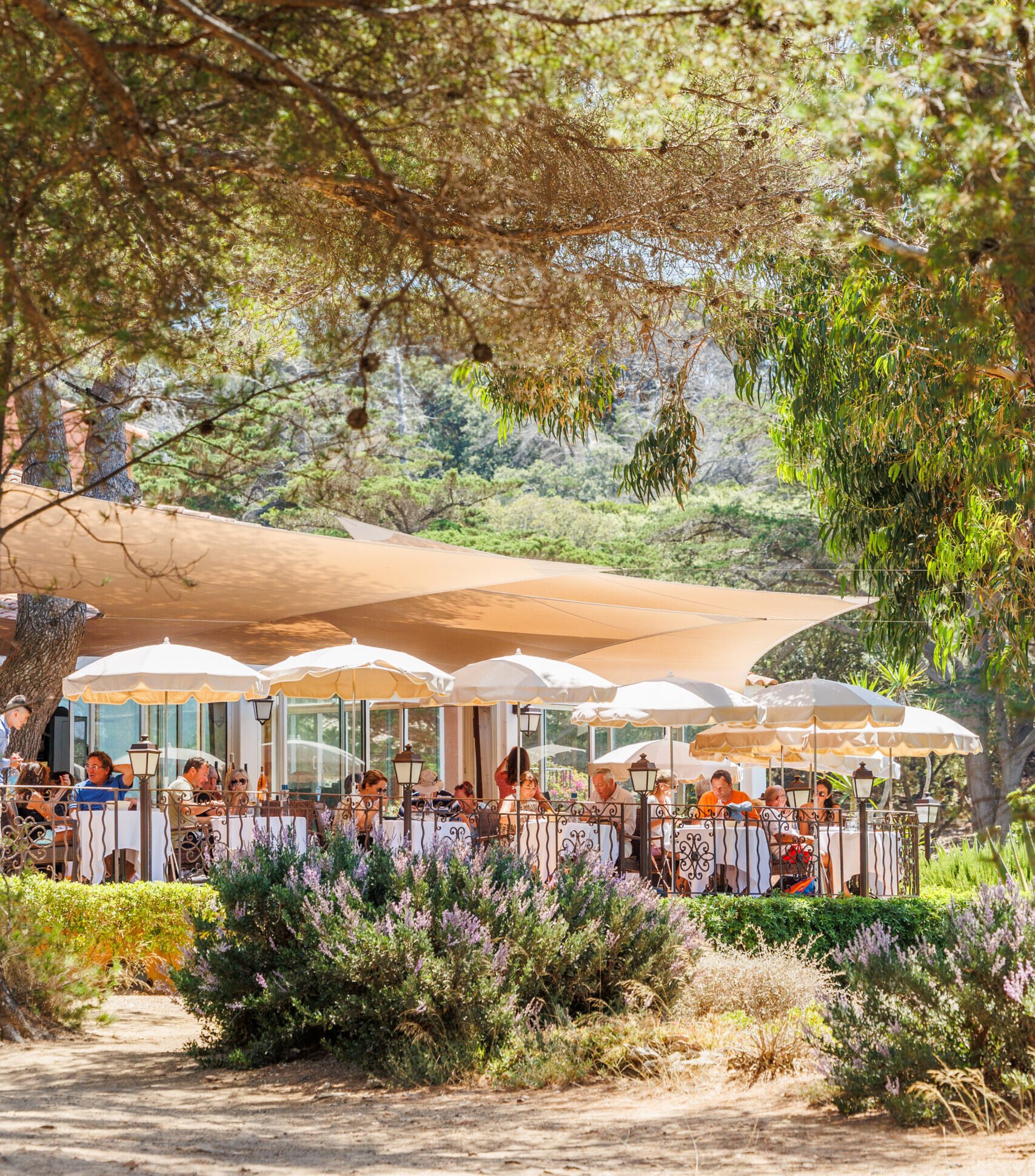
About Le Mas Du Langoustier
Le Mas Du Langoustier sits on the western tip of Porquerolles, the most protected of the Îles d'Or off the Var coast, accessible only by ferry from Hyères. The property occupies a position where the Mediterranean sets the terms: arrival by boat, pine-framed paths to the terrace, and a kitchen that draws from the island's immediate waters. For the French Riviera's quieter register, it is the reference point.
The Island That Resets Your Sense of Distance
Getting to Porquerolles reorients your expectations before you arrive at any address on it. The ferry from the Tour Fondue peninsula near Hyères takes roughly twenty minutes, and the crossing itself functions as a kind of decompression chamber: no cars operate freely on the island, the pine forests come down almost to the water's edge, and the western tip, where Le Mas Du Langoustier sits, is a further bicycle or shuttle ride from the small village port. By the time you arrive at the property, the logic of the mainland — the autoroute, the airport traffic feeding Nice and Toulon — has receded entirely. That physical remove is not incidental to what the Langoustier offers. It is the offer.
Porquerolles belongs to the Parc National de Port-Cros, one of the most tightly protected coastal zones in France, and the island's character reflects that status. Development is tightly constrained, the interior is largely forested, and the beaches on the southern coast remain among the least commercially developed on the French Riviera. For those accustomed to the Côte d'Azur's more congested resort circuit, the contrast is immediate. Le Mas Du Langoustier is the property most associated with the island's premium register, and its address at the far western end of Porquerolles places it at the most isolated point within an already isolated destination. For more context on dining and drinking along this stretch of the Var coast, see our full Hyères restaurants guide.
A Terrace at the Edge of a National Park
The property's setting is defined by ochre-painted stone, umbrella pines, and a terrace orientation that faces the open sea toward the west. Evenings here have a specific quality that the geography enforces: the sun sets over open water rather than over a town or a headland, and the absence of artificial light beyond the property itself makes the transition from afternoon to dusk more pronounced than almost anywhere else on this coastline. The approach along the path from the island's interior gives a gradual reveal that a drive-up entrance never could.
This kind of arrival architecture, where the journey to the venue is itself part of the sensory experience, places Le Mas Du Langoustier in a category of French provincial properties that resist the shorthand of the urban dining review. The reference points are not Paris counters or Lyon brasseries but a smaller set of island and coastal estates where access difficulty functions as a filter. Comparable properties on Corsica or Belle-Île operate on similar logic: the effort of getting there determines who comes and shapes what they expect when they arrive.
Provençal Waters and What They Yield
The kitchen at a property this closely tied to its marine surroundings works within a framework that the Var coastline has defined for generations. Langoustine, sea bass, rascasse, and the broader vocabulary of Méditerranée fishing come through channels far shorter than those feeding most mainland restaurants in the region. The island's own gardens have historically contributed to the table, and the provençal tradition of allowing ingredient quality to carry the weight of a dish rather than technique to mask its absence is the operative philosophy across this part of France.
That tradition connects to a broader conversation about how the French south has repositioned itself over the past two decades. Where the Côte d'Azur's prestige addresses once competed on elaboration and formality, a counter-current of restraint-led cooking has gained ground, particularly in properties where the setting itself provides the frame. Le Petit Nice Passedat in Marseille, a three-Michelin-star address with its own dramatic coastal siting, represents the more technical end of that spectrum. For a sense of how different venues across the region approach the relationship between southern French ingredients and format, Le Petit Nice Passedat in Marseille offers a useful point of comparison.
The Drink Programme at the Edge of the Mediterranean
Island properties of this type in the south of France occupy a specific position in the French aperitif and wine tradition. The Provence rosé category, now the most exported French wine style by volume, is produced within a short distance of Porquerolles, and the Bandol appellation sits just up the coast. A property at this address sits within the source geography of some of France's most recognisable summer wines, which shapes what a thoughtful drinks list here looks like: regional primacy, with Côtes de Provence and Bandol rosé and rouge as the gravitational centre, supported by whatever the Var's smaller producers are doing in a given vintage.
The aperitif tradition in Provence runs through pastis, vermouth-based drinks, and the lighter cocktail formats that have spread from urban bars in Marseille, Montpellier, and further west. For context on how France's cocktail scene has developed across the south and beyond, Papa Doble in Montpellier and Bar Casa Bordeaux in Bordeaux represent contrasting approaches to the regional bar format. At the national level, Bar Nouveau in Paris charts how the capital has pulled ahead on technical cocktail programming, a gap that island properties in Provence have never sought to close. The Langoustier's drinks identity is tied to place rather than technique: the point is the Bandol glass on the terrace at six in the evening, not the clarified-spirit programme.
Further afield in France, the Loire's contribution to the aperitif canon is worth noting for context: BOUVET LADUBAY in Saumur and House of Cointreau in Angers track the northern edge of French drinks culture, while Au Brasseur in Strasbourg, Coté Vin in Toulouse, La Maison M. in Lyon, and Le Café de la Fontaine in La Turbie sketch the range of what a French regional drinks programme can look like. For a transatlantic reference point in the hotel-bar register, Bar Leather Apron in Honolulu demonstrates how island settings in entirely different geographies apply the same premise: remoteness as a feature, not a constraint.
Planning the Visit
The ferry to Porquerolles departs from the Tour Fondue embarkation point near Giens, which is itself a drive or taxi from Hyères-Toulon-Côte d'Azur airport. The crossing takes approximately twenty minutes and operates seasonally, with reduced frequency outside the summer months. The island sees its heaviest visitor numbers between July and August, when day-trippers from the mainland share the paths with hotel guests. Staying on the island rather than making a day trip changes the experience considerably: the late afternoons and mornings, once the ferry traffic has thinned, belong to a much quieter register. Advance planning is advisable for summer stays, and checking directly with the property for seasonal opening dates is necessary given the island's limited-season operating pattern.
Frequently Asked Questions
- What's the general vibe of Le Mas Du Langoustier?
- The atmosphere is shaped entirely by the island setting: no cars, pine forests running to the water's edge, and a terrace facing open sea at the western tip of Porquerolles. It sits within France's most protected coastal park, which keeps the surrounding environment free of the commercial density found on the mainland Riviera. The tone is quiet, unhurried, and oriented around the natural environment rather than social performance. For a broader sense of what the Hyères area offers, see our full Hyères restaurants guide.
- What should I try at Le Mas Du Langoustier?
- The kitchen draws from the immediate waters around Porquerolles, and the Var coast's seafood tradition, centred on fish from the Mediterranean rather than Atlantic species, is the natural point of orientation. Langoustine is in the name for good reason. The regional wine list, drawing from Bandol and Côtes de Provence, is the drink logic of the place: the same provençal south that grows the food grows the wine.
- What should I know about Le Mas Du Langoustier before I go?
- Access is by ferry from the Tour Fondue peninsula near Hyères, with no private cars on the island beyond a limited number of service vehicles. The property operates seasonally, so confirming opening dates before travel is essential. Summer months see the highest demand; arriving outside July and August means a quieter island but requires checking ferry schedules, which reduce in frequency outside peak season.
- Is Le Mas Du Langoustier the kind of place to stay rather than just visit for a meal?
- The property's position at the island's western extreme, a meaningful distance from the village port even by island standards, makes it function most fully as a stay rather than a day excursion. The logic of the place, the terrace sunsets, the absence of ambient noise beyond wind and water, rewards guests who are on-site for the full arc of the day. Day-trippers who time the ferry carefully can reach it for lunch or dinner, but the experience the property is built around is the overnight one.
Related editorial
- Best Fine Dining Restaurants in ParisFrom three-Michelin-star icons to the next generation of Parisian chefs pushing boundaries, these are the restaurants that define fine dining in the world's culinary capital.
- Best Luxury Hotels in RomeFrom rooftop terraces overlooking ancient ruins to Michelin-starred hotel dining, these are the luxury hotels that make Rome unforgettable.
- Best Cocktail Bars in KyotoFrom sleek lounges to hidden speakeasies, Kyoto's cocktail scene blends Japanese precision with global influence in ways you won't find anywhere else.
Save or rate Le Mas Du Langoustier on Pearl
Keep this venue in your Pearl passport, rate it after you visit, and track it alongside every other place you collect.