
Bar in Berlin, Germany
Curry 36
100ptsKreuzberg Queue Culture
About Curry 36
Curry 36 on Mehringdamm has been feeding Berlin since the currywurst format was already a West Berlin institution, and the Kreuzberg stall remains one of the most-referenced stops on the city's street food circuit. The queue at the counter is part of the ritual. Come for the sausage, stay to understand why a sliced bratwurst in spiced ketchup became the city's defining fast food.
A Berlin Institution on Mehringdamm
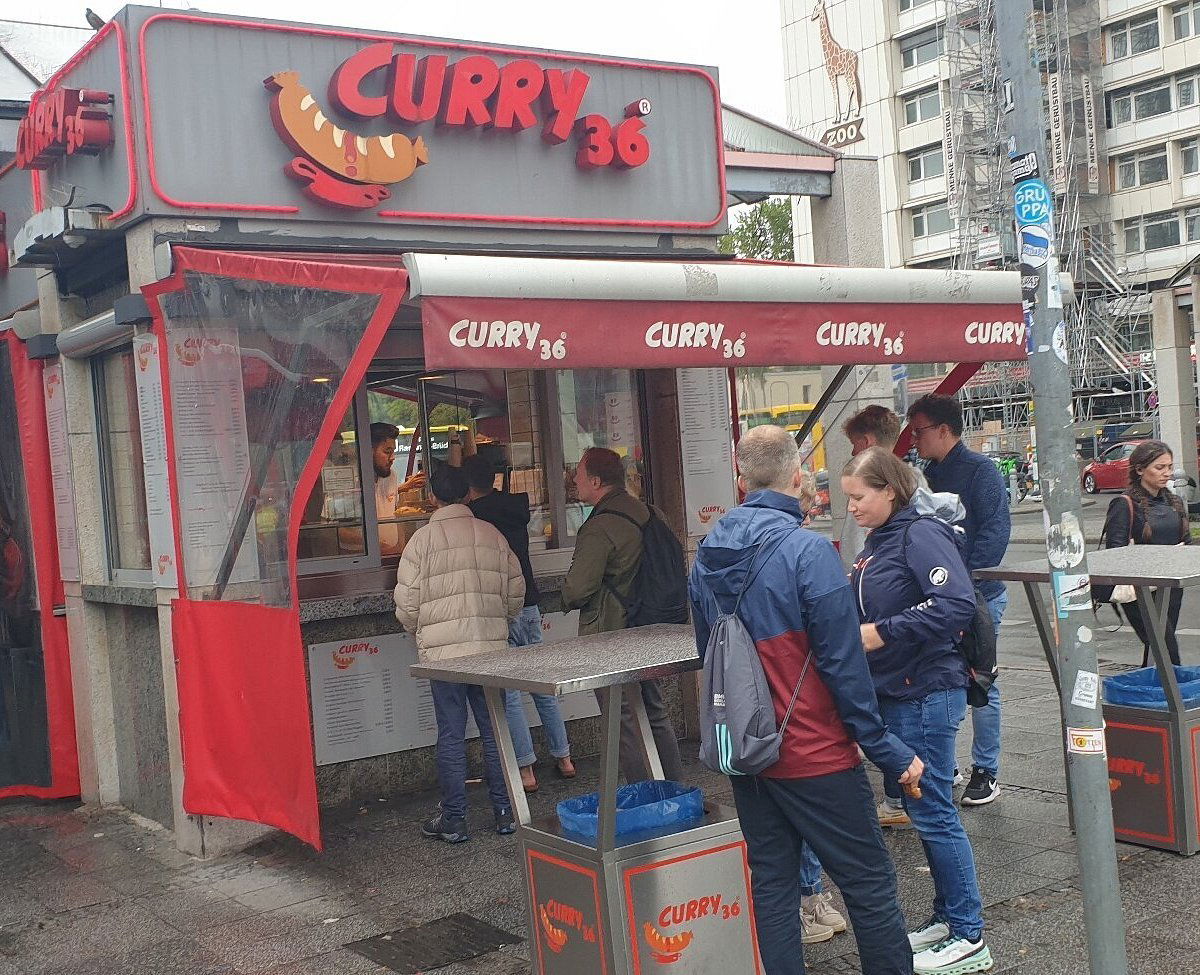
There is a particular quality to the light on Mehringdamm in the early evening, when the U-Bahn disgorges office workers and students alike onto the same pavement strip and the queue at Curry 36 stretches past the neighbouring shopfronts without anyone seeming to mind. The stall is not hidden or atmospheric in any designed sense. It is a counter, a grill, a plastic tray, and a paper cup of sauce. What surrounds it is the social architecture of the Berlin street food stop: strangers eating standing up, nobody looking at a menu because there is not much to decide, and the smell of frying sausage carrying across the U-Bahn station entrance. This is Kreuzberg at its least curated, which is precisely why the address at Mehringdamm 36, 10961 Berlin has accumulated the kind of reputation that survives decades of neighbourhood change.
Currywurst as a Cultural Argument
To understand why Curry 36 draws the queue it does, it helps to understand what currywurst actually represents in the German food tradition. The dish, a grilled or steamed pork sausage sliced and dressed with a tomato-based ketchup seasoned with curry powder, emerged in West Berlin in the postwar period and spread through the city's working-class stall culture before becoming so embedded that it now has its own dedicated museum a short walk from here. It is street food in the strictest sense: no booking, no table, no ceremony. The meal is consumed standing at a high counter or on the pavement, often within minutes of ordering. That directness is not a limitation of the format; it is the format.
Germany's regional street food traditions vary considerably. Frankfurt has its Grüne Soße culture and its Ebbelwoi taverns (see The Parlour in Frankfurt for the drinking side of that city's character). Munich anchors itself to the beer hall and the Weisswurst morning ritual at places like Goldene Bar. Hamburg's food identity runs through the fish market and Alsterpavillon culture, with bars like Le Lion Bar de Paris marking its more refined register. Berlin's contribution to this geography of German eating is the currywurst stall, and Curry 36 is among the most frequently cited examples of that contribution in Kreuzberg specifically.
What the Kreuzberg Location Means
Kreuzberg is not a neighbourhood that needs much introduction for anyone who has spent time in Berlin, but its relationship to food and street culture is worth contextualising. The district sits in what was West Berlin's working-class south, bordered by Neukölln and Mitte, and its food scene runs the spectrum from Turkish döner to natural wine bars to exactly this kind of cash-in-hand sausage counter. The address on Mehringdamm places Curry 36 at a transit node: the U6 and U7 lines intersect at Mehringdamm station, making the stall accessible from most of the city without effort. That logistical convenience reinforces the walk-up, no-planning character of the meal.
For visitors building a broader Berlin evening that moves from street food into cocktail bars, Kreuzberg and the adjacent neighbourhoods offer a coherent circuit. Buck and Breck operates as one of the city's more technically exacting cocktail rooms. Lebensstern and Stagger Lee offer different registers of bar culture across the city, while Velvet sits in its own distinct niche. Street food and cocktail culture have always coexisted in Berlin without the hierarchy that other cities impose between cheap-and-casual and expensive-and-considered. A currywurst at Curry 36 followed by a well-made cocktail elsewhere is not an incongruous itinerary here; it is a fairly typical Berlin evening.
The Queue as Part of the Experience
The queue at Curry 36 operates on a first-come basis with no reservations, no phone number to call, and no website to consult. You arrive, you wait your turn, you order at the counter, and you collect your tray. Peak hours, broadly lunch and the post-work evening window, produce the longest waits, but the queue moves steadily because the transaction is simple. This is the opposite model to the timed-entry tasting menu or the three-month booking window. It is street food democratised to its logical endpoint, where the only variable is how long you are prepared to stand on a pavement in Kreuzberg.
That accessibility has its own kind of authority. Berlin's food scene contains venues at every price point, from the Michelin-documented tasting counters in Mitte to the döner shops operating since the 1970s. Curry 36 occupies the lower end of that cost range by design, not by default. The stall format was never intended to evolve into something else, and that stability of purpose is what keeps regulars returning and gives the address its reputation across German cities. For comparison, the tavern culture of Düsseldorf at places like Uerige or the brewery-anchored drinking rooms of Kiel demonstrate a similar principle: clarity of format, consistency of product, and a local customer base that does not require constant reinvention to stay engaged.
Ordering and What to Expect
The menu is narrow, which is the point. Currywurst with or without casing, fries, rolls, and sauce variations cover most of what is available. Decisions are made quickly because options are limited. The sausage arrives sliced, the sauce poured over, curry powder dusted on leading. The tray is small, the portion is sufficient, and the price lands at the lower end of what you would spend on any food in the city. There are no tasting notes to offer here in good conscience without a verified source for sensory detail, but the format itself is the message: this is a meal measured in minutes from order to finish, calibrated for Mehringdamm foot traffic and not for lingering.
For visitors planning a day in Berlin that covers multiple neighbourhoods, the location makes Curry 36 a natural starting or ending point for a Kreuzberg stretch. The Mehringdamm U-Bahn stop connects directly to the city centre and to the bar and restaurant concentration further north. Full context on where the address fits within the broader Berlin food and drink picture is available in our full Berlin restaurants guide. Those extending beyond Germany will find that the directness-of-format principle runs through the leading street food stops internationally, from Berlin to Honolulu's bar scene where a different kind of casual authority defines neighbourhood favourites. In Cologne, the same community-anchor function appears in venues like Bar Trattoria Celentano, where the neighbourhood draws people back for consistency rather than novelty.
Planning Your Visit
Curry 36 sits at Mehringdamm 36 in Kreuzberg, directly accessible from Mehringdamm U-Bahn station on the U6 and U7 lines. No booking is required or possible. Payment at the counter covers the full transaction. Arriving outside peak lunch and post-work hours shortens the wait. The stall operates as a cash-in-hand street counter, so carry small denominations. There is no indoor seating in the traditional sense; eating happens at standing counters or on the pavement. For a longer Kreuzberg evening, the bar options listed above span the spectrum from technically precise cocktail rooms to neighbourhood locals, all within reasonable distance of this starting point.
Frequently Asked Questions
- What should I expect atmosphere-wise at Curry 36?
- Curry 36 is an outdoor street counter, not a restaurant. The setting is a working Kreuzberg pavement alongside Mehringdamm U-Bahn station, with standing room at counters and no table service. Queues are common during lunch and early evening, and the atmosphere is defined by that transit-node energy: fast, direct, and cross-demographic. It draws tourists and longtime Kreuzberg residents in equal measure.
- What is the leading thing to order at Curry 36?
- The currywurst is the reason people queue here. The format, sliced sausage with spiced ketchup and curry powder, is the dish the stall has built its reputation on over decades. Fries alongside are the standard accompaniment. The menu is narrow enough that ordering decisions take seconds.
- What is the main draw of Curry 36?
- The draw is the combination of a well-established product, a direct no-reservation format, and a location that has made it a reference point for Berlin street food for years. In a city with venues at every price tier, Curry 36 holds its position by doing one thing consistently at an accessible price, which is a harder achievement over time than it appears.
- How hard is it to get in to Curry 36?
- There are no reservations and no entry requirement beyond joining the queue. If you arrive during peak hours, particularly the lunchtime rush and the 6 to 8pm post-work window, expect to wait. Outside those windows, the counter is typically quicker to access. No phone number or website is needed to plan a visit; you simply arrive.
- Is Curry 36 actually as good as people say?
- The reputation is earned more by consistency and context than by any claim to technical complexity. The product is a street food staple, priced accordingly, and the stall has maintained its position in Berlin's food conversation for long enough that the queue itself is evidence of sustained demand. It is a reference point for the currywurst format in Kreuzberg, not a fine dining proposition, and should be approached on those terms.
- Does Curry 36 serve anything other than currywurst?
- The menu stays close to the currywurst stall format: sausage with or without casing, fries, and rolls form the core of what is available. Sauce variations provide the main point of customisation. The offer is deliberately narrow, which is consistent with the street food counter tradition and means most visitors make their decision before they reach the front of the queue. This simplicity is a structural feature of the format across Berlin's currywurst culture, not a limitation specific to this address.
Related editorial
- Best Fine Dining Restaurants in ParisFrom three-Michelin-star icons to the next generation of Parisian chefs pushing boundaries, these are the restaurants that define fine dining in the world's culinary capital.
- Best Luxury Hotels in RomeFrom rooftop terraces overlooking ancient ruins to Michelin-starred hotel dining, these are the luxury hotels that make Rome unforgettable.
- Best Cocktail Bars in KyotoFrom sleek lounges to hidden speakeasies, Kyoto's cocktail scene blends Japanese precision with global influence in ways you won't find anywhere else.
Save or rate Curry 36 on Pearl
Keep this venue in your Pearl passport, rate it after you visit, and track it alongside every other place you collect.