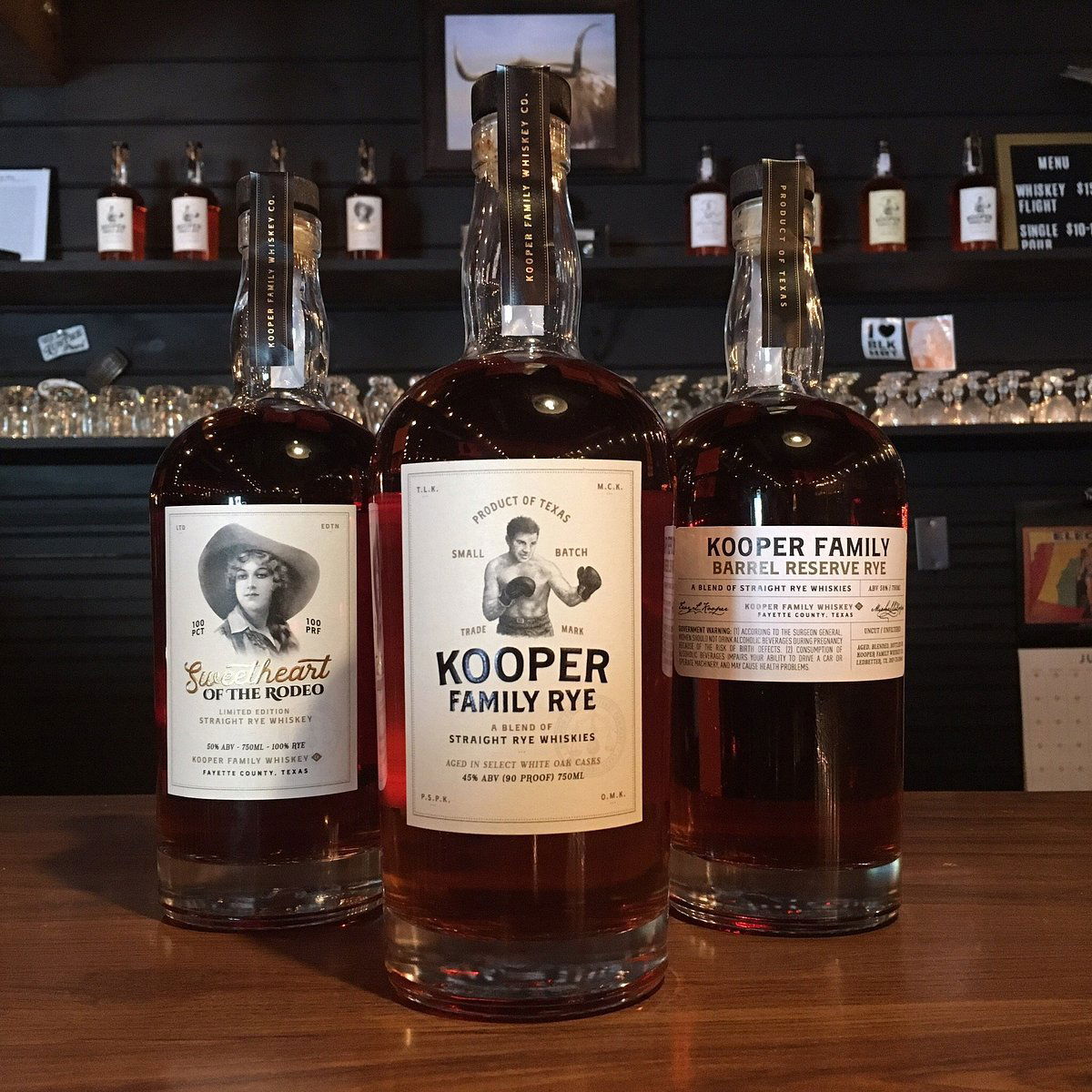
Winery in Ledbetter, United States

    Kooper Family Whiskey Co.

    500pts

    Texas Grain-to-Glass Distilling

    Kooper Family Whiskey Co., Winery in Ledbetter

    About Kooper Family Whiskey Co.

    Kooper Family Whiskey Co. sits along US-290 in Ledbetter, Texas, where the Hill Country's open land and grain-farming heritage inform a whiskey program that earned a Pearl 2 Star Prestige rating in 2025. The operation occupies a stretch of highway that has become a de facto spirits corridor between Austin and the Texas wine country, placing it in a peer set defined more by craft production ethos than by volume.

    Where Texas Grain Country Meets the Glass

    The stretch of US-290 running west from Austin through Washington County is better known for its wine trail than its distilleries, but the corridor has quietly absorbed a generation of craft spirits producers who draw on the same terroir logic that governs the region's vineyards. The soils here are deep, the summers long and punishing, and the grain grown across this part of Texas carries a character that is difficult to replicate with commodity inputs sourced from the Midwest. Kooper Family Whiskey Co., at 100 West US-290 in Ledbetter, sits inside that agricultural context, and the address matters more than it might first appear.

    Ledbetter is not a destination town in any conventional sense. It has no restaurant strip, no boutique hotel cluster, no curated main street. What it has is land, highway access, and proximity to the raw materials and production conditions that define serious grain-to-glass whiskey work. Producers who set up here rather than in Austin or San Antonio are making a statement about priorities: the production environment comes first, and the visitor experience is shaped around that fact rather than the reverse. For a fuller picture of what the broader area offers, see our full Ledbetter restaurants guide.

    The 2025 Pearl 2 Star Prestige Rating and What It Signals

    Kooper Family Whiskey Co. earned a Pearl 2 Star Prestige award in 2025, a credential that places it in a defined tier within EP Club's evaluation framework. Pearl 2 Star Prestige is not a participation category; it reflects a program assessed against peers across production quality, consistency, and the kind of specificity that separates a producer with a genuine point of view from one working to a generic regional template.

    In the broader American craft whiskey field, two-star prestige recognition at the regional level tends to mark producers who have moved past the early volatility of small-batch distilling and into something more deliberate. The analogy to wine is useful here. Just as California Chardonnay houses like Aubert Wines in Calistoga or Au Bon Climat in Santa Barbara have established reputations built on consistency and terroir articulation over many vintages, a whiskey producer earning sustained recognition has demonstrated that the program is not dependent on a single exceptional batch. The 2025 date on the Pearl 2 Star suggests the evaluation captured a program in a period of clear direction.

    Terroir and the Texas Whiskey Argument

    The terroir argument for American whiskey is contested in ways that the wine world largely resolved decades ago. Critics of the concept point out that distillation compresses and transforms raw material in ways that can obscure origin; proponents counter that grain variety, local water chemistry, barrel storage in extreme climates, and seasonal temperature swings all leave marks on the final spirit that a neutral palate can detect. Texas is one of the more compelling test cases for that argument.

    The state's climate is extreme by American distilling standards. Summer warehouse temperatures in Central Texas can exceed 38 degrees Celsius, accelerating the interaction between spirit and oak in ways that compress aging timelines and produce a different flavor profile than spirits matured in the cooler, more temperate warehouses of Kentucky or Tennessee. The wood pulls differently, the evaporation rate (the so-called angel's share) runs higher, and the resulting whiskey tends toward intensity rather than the slow-built complexity of longer-aged bourbons from the traditional belt. This is not a lesser outcome; it is a different one, and producers who understand their climate rather than fight it tend to produce more coherent work.

    Grain side of the equation connects directly to the land around Ledbetter. Washington and Fayette Counties sit in a transition zone between the Blackland Prairie and the Post Oak Savanna, two distinct soil types that have historically supported different agricultural patterns. The proximity of a distillery to its grain supply is not merely a logistical convenience; it is an argument about specificity that producers along this corridor are increasingly willing to make explicitly.

    This kind of terroir-led thinking connects the Texas craft spirits corridor to what established wine regions have built over generations. The Rhône-trained producers at Alban Vineyards in Arroyo Grande or the estate-driven approach at Adelaida Vineyards in Paso Robles are operating under the same foundational assumption: that where something is made, and from what, is inseparable from what ends up in the glass. Texas whiskey producers making the same argument are working in a younger tradition, but the logic is identical.

    The US-290 Corridor in Context

    Understanding Kooper Family Whiskey Co. requires understanding the road it sits on. US-290 west of Austin has been transformed over the past fifteen years by the growth of the Texas wine industry, with Fredericksburg at its western anchor and a dense concentration of producers in the Stonewall and Johnson City areas. The corridor draws weekend visitors from Houston and Austin at a volume that has reshaped the economics of the entire region.

    Spirits producers on or near the highway occupy a different position in that ecosystem than wineries do. They are not yet the primary draw, and they benefit from the wine trail's established visitor infrastructure without having to compete directly with it. The better producers use that adjacency to position themselves as a complement rather than a substitute, offering something the wine trail cannot: a different production story and a spirit category with its own technical depth. Producers like those at Alexander Valley Vineyards in Geyserville and Adelsheim Vineyard in Newberg have demonstrated how estate identity and regional rootedness can drive sustained recognition in the wine world; the craft spirits producers along 290 are building toward an analogous kind of place-based identity.

    For visitors traveling the corridor from Austin, Ledbetter arrives before the main wine country concentration, which makes it a logical first or last stop rather than a detour. The address at 100 West US-290 is on the highway itself, which removes the navigational ambiguity that affects some rural producers tucked further off the main route. Visiting on a weekday typically means fewer crowds than the wine trail sees on peak-season Saturdays, which is worth factoring into a planning decision for anyone who values the kind of unhurried access that lets you actually pay attention to what is in the glass.

    Situating Kooper Family Among Peers

    Texas craft whiskey has grown rapidly enough in the past decade that the category now spans a wide range of quality and ambition. At one end sit producers who are essentially blending and bottling operations with local branding; at the other sit grain-to-glass producers with control over every step from mash bill through maturation. The Pearl 2 Star Prestige rating positions Kooper Family in the latter tier's orbit, distinguishing it from the larger volume of producers who entered the market during the first wave of Texas spirits growth and have not evolved their programs accordingly.

    The comparison to estate-focused wine producers is instructive. Operations like Accendo Cellars in St. Helena, Alpha Omega Winery in Rutherford, or Artesa Vineyards and Winery in Napa have each carved out defined positions in crowded regional markets by committing to a specific production identity rather than trying to compete across categories. The same dynamic is playing out in Texas whiskey, and the producers who will define the category's next decade are likely those who, like Kooper Family, have already secured external recognition for a coherent program. Whiskey from Scotland's established distilleries, such as Aberlour in Aberlour, or historic European producers like Achaia Clauss in Patras, demonstrates what sustained commitment to place and process can produce over time; Texas is earlier in that arc, but the trajectory is visible.

    Planning a Visit

    Kooper Family Whiskey Co. is located directly on US-290 in Ledbetter, making it accessible without a significant detour from the main Hill Country route. Phone and website details are not available in the current record, so the most reliable approach before visiting is to cross-reference current hours and tasting availability through regional travel platforms or the Texas distillery association listings, which tend to carry updated operational details for producers in this corridor. Given the rural location and the possibility of private events or seasonal closures, confirming access before making a dedicated trip is a practical step worth taking. Visitors combining the stop with the wider US-290 wine corridor will find that the road itself provides a clear east-west spine for a day or multi-day itinerary, with Andrew Murray Vineyards in Los Olivos and Babcock Winery and Vineyards in Lompoc offering useful reference points for the kind of regional producer depth that a well-planned spirits and wine itinerary can deliver. The B.R. Cohn Winery in Glen Ellen similarly illustrates how producers with strong regional roots translate that identity into a visitor experience with real substance.

    Frequently Asked Questions

    How would you describe the overall feel of Kooper Family Whiskey Co.?
    The operation sits in Ledbetter, a rural Washington County community with no surrounding hospitality infrastructure to speak of, which means the experience is shaped by the production environment rather than by ancillary amenities. The Pearl 2 Star Prestige recognition in 2025 signals a program with clear direction, and the highway address gives it direct access from the Austin-to-Hill Country route. Price details are not currently available in EP Club's records, but the positioning within a prestige-rated tier suggests a program priced to reflect production quality rather than volume economics.
    What is the must-try whiskey at Kooper Family Whiskey Co.?
    Specific product details are not available in EP Club's current database record for this producer. What the Pearl 2 Star Prestige rating does confirm is that the program as a whole has been assessed favorably at the prestige tier. Given the Texas production context, expressions that engage directly with the climate's effect on maturation are the category most likely to reflect what distinguishes a Central Texas whiskey from its counterparts in cooler-climate American regions. The wine region and winemaker fields do not apply to a whiskey producer; the analogous credentials here sit in grain sourcing and barrel program specifics, which are leading confirmed directly with the producer on-site.
    What is Kooper Family Whiskey Co. leading at?
    The Pearl 2 Star Prestige award, the highest trust signal available in EP Club's current record, indicates a program operating at a level above the baseline of the Texas craft spirits field. The Ledbetter location, on US-290 in Washington County, aligns the producer with the terroir-driven logic that governs the better producers on the Hill Country corridor. Without current pricing data in the record, the quality tier implied by the award is the most reliable calibration point available for placing this producer within its peer set.
    Keep this place

    Save or rate Kooper Family Whiskey Co. on Pearl

    Keep this venue in your Pearl passport, rate it after you visit, and track it alongside every other place you collect.