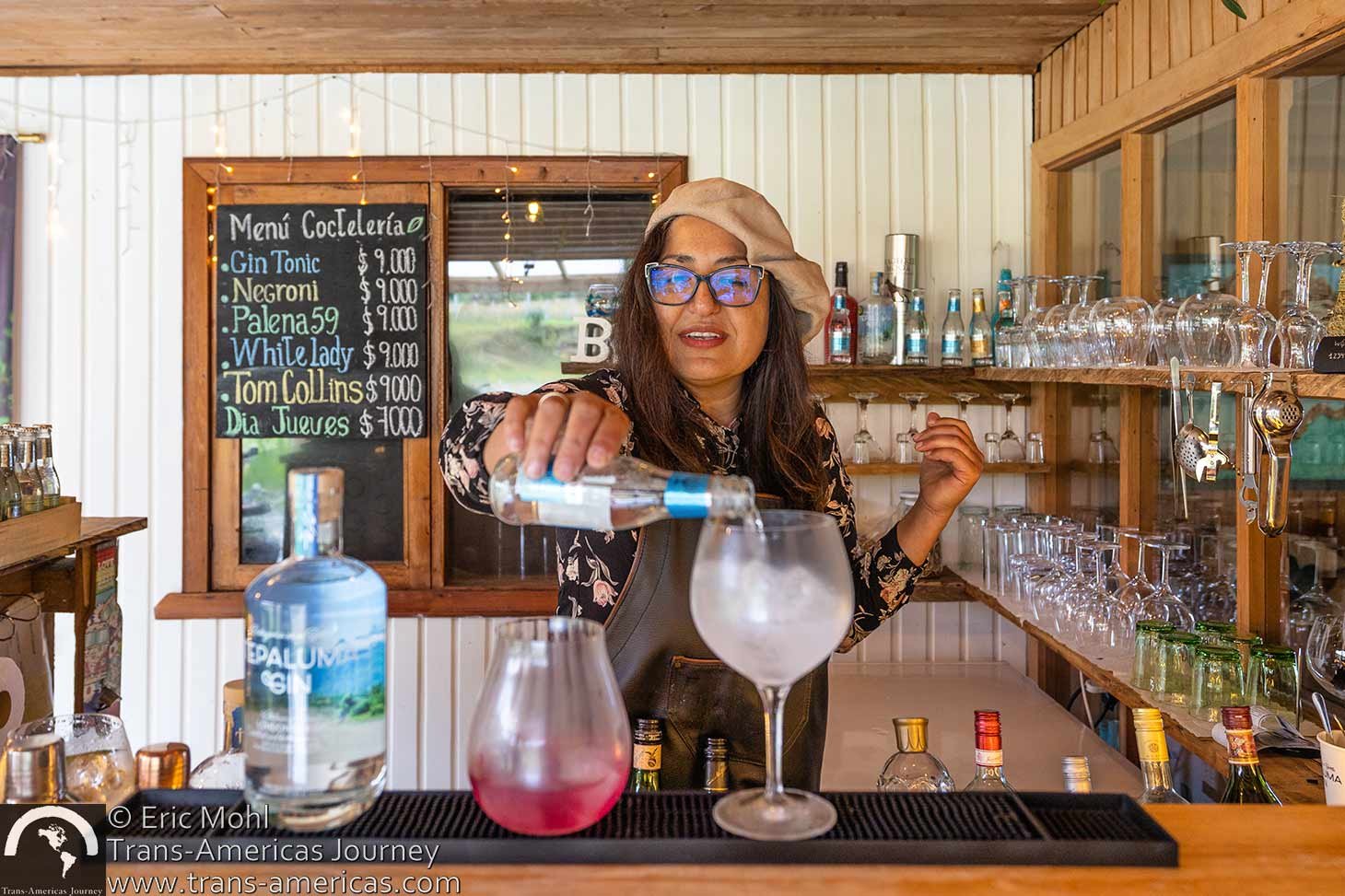

Winery in La Junta, Chile
Tepaluma Distillery
500ptsCarretera Austral Distillation

About Tepaluma Distillery
Tepaluma Distillery operates from La Junta in Chilean Patagonia's Aysén region, one of the most remote production addresses in South American spirits. Holder of a Pearl 2 Star Prestige rating for 2025, it represents a category of terroir-driven distilling that is still taking shape at the southern frontier of Chilean craft production. The Carretera Austral runs past its door, which tells you something about the scale of commitment required to get here.
Where the Carretera Austral Meets the Still
The Carretera Austral — Chile's legendary southern highway, unpaved for long stretches, flanked by glacial rivers and temperate rainforest — is not a road that rewards impatience. It is a road that rewards attention. Tepaluma Distillery sits on this route in La Junta, a small settlement in the Cisnes commune of the Aysén region, at a latitude where almost no other distillery in the world operates. The physical environment here is not backdrop; it is raw material. The water, the air, the ambient temperature, the botanical palette available within reach of the production site , these are not marketing abstractions but functional inputs that shape what comes out of the still.
Approaching La Junta from either direction on the Carretera Austral, the scale of the surrounding landscape recalibrates your sense of what a production address means. Chilean wine country , [Viña Seña in Panquehue](https://www.enprimeurclub.com/wineries/vina-sena-panquehue-winery), [Viña Casa Silva in San Fernando](https://www.enprimeurclub.com/wineries/vina-casa-silva-san-fernando-winery), [Viña De Martino in Isla de Maipo](https://www.enprimeurclub.com/wineries/vina-de-martino-isla-de-maipo-winery) , operates in a different register of landscape entirely, shaped by Mediterranean rhythms and centuries of viticulture. Tepaluma occupies a different axis: colder, wetter, wilder, and far more sparsely settled. That distinction is not incidental to the product. It is the product's argument.
The Terroir Case for Patagonian Spirits
In wine, the concept of terroir , the idea that geography, climate, and soil leave identifiable marks on a finished product , has been debated and documented for centuries. In distilling, the conversation is younger and less settled, but it is gaining ground as craft producers work at geographic extremes where ingredient sourcing, water chemistry, and fermentation temperatures diverge sharply from industrial norms.
Aysén receives among the highest rainfall totals anywhere in South America, fed by Pacific weather systems that stack against the Andes. The result is a hydrological environment unlike anything in Chile's central valley wine regions or even in the altiplano pisco zones where operations like [Viña Falernia in Vicuña](https://www.enprimeurclub.com/wineries/vina-falernia-vicuna-winery) and [Pisco Alto del Carmen Distillery in Huasco](https://www.enprimeurclub.com/wineries/pisco-alto-del-carmen-distillery-huasco-winery) operate under intense northern sun. At these latitudes, ambient cold slows fermentation in ways that affect flavor development. Water drawn from glacial or rain-fed sources carries a mineral profile shaped by some of the least-disturbed geology on the continent. These are not small differences.
Tepaluma's 2025 Pearl 2 Star Prestige recognition from EP Club places it in a tier that requires demonstrable quality and production integrity, not simply geographical novelty. Earning that rating in a category as context-dependent as terroir-driven distilling, from one of the most logistically demanding production addresses in the hemisphere, signals that the operation is delivering on more than an interesting postcode.
La Junta and the Emerging Southern Spirits Circuit
La Junta itself has a population measured in hundreds rather than thousands. It exists as a service stop for travelers on the Carretera Austral and as a node for the surrounding ranching and fishing communities of the Cisnes valley. This is not a place that has historically attracted premium producers. The infrastructure calculus , supply chains, distribution, visitor access , works against it in almost every conventional sense.
Yet producers at the geographic fringes of established industries have consistently produced work that reframes what those industries thought they understood. [Viña Falernia in Vicuña](https://www.enprimeurclub.com/wineries/vina-falernia-vicuna-winery) did this in the Elqui Valley, operating at altitudes and latitudes that the Chilean wine establishment once considered marginal. [El Gobernador (Miguel Torres Chile) in Curicó](https://www.enprimeurclub.com/wineries/el-gobernador-miguel-torres-chile-curico-winery) brought European technical rigor to Chilean varietals at a time when that combination was not obvious. Tepaluma is working in a different category and a different region, but the structural logic is the same: geographic commitment as a form of argument about what the land can produce.
Chile's craft distilling sector has developed unevenly. In contrast to the wine industry , which fields globally recognized producers from [Viña Undurraga in Talagante](https://www.enprimeurclub.com/wineries/vina-undurraga-talagante-winery) to [Viña Ventisquero in Santiago](https://www.enprimeurclub.com/wineries/vina-ventisquero-santiago-winery), from [Viña MontGras in Palmilla](https://www.enprimeurclub.com/wineries/vina-montgras-palmilla-winery) to [Viña Santa Rita in Buin](https://www.enprimeurclub.com/wineries/vina-santa-rita-buin-winery) , craft spirits production remains a fragmented, still-forming category. [Atacamasour Distillery in San Pedro de Atacama](https://www.enprimeurclub.com/wineries/atacamasour-distillery-san-pedro-de-atacama-winery) occupies the northern extreme of this emerging map. Tepaluma occupies the southern extreme. Between those two poles, an argument about Chilean terroir in distilling is beginning to take shape. For a comparative reference from outside Chile, [Aberlour in Aberlour](https://www.enprimeurclub.com/wineries/aberlour-aberlour-winery) offers a useful illustration of what happens when a distillery commits fully to a specific geographic and environmental identity over decades. [Viña Valdivieso in Lontué](https://www.enprimeurclub.com/wineries/vina-valdivieso-lontue-winery) and [Accendo Cellars in St. Helena](https://www.enprimeurclub.com/wineries/accendo-cellars) show, from wine's perspective, what sustained geographic commitment eventually produces in terms of recognition and positioning.
Getting There and Planning Your Visit
La Junta is accessible by road via the Carretera Austral, which runs south from Chaitén or north from Coyhaique; neither approach is fast. Coyhaique, the regional capital of Aysén, is the practical base for most visitors to this part of Patagonia and has the nearest commercial airport with regular connections. From Coyhaique, La Junta sits several hours north along Route 7, with road conditions varying significantly by season. The Carretera Austral's southern sections are partially unpaved, and travel times are leading treated as estimates rather than guarantees. The optimal travel window for this region runs from November through March, when daylight hours are long and precipitation, while still significant, is less likely to disrupt road access. Visiting outside that window requires flexibility and appropriate vehicle preparation. Given the absence of published contact details, planning ahead through regional tourism resources or Carretera Austral specialist operators is the sensible approach. [Our full La Junta restaurants guide](https://www.enprimeurclub.com/cities/la-junta) covers the broader context of what to eat and drink in the area around a visit.
What to Expect on Arrival
The atmosphere at Tepaluma reflects the environment it operates in: this is Patagonian production, not a polished valley tasting room. Visitors should expect a setting shaped by function and geography rather than by hospitality architecture. The landscape is the dominant visual fact, and the production operation sits within it rather than presenting itself as a destination independent of its surroundings. That directness is part of what a visit here delivers , the relationship between place and product is legible in a way that requires no interpretation. For travelers already committed to the Carretera Austral route, Tepaluma represents one of the more compelling reasons to stop in La Junta rather than pass through.
Within Chile's emerging craft spirits conversation, few addresses make a more direct geographical argument. The Pearl 2 Star Prestige rating for 2025 confirms that the argument is being made with genuine quality behind it.
Frequently Asked Questions
- What is the atmosphere like at Tepaluma Distillery?
- Tepaluma sits on the Carretera Austral in La Junta, one of the most isolated production addresses in Chilean spirits. The atmosphere reflects the terrain: spare, direct, shaped by Patagonian weather and landscape rather than by tasting-room convention. It holds a Pearl 2 Star Prestige rating for 2025, which signals production quality at a level that goes beyond geographic novelty. Visitors arriving via the Carretera Austral should expect the environment to be the dominant impression, with the distillery operating very much in dialogue with its surroundings.
- What should I taste at Tepaluma Distillery?
- The production specifics at Tepaluma are not publicly documented in detail, but the distillery's EP Club Pearl 2 Star Prestige recognition for 2025 points to spirits worth serious attention. Given the Aysén region's exceptional water sources and botanical environment, the terroir case for whatever the distillery produces is unusually strong on paper. In the absence of a published wine region or named winemaker, the EP Club rating is the clearest quality signal available , and in this category and geography, a 2 Star Prestige result is a meaningful credential.
Related editorial
- Best Fine Dining Restaurants in ParisFrom three-Michelin-star icons to the next generation of Parisian chefs pushing boundaries, these are the restaurants that define fine dining in the world's culinary capital.
- Best Luxury Hotels in RomeFrom rooftop terraces overlooking ancient ruins to Michelin-starred hotel dining, these are the luxury hotels that make Rome unforgettable.
- Best Cocktail Bars in KyotoFrom sleek lounges to hidden speakeasies, Kyoto's cocktail scene blends Japanese precision with global influence in ways you won't find anywhere else.
Save or rate Tepaluma Distillery on Pearl
Keep this venue in your Pearl passport, rate it after you visit, and track it alongside every other place you collect.