
Winery in Blackness, United Kingdom
Blackness Bay Distillery
500ptsCoastal Terroir Distilling
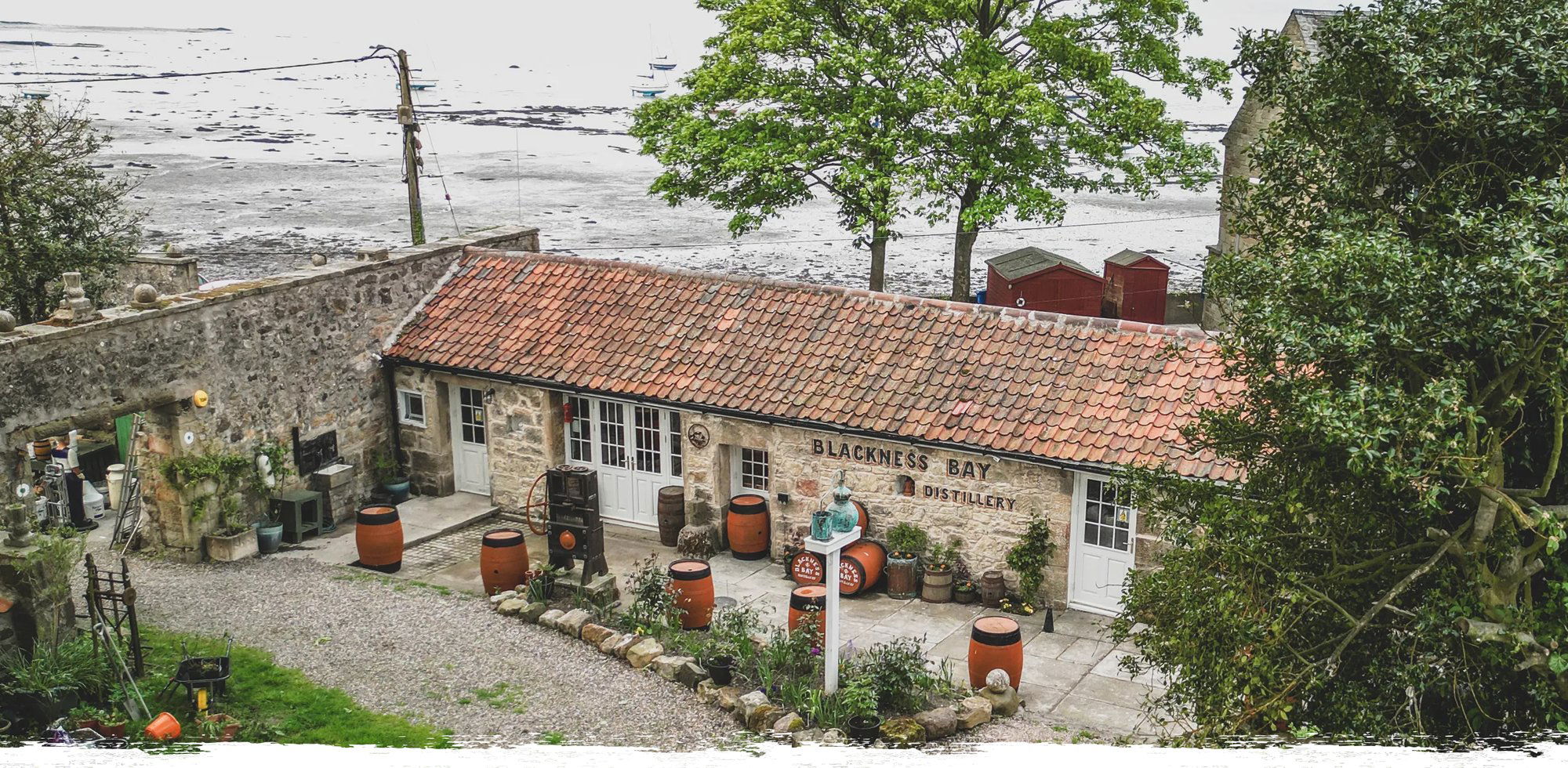
About Blackness Bay Distillery
Blackness Bay Distillery sits on the southern shore of the Firth of Forth at Blackness, earning a Pearl 2 Star Prestige rating in 2025. The setting alone places it apart from inland Scottish distilleries: tidal water, sea winds, and the ruins of Blackness Castle frame every visit. For those tracing Scotland's whisky geography beyond the Highland and Speyside corridors, this is a meaningful stop.
Where the Firth of Forth Shapes the Spirit
Scottish distilling has long been defined by geography, and nowhere is that more legible than on the southern coast of the Firth of Forth. The stretch of water between Edinburgh and Stirling carries salt-laden air inland from the North Sea, and the tidal foreshore at Blackness is as exposed to that influence as anywhere in the Central Belt. Blackness Bay Distillery sits directly on Shore Road, facing the estuary at close range, with Blackness Castle rising nearby on its promontory — a position that situates the operation firmly within a landscape shaped by centuries of maritime and agricultural activity rather than the peat bogs and Highland glens that dominate Scotland's whisky imagination.
That positioning matters more than it might first appear. The terroir argument in Scotch whisky has been contested and refined over decades, but the basic mechanics are well-established: coastal air during maturation, the mineral character of local water sources, and the humidity fluctuations of a particular microclimate all leave measurable traces in the cask over time. A distillery at the water's edge in the Lothians is working with conditions that differ substantially from those at an inland Speyside operation like Aberlour in Aberlour or a far-northern site like Balblair Distillery in Edderton. The Forth estuary introduces a specific salinity and humidity profile that is, in the strictest sense, unrepeatable elsewhere in Scotland.
The Pearl 2 Star Prestige Recognition
Blackness Bay Distillery received a Pearl 2 Star Prestige rating in 2025, placing it in a tier reserved for producers whose quality and presentation meet a high editorial threshold. That recognition is a useful orientation point for visitors planning a trip: it signals that this is not simply a tourism operation attached to a working distillery, but a site where the product and the experience have been assessed and found to merit serious attention. For context, that category of recognition at EP Club sits alongside established names across Scotland's distilling regions, from Auchentoshan Distillery in Clydebank to Ardnahoe in Port Askaig on Islay's northern coast.
Scotland's distilling tier has broadened considerably over the past fifteen years. The number of active distilleries has grown from under one hundred to well over two hundred, with new operations appearing across regions that historically produced no whisky at all. Within that expansion, the Central Belt and Lothians have seen particular activity, driven partly by proximity to Edinburgh's tourism infrastructure and partly by genuine enthusiasm for the region's historical distilling connections — the Forth valley was an important whisky-producing area in the nineteenth century before consolidation reduced it to a handful of operations. Blackness Bay's 2025 recognition positions it within the credible tier of this newer generation.
Coastal Terroir and What It Means in Practice
The terroir question in Scotch whisky is worth examining carefully, because it differs from the wine analogy in important ways. Grape varieties are rooted in specific soils and cannot be moved; barley can be sourced from anywhere. What a coastal distillery does inherit is its maturation environment. Casks stored close to salt water absorb trace elements through the wood over years of expansion and contraction with temperature shifts, and the relative humidity of an estuarine location affects the rate at which spirit evaporates , the so-called angel's share , as well as what the cask draws back in. At Blackness, the Forth provides a consistent source of maritime influence across all four seasons, with Atlantic weather patterns moderating the temperature range compared to more exposed Highland or island sites.
This places Blackness Bay in a loose peer group with other coastal Scottish operations, though the comparisons are instructive rather than direct. Clynelish Distillery in Brora works with a very different northern coastal character; Glen Scotia in Campbeltown draws on the specific brine and peat of the Kintyre peninsula. Each coastal site produces a different register of sea influence depending on its precise geography, the direction of prevailing winds, and the local water chemistry. The Forth, with its mix of freshwater inflow from the River Forth and North Sea salinity, creates conditions specific to this stretch of coast. For those tracking Scotland's regional whisky character with the same attention they would give to Dornoch Distillery in Dornoch or Dunphail Distillery in Dunphail, the Lothian coast represents a distinct and underexplored chapter.
Planning a Visit to Blackness
Blackness village is small , fewer than two hundred residents , and sits roughly eight kilometres from Linlithgow, which is the nearest town of scale. The postal address confirms this: Shore Road, Blackness, Linlithgow EH49 7NL. Linlithgow itself has a railway station on the Edinburgh to Glasgow Queen Street line, making it reachable from Edinburgh in under thirty minutes. From Linlithgow, Blackness is a short drive or, for those inclined, a walkable distance along country roads. The distillery's coastal position on Shore Road means approaching visitors get the full estuary view before arrival , the Forth is visible from the road well before you reach the village.
Given the lack of published booking or hours information in our records, direct confirmation with the distillery before travel is advisable, particularly for visit formats, tasting sessions, or group arrangements. Scotland's newer distilleries have adopted a range of visitor models, from drop-in retail to pre-booked guided experiences, and the format at Blackness Bay should be verified in advance. The surrounding area rewards those who build time for the visit: Blackness Castle is maintained by Historic Environment Scotland and open to visitors, Linlithgow Palace offers a separate half-day, and the Union Canal towpath provides a walking route back toward the town.
Seasonal timing has some relevance here. The Firth of Forth in winter is atmospheric , low light, direct sea wind, and the castle silhouetted against grey water , but summer visits offer longer daylight hours and easier travel connections. For those comparing Scottish distillery experiences across a longer itinerary, pairing Blackness Bay with Deanston in Deanston, Bladnoch Distillery in Bladnoch, or Cardhu in Knockando creates a thematic arc through Scotland's geographic diversity of production. For a wider cross-category perspective on premium drinks producers, Accendo Cellars in St. Helena and Achaia Clauss in Patras illustrate how terroir-led production operates across entirely different traditions. Glen Garioch Distillery in Oldmeldrum rounds out a northeast Scotland angle worth considering for those extending the journey.
For broader context on what Blackness offers beyond the distillery, see our full Blackness restaurants guide.
Frequently Asked Questions
Is Blackness Bay Distillery more formal or casual?
The available information does not include a dress code, seating format, or visitor experience description for Blackness Bay Distillery. What the Pearl 2 Star Prestige recognition (2025) does signal is that the experience meets a threshold associated with considered presentation rather than purely functional distillery tourism. By comparison, similarly recognised Scottish producers tend to run experiences that are structured and attentive without requiring formal attire , the setting here, a working waterfront site near a rural village, lends itself to an atmosphere that is purposeful rather than ceremonial. Confirm the visit format directly before travelling.
What should I taste at Blackness Bay Distillery?
Without specific tasting notes or menu data in our records, recommending individual expressions would require information not currently verified. What the 2025 Pearl 2 Star Prestige rating does support is the expectation of quality production worth engaging with seriously. Given the distillery's coastal Forth estuary position, the logical area of interest is how the maturation environment expresses itself in the spirit , the same question that draws serious visitors to island and coastal producers elsewhere in Scotland. Any tasting visit is leading approached as an opportunity to read the specific character of this microclimate rather than to compare directly with Highland or Speyside benchmarks.
Related editorial
- Best Fine Dining Restaurants in ParisFrom three-Michelin-star icons to the next generation of Parisian chefs pushing boundaries, these are the restaurants that define fine dining in the world's culinary capital.
- Best Luxury Hotels in RomeFrom rooftop terraces overlooking ancient ruins to Michelin-starred hotel dining, these are the luxury hotels that make Rome unforgettable.
- Best Cocktail Bars in KyotoFrom sleek lounges to hidden speakeasies, Kyoto's cocktail scene blends Japanese precision with global influence in ways you won't find anywhere else.
Save or rate Blackness Bay Distillery on Pearl
Keep this venue in your Pearl passport, rate it after you visit, and track it alongside every other place you collect.