
Restaurant in Guangzhou, China
Yu Garden
450Pearl PointsMichelin-starred Fujian cuisine, book ahead.

About Yu Garden
Yu Garden holds a 2025 Michelin star and brings Fujian cuisine — a rarity at this level in Guangzhou — to a gallery-adorned, park-set room at ¥¥ pricing. The cooking is ingredient-driven and umami-focused, with Michelin-cited dishes including sea worm jelly and Xiamen ginger duck stew. A hard booking: allow four to six weeks, and push for a private room if your occasion warrants it.
Should You Book Yu Garden?
If you can secure a table, yes. Yu Garden holds a 2025 Michelin star and brings a cuisine — Fujian — that you will not commonly find executed at this level in Guangzhou. The price sits at ¥¥, which makes it one of the more accessible Michelin-starred meals in the city. The catch is availability: this is a hard booking, and the private rooms in particular fill well in advance. Book the private room if your party warrants it; book the main room if you are flexible on timing but do not leave it to chance.
Yu Garden, Guangzhou
If you are returning to Yu Garden after a first visit, the move is to book further ahead than you did last time and to push for a private room if you are coming with four or more. The main dining room is well worth it , tables are spaced generously, which is less common at this price point than it should be , but the private rooms suit a celebration or a business dinner where the conversation needs to stay at the table. Give yourself at least three to four weeks of lead time, and if you are targeting a Friday or Saturday, stretch that to six weeks minimum.
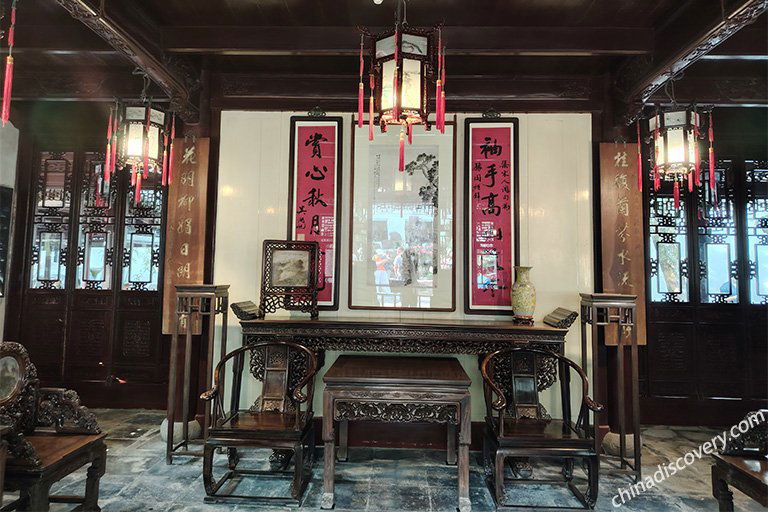
The address places Yu Garden inside Zhongshan Park in Changning, which is relevant to understanding what you are walking into. This is not a restaurant on a busy dining strip competing for foot traffic. The deliberate distance from central Guangzhou's restaurant clusters is the point: the space is airy, the artworks on the walls are on loan from a gallery nearby, and the atmosphere is noticeably quieter than comparably priced restaurants closer to the city core. For diners who have done the rounds of Cantonese fine dining in Guangzhou and want something that sits apart from that circuit, the location alone signals a different kind of meal. For anyone looking for a quick or spontaneous dinner, it is the wrong choice , the journey requires intent.
The kitchen works from a Fujian framework, and most ingredients are sourced directly from the province. That supply chain is worth noting because Fujian cuisine depends heavily on the quality of its coastal and inland produce: the flavour profiles are subtler than Cantonese or Sichuan cooking, built on umami depth and aromatic layering rather than richness or heat. If your reference point for Chinese fine dining is Cantonese cuisine, this is a meaningfully different register , not better or worse, but distinct enough that it rewards some familiarity with the tradition.
Two dishes referenced in the Michelin recognition give you a clear read on what the kitchen does well. The sea worm jelly is the more challenging order for an uninitiated diner , sea worm (sipunculus nudus) is a Fujian coastal ingredient that delivers a concentrated, clean umami with a texture most Western and non-Fujian diners will not have encountered. If you are a returning visitor, this is the dish to revisit with more context. The Xiamen ginger duck stew sits at the other end of the accessibility spectrum: aromatic, deeply savoury, and a good anchor for the table if you are bringing someone unfamiliar with the cuisine. Both dishes are Michelin-cited, which gives you confidence in ordering them without second-guessing the menu.
At ¥¥ pricing with a Michelin star, Yu Garden is positioned well relative to its Guangzhou peers. Imperial Treasure Fine Chinese Cuisine and Jiang by Chef Fei both operate at a higher price tier for Cantonese cooking. Yu Garden's value case is strong: the room is good, the cooking is Michelin-validated, and the bill will not punish you the way a ¥¥¥¥ tasting menu will. The trade-off is that you are working with a cuisine that requires some willingness to engage with unfamiliar ingredients and flavour logic. If you want the path of least resistance into Guangzhou's fine dining scene, BingSheng Mansion is a safer default. If you want something that actually uses a different set of ingredients and techniques, Yu Garden earns the booking.
Fujian cuisine has a small but growing footprint across China's fine dining tier. If you want to understand the broader context before or after dining here, Hokklo in Xiamen is the natural comparison point , Xiamen is the heartland of the tradition. Hokkien Cuisine in Chengdu shows how the same tradition travels to a very different city context. For Fujian-influenced cooking at the higher end of the national scene, Xin Rong Ji in Beijing and Xin Rong Ji in Chengdu are the reference benchmarks. 102 House in Shanghai and Ru Yuan in Hangzhou offer additional data points for the regional Chinese fine dining tier more broadly.
For Guangzhou planning beyond this meal, the full Guangzhou restaurants guide covers the wider field. The Guangzhou hotels guide, bars guide, and experiences guide complete the picture if you are planning a full trip.
Know Before You Go
How It Compares
More to Explore in Guangzhou
- Imperial Treasure Fine Chinese Cuisine , Cantonese, ¥¥¥
- Jiang by Chef Fei , Cantonese, fine dining tier
- Taian Table , Modern European, ¥¥¥¥
- BingSheng Mansion (Xiancun Road) , Cantonese
- Chōwa , Innovative, ¥¥¥
- Full Guangzhou restaurants guide
- Guangzhou hotels guide
- Guangzhou bars guide
- Guangzhou wineries guide
- Guangzhou experiences guide
- Chef Tam's Seasons in Macau
- Dai Yuet Heen in Nanjing
Frequently Asked Questions
Is Yu Garden good for a special occasion?
Yes, and the private room is the reason to choose it over alternatives. Yu Garden holds a 2025 Michelin star, the space is art-filled and well-spaced, and a private room gives you the separation that a milestone dinner requires. Book the private room specifically — the main dining room works for a quiet dinner for two, but for a celebration with four or more, the private room justifies the effort of securing it.
Is Yu Garden worth the price?
At a ¥¥ price range with a 2025 Michelin star attached, Yu Garden sits in a strong value position relative to comparable starred restaurants in China. Fujian cuisine at this level of execution — with ingredients shipped directly from the province — is genuinely rare in Guangzhou. If you are familiar with Fujian food, the sourcing alone makes it worth the visit; if you are not, it is an efficient way to understand the cuisine at its better end.
What should I order at Yu Garden?
The sea worm jelly and the Xiamen ginger duck stew are the two dishes the Michelin guide specifically flags as specialities. Both are rooted in Fujian tradition and reflect the kitchen's focus on province-sourced ingredients. Order both if they are available — they represent what distinguishes Yu Garden from generic Cantonese or pan-Chinese options in the city.
What should I wear to Yu Garden?
The venue is described as an airy, art-filled space with well-spaced tables, which signals a considered dining environment without necessarily being formal. A neat, polished casual approach — the kind you would wear to any Michelin-starred lunch in China — is the safe call. There is no documented dress code in the available venue data, so avoid anything too casual given the starred context.
Is the tasting menu worth it at Yu Garden?
Fujian cuisine is well-suited to a structured tasting format because the flavours are specific and sequential — umami-heavy dishes like the sea worm jelly land better when the kitchen controls the order. At ¥¥ pricing with a Michelin star, a tasting menu here would sit at a fair price-to-credential ratio by Chinese fine dining standards. Specific menu structures are not confirmed in available venue data, so confirm the current format when booking.
Can Yu Garden accommodate groups?
Yes, and the private room is the right option for groups. The main dining room has well-spaced tables, but for parties of four or more — especially for a shared meal where Fujian dishes are ordered to the table — the private room gives you better control of the experience. Request it at the time of booking rather than on arrival, as availability is not guaranteed.
Location
China, 780, 中山公园内780号CN 上海市 长宁区 长宁路 邮政编码: 200050
Guangzhou, China
Compare Yu Garden
| Venue | Cuisine | Price | Booking Difficulty |
|---|---|---|---|
| Yu Garden | Fujian | ¥¥ | Hard |
| Imperial Treasure Fine Chinese Cuisine | Cantonese | ¥¥¥ | Unknown |
| Taian Table | Modern European, European Contemporary | ¥¥¥¥ | Unknown |
| Song | Sichuan | ¥¥ | Unknown |
| Chōwa | Innovative | ¥¥¥ | Unknown |
| Rêver | French Contemporary | ¥¥¥¥ | Unknown |
How Yu Garden stacks up against the competition.
Also Consider
- Imperial Treasure Fine Chinese Cuisine — Cantonese, ¥¥¥
- Taian Table — Modern European, European Contemporary, ¥¥¥¥
- Song — Sichuan, ¥¥
- Chōwa — Innovative, ¥¥¥
- Rêver — French Contemporary, ¥¥¥¥
Yu Garden sits in a different category to most of Guangzhou's starred competition because it is the only venue in the city's Michelin tier working from a Fujian framework at ¥¥ pricing. If you are comparing it directly to Imperial Treasure Fine Chinese Cuisine (¥¥¥, Cantonese), you are getting a Michelin-starred meal for meaningfully less money — but the cuisines are distinct enough that the choice is not purely about price. Imperial Treasure is the safer pick for guests who want a familiar Cantonese fine dining reference point. Yu Garden is the right call if you want something the city's other Michelin tables do not offer.
Chōwa (¥¥¥, Innovative) and Taian Table (¥¥¥¥, Modern European) both operate at a higher price tier and in formats — innovative tasting menus and European contemporary — that prioritise a different kind of dining experience. If the goal is a long, technically ambitious meal, Taian Table or Chōwa are the natural comparisons. If the goal is a considered, ingredient-driven meal with a strong sense of regional identity at a lower spend, Yu Garden is the more compelling case.
For diners weighing Yu Garden against a Sichuan option like Song (¥¥), the decision comes down to occasion and flavour preference. Song and Yu Garden share a price tier, but a Michelin-starred meal in a gallery-set room in Zhongshan Park is a materially different proposition to a Sichuan restaurant, even a good one. Yu Garden is the stronger choice for a special occasion or for anyone building a Guangzhou dining itinerary that covers more than one regional tradition. For a broader view of the city's dining scene, see the full Guangzhou restaurants guide.
Recognized By

Explore Guangzhou
Save or rate Yu Garden on Pearl
Keep this venue in your Pearl passport, rate it after you visit, and track it alongside every other place you collect.