
Hotel in Washington DC, United States
Riggs Washington D.C.
150ptsBank-to-Hotel Conversion

About Riggs Washington D.C.
A converted 1891 Riggs National Bank headquarters in Penn Quarter, Riggs Washington D.C. houses 181 rooms across Richardson Romanesque architecture that once served U.S. presidents. Silver Lyan bar, Café Riggs, and a rooftop with city views make it one of the more complete hospitality programs in the capital. Operated by Lore Group, it positions itself between historic grandeur and contemporary hotel programming.
Where Banking History Becomes Hotel Architecture
Penn Quarter has spent the better part of two decades transforming from a district of federal overflow into one of Washington's more animated central neighborhoods, with galleries, restaurants, and performance venues filling buildings that once served purely civic functions. The hospitality sector followed that shift, and adaptive reuse became the dominant grammar for premium hotel development in the area. Riggs Washington D.C., at 900 F St NW, sits at the sharper end of that tradition: a building completed in 1891 as the headquarters of Riggs National Bank, one of the most politically connected financial institutions in American history, converted by Lore Group into a 181-room hotel with a full food-and-beverage program across three distinct spaces.
The building's Richardson Romanesque facade reads immediately as something older and more deliberate than the glass-and-steel additions around it. That style, developed by Henry Hobson Richardson in the late nineteenth century, relies on heavy masonry, rounded arches, and a sense of compressed monumentality that federal Washington absorbed enthusiastically. Walking toward the F Street entrance, the stonework announces a different set of spatial expectations than a conventional hotel lobby would. The transition from street to interior is architectural argument, not just threshold.
The Interior: Vault Ceilings and Jewel-Box Rooms
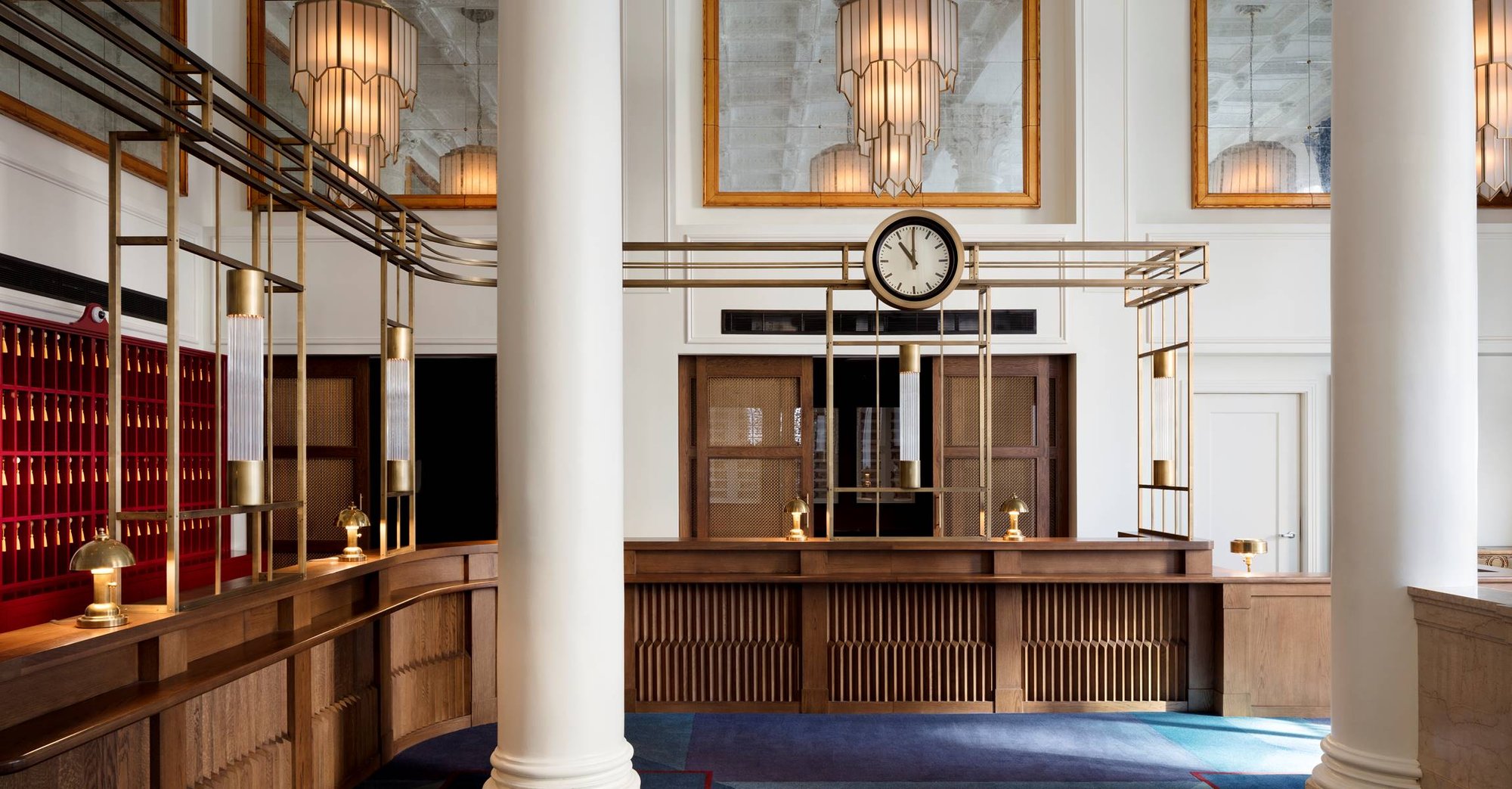
Inside, the soaring entrance hall preserves the proportional logic of a banking floor built to project institutional confidence. High ceilings, dense ornamental detail, and the spatial generosity that comes from a building designed to accommodate crowds of depositors rather than hotel guests create an atmosphere that is difficult to replicate through new construction. Premium hotel development in cities like Washington, New York, and Boston has increasingly recognized that this kind of spatial inheritance, the kind available only through conversion of a genuinely significant historic building, carries more atmospheric authority than purpose-built equivalents. Properties like The Hay-Adams Hotel and The Jefferson have long anchored their identities in Washington's architectural and political legacy; Riggs makes a similar claim, but from a distinctly commercial rather than residential or political point of origin.
The 181 rooms and suites are described as jewel-box in scale, a term that signals deliberate curation over raw square footage. That format aligns Riggs with a segment of urban luxury hotels that prioritize material quality and visual density in smaller room footprints over the open-plan, neutral-palette approach that dominated hotel design through the 2010s. Guests approaching the property from that context will find the sensory register more saturated, not in a maximalist or chaotic sense, but in the way that a well-considered historic conversion tends to layer detail that a new build cannot easily source.
Silver Lyan, Café Riggs, and Rooftop Programming
The food and beverage configuration at Riggs is worth understanding as a complete program rather than a set of individual outlets. Silver Lyan operates as the hotel bar with a globally-influenced cocktail menu, a positioning that places it within the broader Washington cocktail movement that has moved away from direct spirit-forward lists toward more reference-diverse, technically considered programs. For comparison, the cocktail culture at Rosewood Washington, D.C. and Pendry Washington DC at The Wharf similarly reflects this city-wide drift toward drinks programs that carry their own editorial identity rather than functioning as hotel amenity afterthoughts.
Café Riggs serves as the main gathering space and brings an all-day format that makes the ground floor usable across a wider window than a dinner-only restaurant would allow. For guests who want the atmospheric benefit of the historic interior without committing to a full meal, the café format creates an accessible entry point. The Rooftop at Riggs adds a different sensory layer entirely: outdoor space in a city whose skyline is constitutionally height-limited, meaning rooftop views in Washington carry more spatial openness than equivalent perches in denser vertical cities. The view over Penn Quarter and toward the federal core is the kind of orientation exercise that frames the city differently than street-level circulation does.
Penn Quarter as a Hotel Context
Location in Penn Quarter positions Riggs within walking distance of the National Gallery of Art, the Shakespeare Theatre Company, and the cluster of federal buildings that define the Mall's eastern edge. This is not an especially quiet or residential neighborhood, and guests calibrated toward the relative calm of Georgetown or Dupont Circle, where The Dupont Circle Hotel and Mayflower Inn operate in noticeably different urban registers, should weigh that distinction. Penn Quarter rewards guests who want dense access to cultural institutions and the energy of a central commercial district over those seeking a more insulated residential atmosphere.
The Metro Center and Gallery Place-Chinatown stations are both within a short walking radius, which makes ground-level transit throughout the city direct without relying on car service. For airport connections, Reagan National is the closest option via Metro's Yellow and Blue lines, typically 20 to 25 minutes depending on the time of day. That access pattern suits the high-frequency business and political traveler that Washington attracts at volume, and positions Riggs as a genuinely functional choice for that cohort rather than purely an aesthetic one.
Where Riggs Sits in Washington's Hotel Tier
Washington's premium independent hotel sector has expanded considerably since 2015, with Lore Group's conversion of this building representing one of the more architecturally committed entries in that expansion. The competitive set includes both heritage institutions and newer design-led entrants: Eaton D.C. occupies a different ideological register, while the Hay-Adams sits at the more traditionally formal end of the spectrum. Riggs positions itself between those poles: historically grounded but operating with contemporary hospitality sensibility rather than strict period formalism.
For travelers who approach American urban hotels through the lens of adaptive reuse and architectural specificity, the building's credentials are straightforwardly the primary argument. Properties like Raffles Boston or The Fifth Avenue Hotel in New York City offer comparable reference points in terms of the premium historic conversion format, though each carries its own city-specific architectural character. Washington's relative building-height restrictions and the weight of its civic history give Riggs a spatial context that differs from either of those northeastern comparators. For readers exploring the full range of Washington's hotel options, our full Washington, D.C. guide maps the city's hospitality offering across neighborhoods and price tiers.
Planning Your Stay
Riggs Washington D.C. accepts reservations through standard hotel booking channels. The Penn Quarter address at 900 F St NW is accessible by Metro (Gallery Place-Chinatown station on the Red, Yellow, and Green lines is the closest stop), and the neighborhood is dense enough that most cultural and dining destinations within the central core are reachable on foot. Guests interested in the full atmospheric case for the property should factor in time at Silver Lyan and at least one morning in Café Riggs, where the banking-hall proportions read differently in daylight than they do in an evening cocktail-bar register. The rooftop is weather-dependent and most useful from late spring through early fall, when Washington's evenings carry enough warmth to make outdoor seating viable.
Frequently Asked Questions
What's the signature room at Riggs Washington D.C.?
Riggs operates 181 rooms and suites across a building whose Richardson Romanesque architecture dates to 1891. The rooms are positioned as jewel-box in scale, meaning they prioritize material and visual quality over generous square footage. Suites in the upper tiers offer the most direct relationship to the building's historic proportions and ornamental detail, which is the primary spatial differentiator relative to newer-construction competitors in the Penn Quarter area.
What's the defining thing about Riggs Washington D.C.?
The building is the argument. Riggs National Bank was known as the Bank of Presidents given its historical ties to the American political establishment, and the 1891 headquarters at 9th and F Street NW is described as the last of its kind in Richardson Romanesque form. Lore Group's conversion preserves the soaring entrance hall and monumental scale of the original banking floor while adding contemporary hotel programming across three food-and-beverage spaces and 181 guest rooms.
What's the leading way to book Riggs Washington D.C.?
If you want guaranteed room category and direct cancellation flexibility, booking through the hotel's own channels is generally the more reliable path for properties in this tier. Penn Quarter experiences high demand during congressional sessions, major national events, and spring and fall conference season, so advance planning of four to six weeks is advisable for those periods. For guests prioritizing loyalty points or rate comparisons, major booking platforms carry the property alongside Washington's broader hotel inventory.
Who tends to like Riggs Washington D.C. most?
Guests drawn to architecture-led hospitality and American political history get the most from the building's specific identity. The Penn Quarter location suits travelers who want walkable access to cultural institutions and the federal core rather than the residential calm of Georgetown or the embassy-district character of Dupont Circle. Washington's frequent business and political traveler cohort also finds the Metro access and central position functional alongside the aesthetic case.
Is Riggs Washington D.C. a good choice for travelers visiting the National Mall?
The Penn Quarter address at 900 F St NW places Riggs within a walkable distance of the eastern end of the National Mall, making it a practical base for visits to the National Gallery of Art, the Smithsonian cluster, and the Capitol. Gallery Place-Chinatown Metro station is the closest transit point, connecting directly to multiple lines for wider city access. For travelers whose Washington itinerary centers on the Mall's cultural and civic institutions, the location reduces transit friction compared to properties further north or west.
Recognized By
Related editorial
- Best Fine Dining Restaurants in ParisFrom three-Michelin-star icons to the next generation of Parisian chefs pushing boundaries, these are the restaurants that define fine dining in the world's culinary capital.
- Best Luxury Hotels in RomeFrom rooftop terraces overlooking ancient ruins to Michelin-starred hotel dining, these are the luxury hotels that make Rome unforgettable.
- Best Cocktail Bars in KyotoFrom sleek lounges to hidden speakeasies, Kyoto's cocktail scene blends Japanese precision with global influence in ways you won't find anywhere else.
Save or rate Riggs Washington D.C. on Pearl
Keep this venue in your Pearl passport, rate it after you visit, and track it alongside every other place you collect.