
Hotel in Toyakocho U002c Abuta Gun, Japan
WE Hotel Toya
150ptsCaldera-Edge Restraint

About WE Hotel Toya
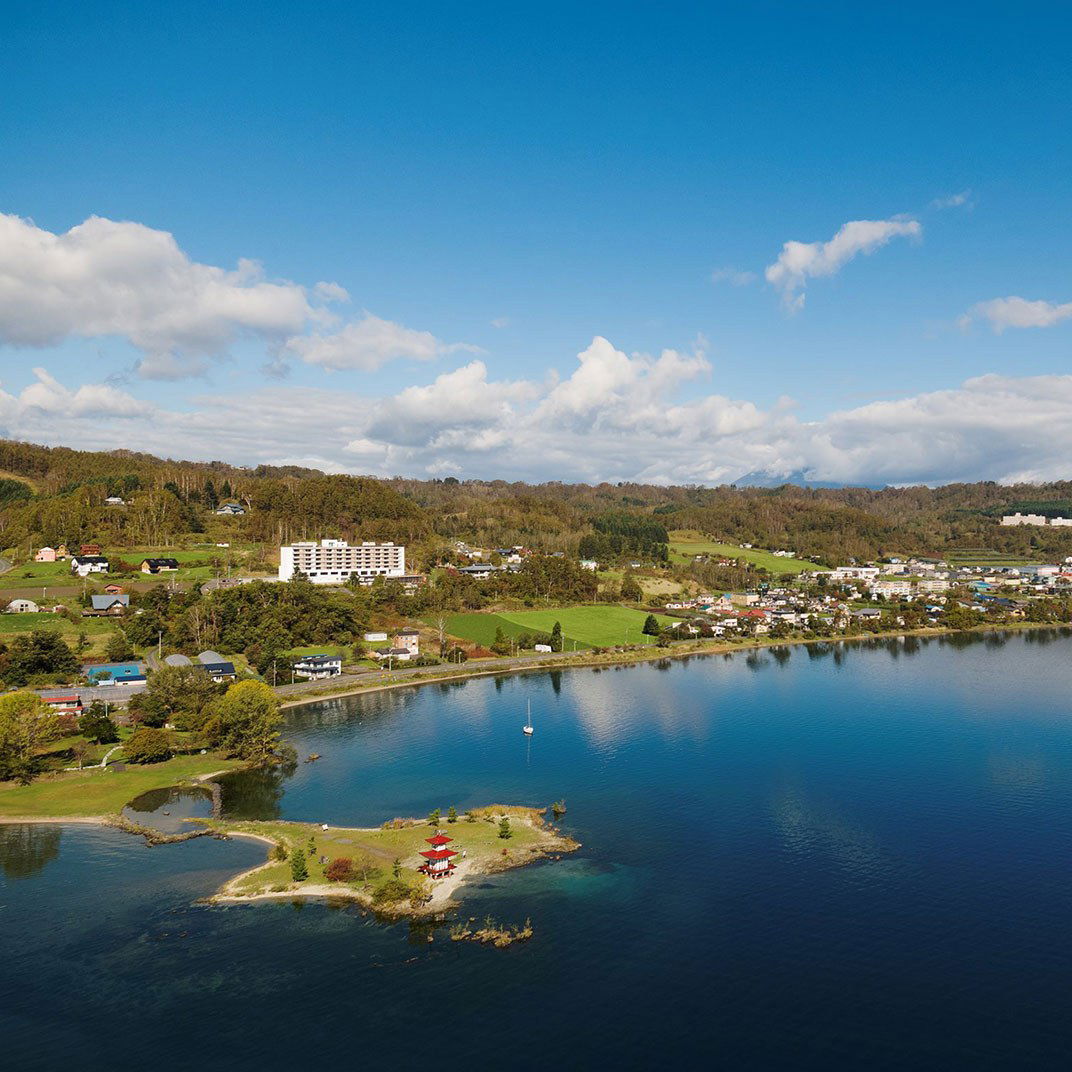
Selected by the Michelin Guide Hotels 2025, WE Hotel Toya sits above Lake Toya in Hokkaido's caldera country, where the architecture works with the volcanic topography rather than against it. The property belongs to a tier of Japanese resort hotels where landscape integration and spatial discipline matter more than room count or brand recognition. A considered choice for travelers arriving from Sapporo or en route through Hokkaido's interior.
Where Volcanic Topography Meets Architectural Restraint
Lake Toya sits inside a caldera formed roughly 110,000 years ago, and the hotels that have gravitated to its shores over the decades have had to negotiate with that fact. The lake does not offer a neutral backdrop. Its circular shape, the four islands at its center, and the surrounding ring of peaks create a framing condition that either works for or against a building's design. WE Hotel Toya, addressed at 293-1 Toyamachi in Toyakocho, Abuta-gun, is among the properties that have leaned into that condition rather than built around it. The result is a hotel whose architectural logic is inseparable from its geography.
Japan's premium ryokan and resort circuit has split into two broad categories over the past decade. One group follows the grand-resort model: high room counts, extensive facilities, brand affiliations that travel internationally. The other operates at smaller scale with a design vocabulary derived from the specific site. WE Hotel Toya belongs to the second group, and its 2025 Michelin Guide Hotels selection confirms a placement that regional travelers have recognized for longer. Michelin's hotel program does not grade on a numerical scale the way its restaurant guide does; inclusion signals that the property meets a threshold of quality and distinctiveness rather than ranking it against peers numerically. For Hokkaido, where the Michelin-selected hotel count remains limited relative to Honshu's resort corridors, that distinction carries weight.
The Architecture as Primary Material
Hotels in the Lake Toya area have historically positioned themselves against the view rather than within it, using picture windows as the primary design gesture. What distinguishes more considered properties in this category is the treatment of threshold spaces: the approach, the lobby transition, the relationship between corridor and exterior. When a building handles those transitions well, the view becomes something you arrive at rather than something presented to you. That sequencing changes the experience of a room entirely.
The architectural approach at WE Hotel Toya works with the horizontal planes of the caldera setting. The surrounding volcanic terrain, including the active Usu volcano whose 2000 eruption reshaped the southern lakeshore, provides a context that rewards restraint over spectacle. Properties that compete on facility volume alone tend to sit awkwardly against that terrain. A design-led property, by contrast, can use the geological scale as a compositional element rather than a problem to solve.
For comparison within the Hokkaido design-hotel category, Zaborin in Kutchan and Higashiyama Niseko Village, a Ritz-Carlton Reserve represent the ski-corridor end of the market, where snow sport access is the primary draw and architecture serves that function. WE Hotel Toya occupies a different niche: a four-season caldera setting where geology, hot spring access, and spatial experience are the core proposition rather than lift access.
Hot Spring Country and the Onsen Hotel Framework
Toyako Onsen, the spa town on Lake Toya's southern shore, sits on one of Hokkaido's most active geothermal zones. The hot spring circuit here predates contemporary resort development by several generations, and the better hotels in the area have historically positioned onsen access as a structural feature rather than an amenity add-on. In the broader framework of Japanese onsen hospitality, the quality of spring water, the design of bathing facilities, and the relationship between indoor and outdoor bathing define the property's credibility within its category at least as much as room design or food.
That framework places WE Hotel Toya within a tradition that runs across Japan's premium ryokan circuit. Properties like Gora Kadan in Hakone, Asaba in Izu, and Amanemu in Mie each earn their standing partly through how they handle the bathing experience: water quality, thermal range, architectural treatment of outdoor baths, and the degree to which the onsen integrates with the overall spatial sequence of the stay. WE Hotel Toya operates within that same evaluative framework from a Hokkaido base.
Seasonal timing matters here. Lake Toya is one of the few Hokkaido lakes that does not freeze in winter, which means the caldera view is available year-round and open-air bathing against a snow-framed landscape is possible in February in a way that is not available at most Honshu hot spring properties. Summer brings fireworks displays over the lake on scheduled evenings from late April through October, a regional tradition that has shaped the leisure calendar in Toyako for decades. These are not venue-specific details so much as factors that define when the destination performs at different registers.
Placing WE Hotel Toya in Its Peer Set
The Michelin-selected hotel designation for 2025 positions WE Hotel Toya within a cohort that includes some of Japan's most considered properties. On Honshu, hotels like HOTEL THE MITSUI KYOTO, Nishimuraya Honkan in Kinosaki-cho, and Kamenoi Besso in Yufu each carry Michelin recognition in their respective categories. What unites that cohort is less a price point or room count than a coherent relationship between the physical setting, the service tradition, and the built environment. WE Hotel Toya earns its place in that group from the Hokkaido end of Japan's resort geography.
Further afield, properties like Benesse House in Naoshima demonstrate what a sustained commitment to design-led hospitality in a non-urban Japanese setting can produce over time. That model, where the built environment and the experience it structures are the primary offering, is one that WE Hotel Toya shares. The contrast with urban luxury properties like Bvlgari Hotel Tokyo is instructive: the Tokyo property competes on urban-luxury terms, brand infrastructure, and metropolitan access; WE Hotel Toya competes on proximity to natural systems, architectural integration, and the specific quality of what Hokkaido's caldera country offers that no city hotel can replicate.
Other Michelin-selected properties across Japan's more remote prefectures, including Satoyama-Jujo in Niigata, Nasu Mukunone in Nasu, and GOTO RETREAT by Onko Chishin in Goto, share a similar positioning logic: the destination itself carries as much weight as the property, and the hotel's job is to make that destination legible rather than to substitute for it.
Planning a Stay
Lake Toya is accessible from Sapporo by car in approximately 90 minutes, or via the JR Muroran Line to Toya Station followed by a local connection. The area draws visitors across all four seasons, though the winter-to-spring shoulder period offers the least competition for availability while still providing the full caldera experience. For a broader orientation to the region's dining and travel options, our full Toyakocho, Abuta-gun restaurants and hotels guide covers the area in detail. Booking directly through the hotel is the standard approach for Michelin-selected Japanese resort properties; lead times for peak summer weekends and the fireworks season run longer than off-peak periods. Comparable Hokkaido planning considerations apply to Fufu Kawaguchiko in Fujikawaguchiko and Fufu Nikko in Nikko, where caldera and volcanic settings similarly define the seasonal calendar.
Frequently Asked Questions
- What's the vibe at WE Hotel Toya?
- WE Hotel Toya reads as a design-led resort property rather than a traditional ryokan or an international chain outpost. The caldera setting and Michelin Hotels 2025 selection place it in a tier where the physical environment and spatial experience take precedence over entertainment-focused amenities. If you are arriving expecting a large-hotel atmosphere with multiple restaurants and event facilities, the property's design-first ethos may read as understated. If the Lake Toya setting and onsen access are the draw, the tone is well-matched.
- What's the signature room at WE Hotel Toya?
- Specific room category data is not available in our current record. As a Michelin-selected property in a caldera setting, the rooms most likely to distinguish the stay are those oriented toward the lake with access to private or semi-private onsen facilities, a configuration standard across Hokkaido's higher-tier resort hotels. Confirm room-type availability and lake orientation directly when booking.
- What should I know about WE Hotel Toya before I go?
- The hotel sits in Toyakocho, Abuta-gun, approximately 90 minutes from Sapporo by road. Toyako Onsen is a hot spring town built around the lake, not a resort complex with attached infrastructure, so dining and activity options beyond the hotel are those of a small onsen town rather than a resort destination. The Michelin Hotels 2025 selection confirms quality at the property level, but understanding the local context sets realistic expectations for what surrounds it.
- How hard is it to get in to WE Hotel Toya?
- No booking data or availability metrics are in our current record. As a Michelin-selected Hokkaido property in a destination with a defined peak season tied to the Lake Toya fireworks calendar (late April to October), summer weekend availability will be the most constrained period. Off-peak winter stays, while colder, are typically easier to secure and offer the distinctive experience of open-air bathing against a snow-framed caldera that is not available at most comparable properties.
- Why does WE Hotel Toya draw guests specifically to Lake Toya rather than other Hokkaido destinations?
- Lake Toya's caldera is one of the few large Hokkaido lakes that remains unfrozen year-round, which expands the window for open-air onsen use and lake-view experiences relative to properties on seasonal lakes further north. The active volcanic geography, including the proximity to Usu volcano and Showa Shinzan, gives the destination a geological specificity that differs from Hokkaido's ski and agricultural tourism circuits. The Michelin Hotels 2025 selection for WE Hotel Toya confirms that at least one property in the area meets the threshold to compete with Japan's wider luxury ryokan and resort set.
Recognized By

Similar venues by awards
Related editorial
- How travel will be redefined by 2040By 2040, Travel Will Stop Being a Place You Go and Become a State You Inhabit Thesis: The defining shift in travel by 2040 will not be faster planes or smarter hotels — it will be the collapse of the
- How travel will be redefined by 2040By 2040, Travel Won't Be an Industry — It Will Be Infrastructure My thesis is simple and, I suspect, unfashionable: by 2040 travel will stop behaving like a discretionary consumer category and start
- How travel will be redefined by 2040By 2040, Travel Won't Be a Trip — It Will Be a Stack My thesis is simple and, I think, uncomfortable: by 2040, "travel" will no longer describe a discrete journey from point A to point B.
Save or rate WE Hotel Toya on Pearl
Keep this venue in your Pearl passport, rate it after you visit, and track it alongside every other place you collect.