
Hotel in Sorrento, Italy
Ara Maris
575ptsSustainability-Led Mediterranean Design


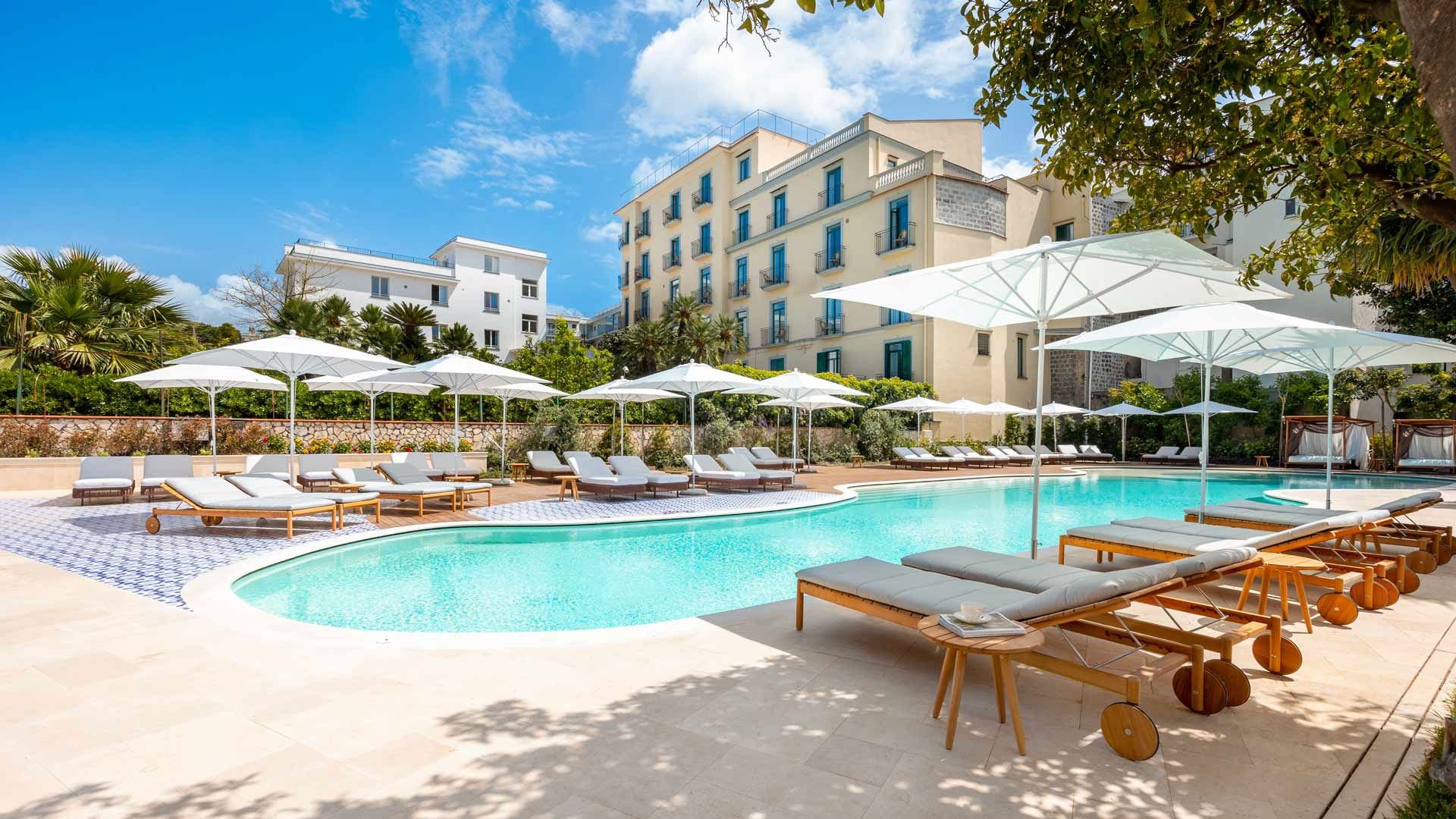
About Ara Maris
At Via Correale 15, Ara Maris occupies a considered position in Sorrento's upper accommodation tier: 49 rooms framed by marble, curated fabrics, and a design language that draws from the Mediterranean's visual grammar rather than generic coastal luxury. The property positions itself at the intersection of Italian material craft and environmental consciousness, making it a counterpoint to the cliff-top grand hotels that have long defined the town's prestige skyline.
Where Sorrento's Design Conversation Is Heading
Sorrento's hotel offer has historically split along a clear fault line: the grand nineteenth-century palaces perched above the water, and the smaller, category-agnostic properties filling the town's interior streets. For much of the past decade, the prestige market belonged almost entirely to the former. Properties like the Grand Hotel Excelsior Vittoria and Grand Hotel Cocumella defined what luxury looked like here: frescoed ceilings, terraced gardens, history as the primary currency. What has changed more recently is the arrival of properties whose design vocabulary is contemporary rather than archival, and whose pitch to guests is aesthetic coherence over accumulated heritage.
Ara Maris, at Via Correale 15, belongs to this newer cohort. With 49 rooms and a stated design framework built on marble, refined fabrics, and sustainability-integrated luxury, it enters the market not as a legacy property but as a position statement about what Mediterranean hospitality can look like when it is assembled from scratch rather than inherited.
The Physical Language of the Property
The design logic at Ara Maris draws directly from the material vocabulary of the Mediterranean. Marble is used as a primary surface element, which in the context of southern Italian interiors is a specific cultural choice: it references the stone traditions of Campania and the broader Italian craftsmanship lineage rather than the polished anonymity of international hotel specification. When marble appears alongside curated fabrics and what the property describes as contemporary aesthetics, the result is a layering of references that tries to keep one foot in regional identity while reading legibly to an internationally travelled guest.
This approach, combining rigorous material quality with environmental awareness, places Ara Maris in a design tier that has become increasingly credible across Italy's premium hotel market. Properties like Borgo Santandrea on the Amalfi Coast and La Minervetta in Sorrento itself have demonstrated that design-forward properties with a clear material identity can compete directly with larger, more established names. The differentiator in each case is consistency: when the design logic extends through every surface, the property reads as intentional rather than assembled.
At 49 rooms, Ara Maris operates at a scale that supports this kind of material coherence. Larger properties face the problem of dilution; the design statement becomes harder to sustain across 150 keys than across 49. The size also positions the property outside the territory of the grand resort and inside something closer to the design-led boutique tier, where the peer set includes places like JK Place Capri and, further up the Italian peninsula, Portrait Milano, both of which use limited keys as part of their value argument.
Sustainability as a Design Principle, Not a Marketing Add-On
The integration of sustainability into Ara Maris's stated identity is worth examining carefully, because it reflects a broader shift in how premium hospitality communicates its values in the 2020s. The older model treated environmental responsibility as a footnote; the newer model, particularly in Mediterranean and Italian contexts, treats it as inseparable from the design premise itself. The idea is that materials chosen with environmental care are also materials chosen with aesthetic seriousness: local stone, natural fibres, production methods with traceable provenance.
Across Italy's most considered recent openings, this integration has become a legibility signal. Castello di Reschio in Lisciano Niccone uses restoration and craft as the core of its environmental argument. Castelfalfi in Tuscany and Borgo San Felice in Castelnuovo Berardenga both position agricultural and material rootedness as part of what justifies their price. Ara Maris makes a similar argument in a coastal context, where the relationship to the sea and to the specific material culture of Campania provides the grounding that sustainability claims require to feel substantive rather than decorative.
Positioning in Sorrento's Competitive Set
Sorrento's position as a destination is well-established but also slightly precarious. It functions as both a genuine destination and as a gateway to the Amalfi Coast and Capri, which means a significant portion of its hotel guests are using it as a base rather than treating it as the endpoint. The properties that have historically commanded the highest regard, the Bellevue Syrene 1820 among them, have done so partly by making Sorrento itself the argument, offering the clifftop view, the historic garden, the sense of place that makes the town worth staying in rather than passing through.
Ara Maris's argument is different. A design-forward property on Via Correale is making a case for Sorrento as a town of interior qualities: its streets, its material culture, its relationship to a broader Mediterranean aesthetic tradition. This is a less obvious pitch than the sea-view legacy approach, but it connects to how design-literate travellers have started to engage with towns like this, interested in the grain of the place rather than just the panorama from the terrace.
For context on how this plays out at the regional scale, Il San Pietro di Positano represents the Amalfi Coast's strongest version of the view-plus-design argument, where the physical drama of the setting and the quality of the interiors reinforce each other. Ara Maris operates without that immediate drama, which places greater weight on the interior coherence of the design to do the work.
Planning a Stay
Ara Maris is located at Via Correale 15 in Sorrento, within walking distance of the town's main piazzas and transport links to the Circumvesuviana rail line, which connects Sorrento to Naples in roughly an hour and provides access to Pompeii, Herculaneum, and Ercolano en route. The ferry terminal for Capri and the Amalfi Coast is accessible from the Marina Piccola, a short downhill walk or taxi from the town centre. Sorrento's peak season runs from late May through September, with July and August bringing the densest visitor numbers and the warmest sea temperatures. Spring and early autumn offer more navigable conditions for those prioritising the town itself over beach access. Contact and booking details are leading confirmed through the property directly at Via Correale 15 or through current third-party channels, as specific rate and availability information is not confirmed in EP Club's data at time of publication.
For a broader picture of where Ara Maris sits among Sorrento's hotel and dining options, see our full Sorrento guide. Those extending their Italy itinerary beyond Campania will find comparable design-led thinking at Aman Venice, Bulgari Hotel Roma, Passalacqua in Moltrasio, Four Seasons Hotel Firenze, Il Pellicano in Porto Ercole, and Casa Maria Luigia in Modena. For those whose travel extends further, Corte della Maestà in Civita di Bagnoregio, Castel Fragsburg in Merano, Rosewood Castiglion Del Bosco, and Borgo Egnazia in Fasano each represent the Italian luxury property market's range across different regions and design philosophies. For international comparison, The Fifth Avenue Hotel in New York, Aman New York, and Amangiri in Canyon Point illustrate how the same design-seriousness-meets-materiality argument translates across very different geographies.
Frequently Asked Questions
- What is Ara Maris known for?
- Ara Maris is a 49-room property in Sorrento that positions itself around design coherence and sustainability-integrated luxury. Its stated identity draws from Mediterranean material culture, with marble and curated fabrics as primary design elements, and an explicit commitment to environmental consciousness as part of the property's value proposition rather than an afterthought. In the context of Sorrento's hotel market, it represents a contemporary design-led approach rather than the historic grand-hotel model.
- What is the leading room type at Ara Maris?
- Specific room category data is not available in EP Club's confirmed records at time of publication. In a 49-room property with a strong design emphasis, the usual guidance applies: rooms on higher floors or with sea-facing aspects in coastal Sorrento tend to command the most favourable positions, while the design quality at properties of this type is typically consistent across categories. Confirm current room tier availability and pricing directly with the property.
- Do they accept walk-ins at Ara Maris?
- No confirmed booking policy data is available through EP Club's records. In Sorrento's peak summer months, July and August in particular, availability at design-forward properties in this tier tends to be constrained. Direct contact with the property at Via Correale 15 is the most reliable route to confirm current availability, and advance booking through confirmed channels is advisable for travel between May and September.
Recognized By


Related editorial
- Best Fine Dining Restaurants in ParisFrom three-Michelin-star icons to the next generation of Parisian chefs pushing boundaries, these are the restaurants that define fine dining in the world's culinary capital.
- Best Luxury Hotels in RomeFrom rooftop terraces overlooking ancient ruins to Michelin-starred hotel dining, these are the luxury hotels that make Rome unforgettable.
- Best Cocktail Bars in KyotoFrom sleek lounges to hidden speakeasies, Kyoto's cocktail scene blends Japanese precision with global influence in ways you won't find anywhere else.
Save or rate Ara Maris on Pearl
Keep this venue in your Pearl passport, rate it after you visit, and track it alongside every other place you collect.