
Hotel in Paris, France
Le Burgundy
625ptsDiscreet 1st Arrondissement Luxury

About Le Burgundy
Against the grand-hotel tradition of Paris's 1st arrondissement, Le Burgundy takes a different position: 59 rooms rather than several hundred, a spa anchored by Susanne Kaufmann's Alpine wellness philosophy, and a Michelin-starred restaurant named for Baudelaire. Priced from $875 per night with a Michelin 1 Key award in 2024, it sits in a tight peer set between the neighbourhood's historic palaces and newer design-led properties.
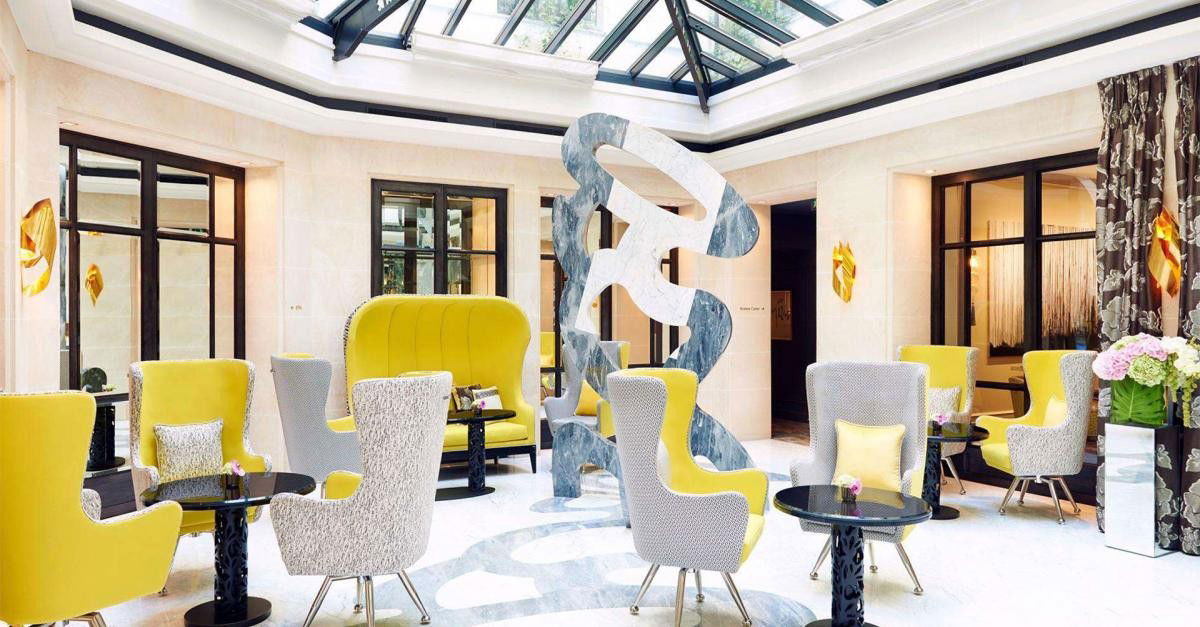
Rue Duphot runs quietly between the Madeleine and the Place de la Concorde axis, and the street has none of the tourist pressure you'd expect from its coordinates. The 1st arrondissement's luxury hotel stock tilts heavily toward grand palace formats, properties that announce themselves with colonnaded facades and lobby volumes designed to make new arrivals feel appropriately small. Le Burgundy does the opposite. Its entrance is composed rather than theatrical, the kind of arrival that asks you to adjust your eyes before you adjust your expectations. What you find inside is a contemporary restraint warmed by saturated colour and layered texture, electronics integrated without becoming the point. Paris has always had a specific relationship with modernism in its interior spaces, treating it not as rupture but as calibrated evolution, and Le Burgundy sits squarely in that tradition.
Scale as an Editorial Statement
Paris's hotel market separates into a few distinct tiers. At the leading sit the historic palaces: the Le Bristol Paris, Hôtel de Crillon, Le Meurice, and Four Seasons George V, each with hundreds of rooms and a public presence calibrated for ceremony. Then come the newer entrants: Cheval Blanc Paris and Hotel Plaza Athénée occupy a hybrid space, retaining scale while pushing design and culinary ambition. Le Burgundy operates at 59 rooms, a count that places it in a more intimate category and shapes how the property functions day to day. Rooms here are not units in a large inventory; at that scale, the hotel can run more like a private house than a public institution. The Michelin 1 Key recognition awarded in 2024 confirms that this operating philosophy meets a defined standard of hospitality excellence, placing Le Burgundy within a set of Parisian addresses that earn that distinction regardless of room count.
Rates from $875 per night position the property within reach of travellers who are choosing between it and larger palace competitors on deliberate grounds rather than price. That decision usually comes down to atmosphere and proximity. For those prioritising the cultural core of Paris and immediate access to the 1st arrondissement's commercial and institutional fabric, the location on Rue Duphot makes a clear argument.
Location and the 1st Arrondissement Context
The address places guests within walking distance of the Louvre, the Tuileries Garden, the Palais-Royal, and the principal shopping corridors of the Rue Saint-Honoré and Place Vendôme. This is not marginal proximity: in a city where neighbourhood matters as much as the hotel itself, the 1st arrondissement provides the most logistically efficient base for anyone whose visit involves both cultural institutions and the concentrated luxury retail that few other streets in the world replicate. La Réserve Paris and the Hôtel de Crillon serve the 8th arrondissement's grands boulevards axis; Le Burgundy answers a different geography without sacrificing any material luxury credential.
For those whose Paris itineraries reach beyond the city, the broader French hotel network offers strong regional comparisons. Properties like Domaine Les Crayères in Reims, Les Sources de Caudalie in Bordeaux, and Royal Champagne Hotel & Spa in Champillon serve specific regional wine and gastronomy purposes; Le Burgundy functions as the Paris anchor in a broader French itinerary for that kind of traveller. Further south, Hotel Du Cap-Eden-Roc in Cap d'Antibes, Baumanière Les Baux-de-Provence in Les Baux, and La Réserve Ramatuelle in Ramatuelle represent the Provence and Riviera end of that same itinerary, while Cheval Blanc Courchevel and Four Seasons Megève serve the Alpine bracket.
The Culinary Infrastructure
French hotel dining operates on a spectrum from ambient restaurant to destination table, and Paris specifically has a long history of hotels whose restaurants earn reputations entirely independent of the room product. Le Burgundy's restaurant Le Baudelaire holds a Michelin star, anchoring the property at the serious end of that spectrum. The naming choice is deliberate: Baudelaire's connection to Paris's bourgeois bohemian literary tradition, his residence in the 1st arrondissement, and his preoccupation with beauty as a critical category all resonate with a hotel that positions contemporary aesthetic refinement against the more ornate conventions of its neighbourhood competitors.
The English-style cocktail bar, Le Charles, extends that literary reference and serves a function that matters in this tier of Parisian hospitality: a serious bar program within the hotel reduces the pressure on guests to orient around external venues for evening drinks, without replicating the formal bar atmospheres of the palace category. This is a calibration that smaller, design-conscious properties in Paris and elsewhere have increasingly adopted as a differentiator from both the palaces and the boutique hotels that lack proper F&B depth. For a broader view of where Le Baudelaire sits in Paris's dining scene, see our full Paris restaurants guide.
Wellness in Context
The Spa Le Burgundy by Susanne Kaufmann is a meaningful detail in this property's positioning. Kaufmann's brand originates in the Austrian Vorarlberg and is associated with an Alpine wellness philosophy that emphasises plant-based formulations and a functional rather than ceremonial approach to treatment. Its presence in a 59-room Paris hotel is not a checkbox exercise; Kaufmann partnerships at this scale carry weight in the same way that a named chef partnership carries weight in a restaurant context. The addition of an indoor pool within the health club is a practical rarity at boutique scale in central Paris, where basement footprints constrain wellness infrastructure significantly. Properties in the palace tier, like Airelles Château de Versailles, can marshal larger spa operations, but at 59 rooms Le Burgundy's wellness offering competes in a different and more selective frame.
How Le Burgundy Compares in the Paris Peer Set
Placing Le Burgundy in competitive context requires some precision. It is not trying to be a palace, and it does not pretend to the scale or the ceremonial weight of Le Meurice or the Hôtel de Crillon. Nor does it position itself in the minimalist boutique tier that trades all culinary and wellness infrastructure for pure design statement. Its actual peer set is a narrow one: small-key properties in central Paris that carry Michelin-recognised dining, credible spa operations, and rates in the upper bracket. That is a short list in any city. The 2024 Michelin 1 Key award provides a useful external validation, since the Key system evaluates the hotel experience as a total proposition rather than isolating individual components. At Airelles Saint-Tropez or The Maybourne Riviera, the Michelin Key system has similarly recognised properties where the integrated proposition exceeds what individual star ratings for dining or spa rankings would suggest in isolation.
For travellers comparing Paris alongside international alternatives, Aman New York and The Fifth Avenue Hotel occupy a comparable bracket in New York, while Aman Venice represents the European small-key luxury format in a different city context. Villa La Coste and Hôtel & Spa du Castellet serve a similar integrated-luxury brief in Provence, and La Bastide de Gordes holds that position in the Luberon. The common thread across all of them is the rejection of scale as the primary luxury signal.
Know Before You Go
| Address | 6-8 Rue Duphot, 75001 Paris |
|---|---|
| Rooms | 59 |
| Rate from | $875 per night |
| Awards | Michelin 1 Key (2024); Le Baudelaire restaurant holds 1 Michelin Star |
| Spa | Spa Le Burgundy by Susanne Kaufmann, with indoor pool |
| F&B | Le Baudelaire (Michelin-starred restaurant); Le Charles cocktail bar |
| Arrondissement | 1st — walking distance to Louvre, Tuileries, Place Vendôme, Rue Saint-Honoré |
Frequently Asked Questions
- What room category do guests prefer at Le Burgundy?
- Le Burgundy's 59-room count means category distinctions carry more weight than at larger properties: at this scale, room placement and configuration are determining factors in the experience. The awards profile and $875 starting rate suggest the upper room categories are calibrated to deliver on the hotel's full proposition, with the Michelin 1 Key recognition (2024) applying to the property as an integrated whole rather than to entry-level accommodation alone. Guests seeking the complete picture of what the hotel offers, including proximity to the spa and Le Baudelaire, should confirm room positioning at booking.
- What is the standout thing about Le Burgundy?
- In Paris's 1st arrondissement, finding a hotel with a Michelin-starred restaurant, a named-brand spa with indoor pool, and fewer than 60 rooms at under $1,000 entry point is a relatively narrow field. The 2024 Michelin 1 Key award recognises this integrated proposition. Most properties at this price point in Paris either have the scale of a palace or the stripped-back format of a design boutique; Le Burgundy maintains full culinary and wellness infrastructure at intimate scale.
- Should I book Le Burgundy in advance?
- At 59 rooms, inventory moves faster than at palace-scale competitors. Paris's peak demand periods, spring and autumn in particular, compress availability across all upper-bracket hotels in the 1st arrondissement, and a property at this scale can fill considerably faster than a 200-room neighbour. The Michelin 1 Key recognition in 2024 has also increased visibility in the well-travelled segment that cross-references award data with booking decisions. Booking well ahead of peak travel windows is advisable, and the same applies to reserving at Le Baudelaire if dining there is part of the plan.
- When does Le Burgundy make the most sense to choose?
- Le Burgundy is the stronger argument when the itinerary centres on the 1st arrondissement's cultural and commercial core, when an integrated spa and Michelin-level dining within the hotel reduces the operational complexity of a Paris visit, and when the preference is for a hotel that functions more quietly than a palace without sacrificing the credentialled substance that those palaces signal. At $875 entry and Michelin 1 Key validated, it competes on depth rather than volume.
- Does Le Burgundy's restaurant Le Baudelaire accept non-hotel guests?
- Le Baudelaire's Michelin star places it in the category of Paris hotel restaurants that draw reservations independently of room bookings. Like comparable hotel dining rooms in the French capital, Le Baudelaire operates as a named destination rather than an in-house amenity exclusive to guests, though precise reservation policies and hours should be confirmed directly with the property before visit.
Recognized By

More hotels in Paris
- 42 Av. Gabriel42 Av. Gabriel sits in one of Paris's most competitive hotel corridors, steps from the Champs-Élysées gardens in the 8th arrondissement. Full pricing and awards data are not yet confirmed, so book direct and verify upgrade eligibility at reservation. For verified alternatives nearby, see Le Bristol Paris, Hôtel de Crillon, or La Réserve Paris.
- Auberge FloraAuberge Flora is a boutique hotel in Paris's 11th arrondissement, offering a neighbourhood-embedded alternative to the palace-district properties at a lower price point. It books easily, sits close to the Marais and Bastille, and suits travellers who want a design-forward base rather than full concierge service. A practical choice if location flexibility and value matter more than brand prestige.
Related editorial
- Best Fine Dining Restaurants in ParisFrom three-Michelin-star icons to the next generation of Parisian chefs pushing boundaries, these are the restaurants that define fine dining in the world's culinary capital.
- Best Luxury Hotels in RomeFrom rooftop terraces overlooking ancient ruins to Michelin-starred hotel dining, these are the luxury hotels that make Rome unforgettable.
- Best Cocktail Bars in KyotoFrom sleek lounges to hidden speakeasies, Kyoto's cocktail scene blends Japanese precision with global influence in ways you won't find anywhere else.
Save or rate Le Burgundy on Pearl
Keep this venue in your Pearl passport, rate it after you visit, and track it alongside every other place you collect.