
Hotel in Paris, France
Hôtel Le Ballu
625ptsSyldavian-Themed Boutique

About Hôtel Le Ballu
A 37-room boutique hotel in Paris's 9th arrondissement, Hôtel Le Ballu draws its design vocabulary from Syldavia, the fictional Balkan country in the Tintin comics. The result is a mid-century palette with an Eastern accent, a Michelin-recognised restaurant serving inventive French classics, and a private swimming pool that is genuinely rare at this price point. Rates from $313 per night.
Where the 9th Arrondissement's Creative Energy Meets Deliberate Eccentricity
Paris's 9th arrondissement has long occupied an interesting position in the city's hospitality map: close enough to the grands boulevards to feel central, but sufficiently removed from the 1st and 8th to attract a more independent-minded crowd. The neighbourhood around Place de Clichy and Quartier Pigalle has evolved into one of the city's more interesting overnight territories, with a density of restaurants, bars, and cultural venues that rivals more famous hotel districts while operating at a different register. It is in this context that Hôtel Le Ballu positions itself — not as a conventional luxury address but as a design-driven boutique property with a clear point of view.
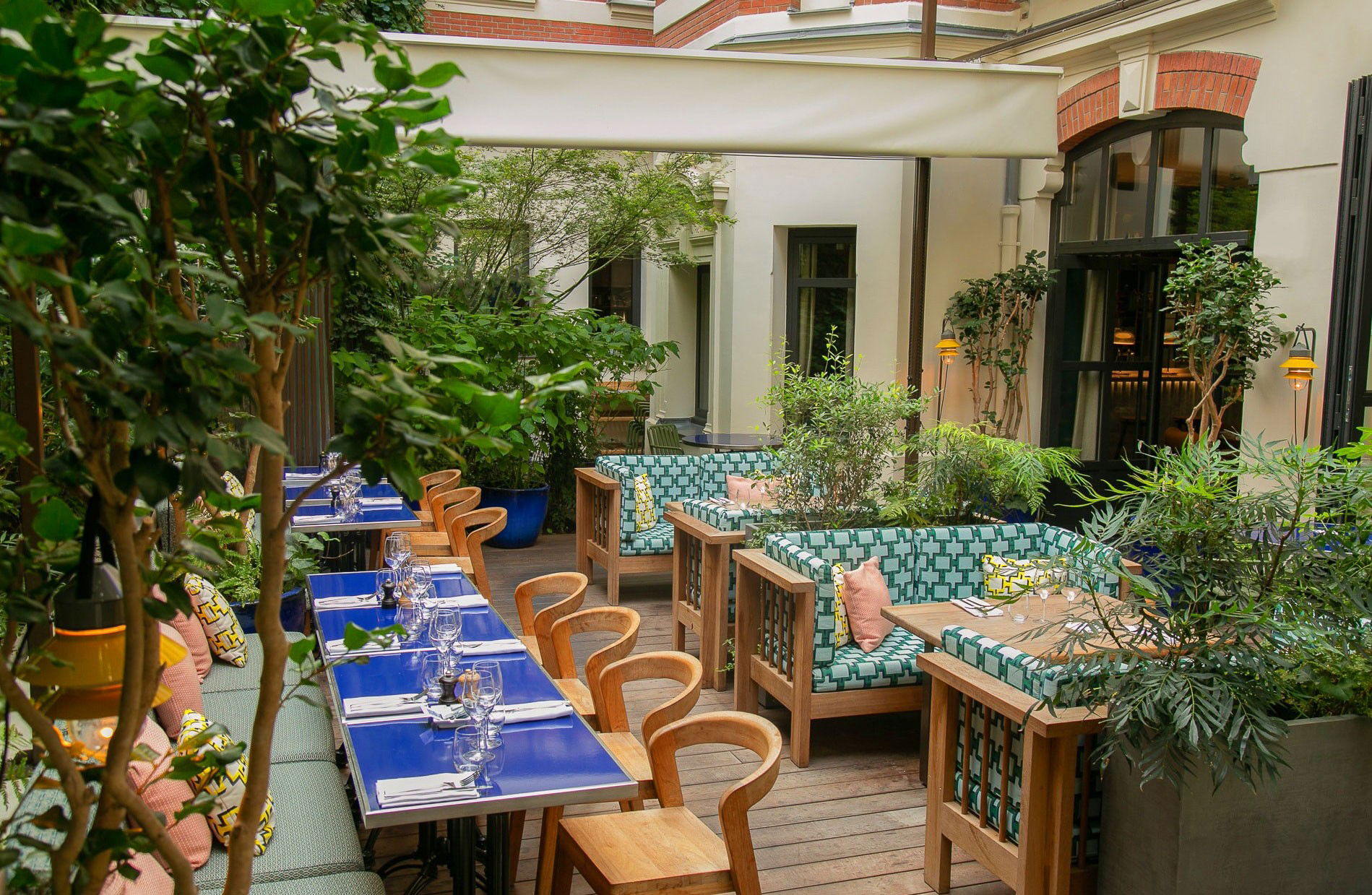
That point of view arrives directly from the source material: Syldavia, the fictional Balkan kingdom invented by Hergé for the Tintin comics. It is an unusual premise for a hotel, and the risk is obvious — themed hospitality can curdle into costume. What keeps Le Ballu on the right side of that line is that the reference functions as a design grammar rather than a literal recreation. The palette is warm and saturated, the forms are mid-century, and there is a consistent Eastern European accent running through the spaces that gives the interiors coherence without tipping into pastiche. The fact that the owners are also the architects matters here: the kind of stylistic consistency that produces a genuinely distinctive visual identity is difficult to achieve when design is delegated.
37 Rooms Built Around Liveable Detail
At 37 rooms, Le Ballu occupies the smaller end of Paris boutique hospitality, where room count tends to correlate with individual character. The configuration includes kitchenettes throughout, with select rooms adding freestanding bathtubs and private terraces. This cluster of amenities places the hotel in a practical tier above the standard boutique format: the kitchenette provision signals a property comfortable with longer stays and guests who want operational independence alongside design quality.
Paris boutique hotels in the sub-$400 bracket often succeed in one register while conceding in another , strong design but thin amenity, or comfortable rooms without visual interest. Le Ballu's rate from $313 per night sits in a zone where the terrace-equipped and bathtub rooms represent meaningful differentiation from the base offering. For travellers calibrating between a standard room at one of Paris's palace-tier addresses and something with more spatial personality at a lower entry point, the 9th arrondissement boutique category is worth serious attention. Le Ballu is among the more considered options in that tier.
The private swimming pool sits in a different category of rarity altogether. Hotel pools in Paris are uncommon at any price point; at the boutique end of the market, they are close to nonexistent. The aesthetic here draws on the Russian bath tradition, which aligns with the property's broader Eastern European visual logic. It is offered for private use , a detail that changes the nature of the amenity entirely, shifting it from hotel facility to something closer to a reserved urban retreat.
The Restaurant: French Classics Read Through an Eastern Lens
Michelin's 2024 Key designation for Le Ballu covers the hotel as a hospitality experience, not the restaurant specifically, but the restaurant functions as a genuine part of the property's identity rather than an afterthought. In a neighbourhood like the 9th, where the dining scene runs from serious natural wine bars to established bistros, holding a local reputation in the restaurant category requires consistent execution.
The menu architecture at Le Ballu's restaurant is worth understanding as a structural decision rather than a style choice. French classical cooking provides the framework , the techniques, the sauce logic, the sourcing assumptions , while the Eastern Bloc aesthetic of the room creates a counterpoint that keeps the experience from feeling generic. The Art Deco-influenced interior, read through a decidedly non-Western European lens, produces the kind of dining room where the physical context adds a layer of interpretation to what arrives on the plate. Inventive French classics in this setting carry a different charge than they would in a direct Haussmann-era brasserie.
This approach to menu architecture , using a well-understood cooking tradition as the structural base while allowing the surrounding context to shift its meaning , is more sophisticated than it first appears. It does not require the kitchen to reinvent classical technique; it requires confidence that the environment and the food are in genuine dialogue. In the 9th, where Paris's restaurant scene runs at high density and competition, that kind of coherence matters more than novelty for its own sake.
Where Le Ballu Sits in the Paris Hotel Conversation
Paris's luxury hotel market is heavily weighted toward the palace category, with properties like Le Bristol Paris, Hotel Plaza Athénée, Hôtel de Crillon, Le Meurice, and Four Seasons George V defining the upper tier. La Réserve Paris and Cheval Blanc Paris represent the design-conscious luxury end. Le Ballu operates in a different register entirely , smaller, more idiosyncratic, and priced well below that cohort while offering amenities, specifically the private pool and Michelin recognition, that punch above its bracket.
The relevant peer set for Le Ballu is not the palace hotels but the design-led boutique properties scattered across the 9th and 10th arrondissements: properties where architectural authorship and a specific point of view matter more than square footage or concierge infrastructure. Within that peer set, the Syldavia conceit, executed with enough rigour to feel like a design language rather than a novelty, and the swimming pool provision, give Le Ballu a competitive position that is genuinely distinct.
For travellers who want the context of a Paris boutique stay but with access to the Pigalle-area restaurant and bar scene rather than the tourist infrastructure of the Marais or Saint-Germain, this end of the 9th arrondissement offers a different kind of Paris experience. Le Ballu's Google rating of 4.7 across 387 reviews suggests consistent delivery on that promise.
Elsewhere in France, the same design-led boutique logic applies at different scales: Villa La Coste in Provence takes an art-and-architecture approach at the luxury end, while La Bastide de Gordes and Domaine Les Crayères in Reims each build their identities around a specific regional context. The broader lesson from properties like Les Sources de Caudalie in Bordeaux and Royal Champagne Hotel and Spa in Champagne is that French boutique hospitality at its most successful tends to build a coherent identity from a specific place or idea rather than reaching for generic luxury signals. Le Ballu's Syldavia premise is the Parisian version of that logic.
Planning Your Stay
Hôtel Le Ballu is at 30 Rue Ballu in the 9th arrondissement, close to Place de Clichy and within reach of the Pigalle neighbourhood's concentration of restaurants and late-night venues. With rates from $313 per night, the property prices in the upper-mid boutique range rather than the luxury tier, though the private pool access and Michelin Key designation (2024) position it above most comparably-priced Paris options. Given the 37-room capacity and the property's reputation, booking in advance is advisable, particularly for rooms with private terraces or freestanding bathtubs, which represent the most differentiated accommodation in the house. The website should be the primary booking channel to confirm current availability and room category specifics.
Frequently Asked Questions
What is Hôtel Le Ballu known for?
Le Ballu is recognised primarily for its design concept, which draws on Syldavia , the fictional Balkan kingdom from the Tintin comics , to produce a mid-century interior with a consistent Eastern European visual accent. At the practical level, it holds a Michelin Key (2024), operates a private swimming pool (rare at this price point in Paris), and rates from $313 per night across 37 rooms. Its restaurant, serving inventive French classics in an Art Deco-influenced space, carries a local reputation in a neighbourhood where dining standards are high.
Is Hôtel Le Ballu more formal or casual?
Le Ballu sits firmly in the casual-to-relaxed register. The Michelin Key recognition covers the hospitality experience rather than signalling a formal dining or service protocol. The design-led boutique format, the Pigalle-adjacent location, and the kitchen-equipped rooms all suggest a property built for guests who want personality and comfort over ceremony. That said, at $313 per night with a Michelin-recognised restaurant on site, it operates with more intentionality than a standard casual hotel.
What room should I choose at Hôtel Le Ballu?
The rooms with private terraces represent the most distinctive choice for guests who want outdoor space in a city where that is genuinely scarce at the boutique level. The freestanding bathtub rooms offer a different kind of comfort premium. All 37 rooms include kitchenettes, so the base offering already provides more operational flexibility than most Paris boutique comparators. The specific room configuration should be confirmed directly with the hotel, as availability across 37 rooms can shift quickly.
What's the leading way to book Hôtel Le Ballu?
Booking directly through the hotel's own channels is the recommended approach for a property of this size: at 37 rooms, direct contact gives the clearest picture of which room categories are available and allows you to specify preferences for terraces or bathtub rooms. Phone and website details should be confirmed at time of booking. Given the property's Michelin Key status and its 4.7 Google rating across nearly 400 reviews, demand is consistent, so early booking is advisable for peak Paris travel periods.
Does the Tintin connection at Hôtel Le Ballu go beyond the décor?
The Syldavia reference functions as a full design language rather than a surface theme. Because the owners are also the architects, the Eastern European mid-century aesthetic runs through the spatial planning, colour choices, and material decisions rather than being applied as decoration after the fact. The private pool, styled to evoke a Russian bath, is one example of the concept extending into an amenity rather than stopping at the walls. Guests familiar with the Tintin source material will find specific visual nods; those who are not will simply encounter a coherent and distinctively non-generic interior that holds together on its own terms.
Recognized By

More hotels in Paris
- 42 Av. Gabriel42 Av. Gabriel sits in one of Paris's most competitive hotel corridors, steps from the Champs-Élysées gardens in the 8th arrondissement. Full pricing and awards data are not yet confirmed, so book direct and verify upgrade eligibility at reservation. For verified alternatives nearby, see Le Bristol Paris, Hôtel de Crillon, or La Réserve Paris.
- Auberge FloraAuberge Flora is a boutique hotel in Paris's 11th arrondissement, offering a neighbourhood-embedded alternative to the palace-district properties at a lower price point. It books easily, sits close to the Marais and Bastille, and suits travellers who want a design-forward base rather than full concierge service. A practical choice if location flexibility and value matter more than brand prestige.
Related editorial
- Best Fine Dining Restaurants in ParisFrom three-Michelin-star icons to the next generation of Parisian chefs pushing boundaries, these are the restaurants that define fine dining in the world's culinary capital.
- Best Luxury Hotels in RomeFrom rooftop terraces overlooking ancient ruins to Michelin-starred hotel dining, these are the luxury hotels that make Rome unforgettable.
- Best Cocktail Bars in KyotoFrom sleek lounges to hidden speakeasies, Kyoto's cocktail scene blends Japanese precision with global influence in ways you won't find anywhere else.
Save or rate Hôtel Le Ballu on Pearl
Keep this venue in your Pearl passport, rate it after you visit, and track it alongside every other place you collect.