
Hotel in Okinawa Prefecture, Japan
Hoshinoya Taketomi Island
150ptsRyukyuan Vernacular Immersion

About Hoshinoya Taketomi Island
Hoshinoya Taketomi Island sits on a protected coral atoll in the Yaeyama archipelago, where traditional Ryukyuan village architecture and a Michelin Selected recognition position it at the quieter, more considered end of Japanese luxury hospitality. The property reads less as a resort than as a deliberate immersion in a place that has resisted the pace of mainland development for centuries.
Architecture as Argument: The Design Logic of Hoshinoya Taketomi Island
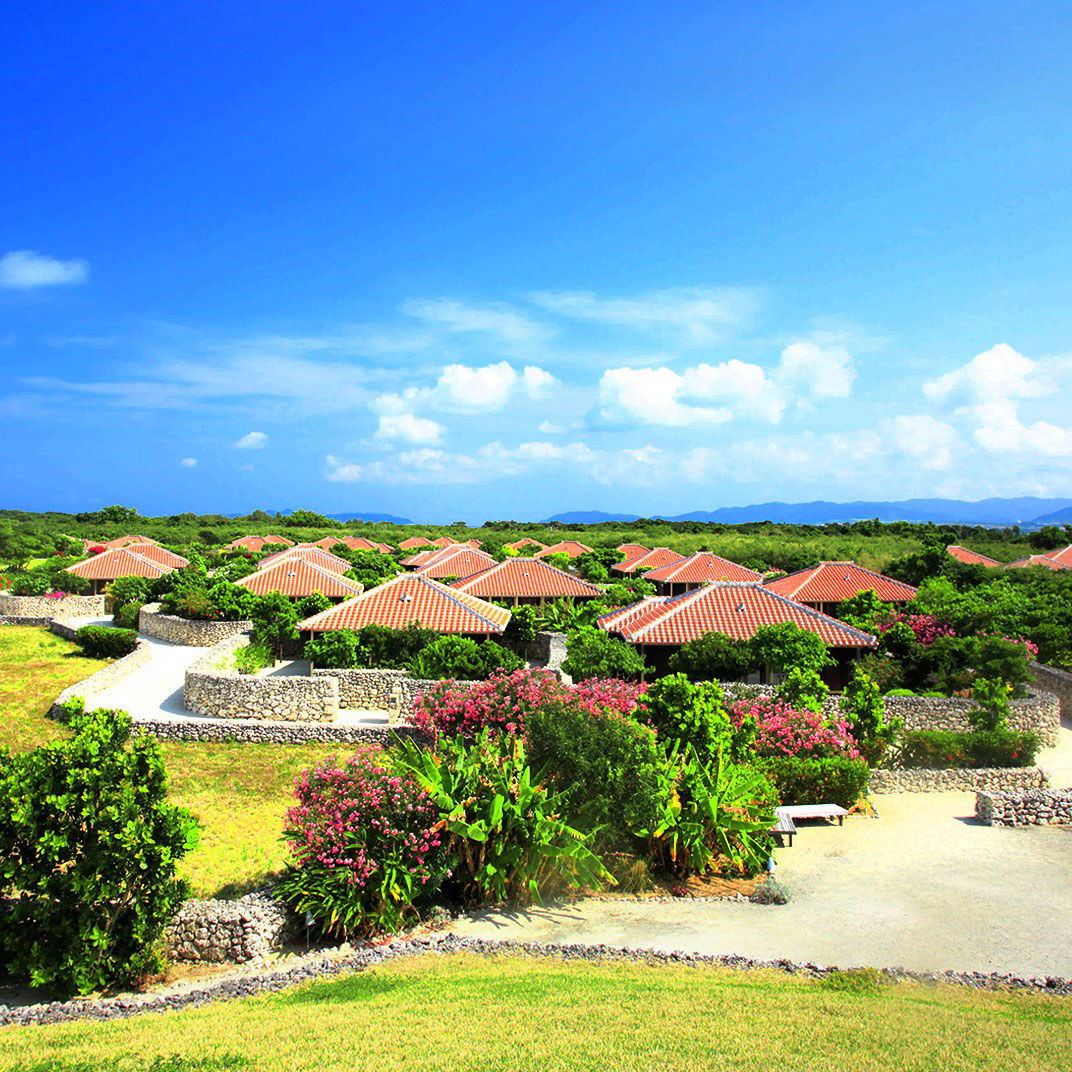
Taketomi Island occupies roughly 9 square kilometres of the Yaeyama archipelago, roughly 20 minutes by ferry from Ishigaki. The island has no traffic lights, no conbini, and a local population that actively manages visitor numbers to preserve its built fabric. That fabric, characterised by low coral-stone walls, terracotta-tiled rooftops weighted with shisa guardian figures, and unpaved sandy lanes, has been designated a National Important Preservation District for Groups of Historic Buildings. Any architecture placed within or adjacent to it operates under significant constraint — and that constraint has shaped Hoshinoya Taketomi Island more definitively than any design brief could.
Hoshino Resorts, the group behind the property, has pursued a consistent philosophy across its Hoshinoya line: build from the vernacular rather than against it. At Taketomi, that means structures whose scale, materials, and visual grammar echo the existing Ryukyuan village rather than contrasting with it. The low-pitched roofs, the rough-textured exterior walls, and the proportions of the guest pavilions are calibrated to read as an extension of the historic settlement rather than a counterpoint. In a region where international resort development has frequently defaulted to the generic — glass towers, imported marble, pools oriented for Instagram rather than orientation , this represents a deliberate positioning choice as much as an aesthetic one.
The design sits within a broader pattern in Japanese premium hospitality, where the most considered properties draw authority from their physical context rather than from imported luxury codes. Benesse House in Naoshima anchors its identity in the island's contemporary art infrastructure. Gora Kadan in Hakone works within the historical weight of an imperial family villa. Amanemu in Mie draws from the ceremonial landscape surrounding the Ise shrines. At Taketomi, the grounding material is a living Ryukyuan village, still inhabited, still governed by community rules about what changes and what does not. That makes the design conversation here different in kind, not just degree.
The Ryukyuan Vernacular and What It Demands
The Ryukyu Islands developed an architectural tradition distinct from mainland Japanese forms, shaped by typhoon exposure, coral reef geology, and centuries of maritime trade with China, Southeast Asia, and the Korean peninsula. The heavy tiled roofs , sealed with lime mortar to resist wind , the shisa guardian figures, the enclosed compound layouts with their low perimeter walls: these are responses to climate and history simultaneously. Taketomi has preserved them with unusual fidelity, which is partly why the island draws the kind of visitors who come specifically to experience a built environment that has not been substantially reworked.
Hoshinoya's guest pavilions are distributed across the property in a loose compound arrangement that mirrors the spatial logic of the village. Approached from the water, the resort's roofline does not spike above the treeline. Internal pathways are shaded by plantings that reference local vegetation. This spatial restraint , the decision not to dominate the site , is itself a design statement, and one with real consequences for how the property feels to move through. It is not a hotel that announces itself loudly on arrival.
For context on how other premium properties handle the tension between strong site identity and guest expectations, Zaborin in Kutchan and Asaba in Izu represent the mainland ryokan tradition's version of the same negotiation: landscape deference, material restraint, and an architecture that frames rather than competes with its setting. Hoshinoya Taketomi Island belongs to the same conversation, though the vernacular material is coastal and Okinawan rather than alpine or onsen-valley Japanese.
Michelin Recognition and the Peer Group It Implies
A Michelin Selected designation in the 2025 Michelin Hotels list places Hoshinoya Taketomi Island in a curated tier that includes properties selected for quality and character rather than solely for scale or amenity count. Within Okinawa Prefecture, that recognition carries particular weight given the breadth of the accommodation offer, which ranges from mass-market beach resorts to niche cultural properties. The Michelin framework, applied to hotels since Michelin began expanding its hotel selections in Japan, tends to favour properties with a strong sense of place and architectural coherence , both of which Hoshinoya Taketomi Island supplies in direct, site-specific form.
Other Okinawa-area properties with comparable positioning include Halekulani Okinawa and The Hiramatsu Hotels and Resorts Ginoza, both of which occupy the upper tier of the prefecture's hotel offer but approach the question of design identity differently. Halekulani imports a Hawaiian lineage. The Hiramatsu brand brings a food-first French-inflected sensibility. Hoshinoya Taketomi Island's claim rests primarily on architectural and cultural specificity: you cannot replicate this sense of place at another location because the location is the argument.
Further afield, the Hoshinoya brand has demonstrated consistency across its properties. Fufu Kawaguchiko and Fufu Nikko represent related but distinct approaches to Japanese regional luxury. For reference points at the upper end of Japanese luxury more broadly, Bvlgari Hotel Tokyo and HOTEL THE MITSUI KYOTO operate in a different register entirely, anchored in urban scale and international luxury codes. The Taketomi property is emphatically not that kind of hotel, and the contrast is instructive about what Japanese premium hospitality actually encompasses as a category.
Getting There and Practical Orientation
Reaching Taketomi Island requires flying into Ishigaki Airport, which receives direct flights from Tokyo, Osaka, Nagoya, and several other Japanese cities, then taking a ferry from Ishigaki port. The crossing is short but the logistics mean that Taketomi operates on a different pace from the moment the journey begins. This is not incidental , the access pattern filters for guests who have decided, in advance, that the island itself is the destination. Booking through the Hoshinoya Taketomi Island website or via the Hoshino Resorts reservation system is standard for the brand; like most properties in the Hoshinoya line, advance reservations are advisable, particularly during the warmer months when the Yaeyama islands receive the bulk of their visitors.
The island is small enough to cover by buffalo cart or bicycle, which are the traditional transport modes the village has maintained. Hoshinoya's position on the island means guests are within proximity of the village centre without being embedded in it, which respects both the residents' daily life and the guest experience. For those building a broader Okinawa itinerary, our full Okinawa Prefecture guide covers the prefecture's dining and hospitality offer across the main island and the Yaeyama chain. For nearby alternatives at the island-property end of the spectrum, Jusandi in Ishigaki operates on the larger adjacent island with a comparable design-led ethos.
Formality, Atmosphere, and What to Expect
Is Hoshinoya Taketomi Island more formal or casual? The honest answer is neither, in the conventional sense. The property sits within Hoshinoya's broader positioning as a culturally immersive ryokan-style experience rather than a resort-format hotel with pools, structured programming, and a lobby designed to impress on arrival. The atmosphere is calm in a way that is architectural as much as service-driven , the low ceilings, the open-air corridors, the sound of the wind and the roosters that are a documented fact of Taketomi village life. Dress codes are not the operative concern here; the operative question is whether a guest is prepared for an experience defined by what the property removes rather than what it adds. This is luxury through subtraction, a mode that sits at one end of a spectrum whose other end might be occupied by something like Badrutt's Palace in St. Moritz or Hôtel de Paris Monte-Carlo. Both ends are legitimate; they answer different questions about what travel is for.
As for the accommodation tier structure, the Hoshinoya line typically organises its rooms and suites around varying levels of space and garden or water orientation, with the higher categories offering greater separation from shared areas. Specific suite configurations and pricing are leading confirmed directly with the property at the time of booking, as they vary by season and availability. What holds across the range is the design language: Ryukyuan materials, low furniture scaled for floor-level living, and an interior logic that asks guests to slow down rather than fill the days with activity.
How It Fits the Wider Premium Japan Circuit
Japan's premium ryokan and design-hotel circuit has expanded considerably over the past decade, and properties like Hoshinoya Taketomi Island now operate within a peer group that includes Nishimuraya Honkan in Kinosaki, Kamenoi Besso in Yufu, Satoyama-Jujo in Niigata, and Nasu Mukunone. What these properties share is an insistence on regional specificity as the primary value proposition. Each one is the product of a particular place, and removing it from that place would make it nonsensical. Hoshinoya Taketomi Island is, in that sense, among the clearest expressions of what this tier of Japanese hospitality is attempting: not a hotel that could be anywhere, but one that could only be here.
Recognized By

Similar venues by awards
Related editorial
- How travel will be redefined by 2040By 2040, Travel Will Stop Being a Place You Go and Become a State You Inhabit Thesis: The defining shift in travel by 2040 will not be faster planes or smarter hotels — it will be the collapse of the
- How travel will be redefined by 2040By 2040, Travel Won't Be an Industry — It Will Be Infrastructure My thesis is simple and, I suspect, unfashionable: by 2040 travel will stop behaving like a discretionary consumer category and start
- How travel will be redefined by 2040By 2040, Travel Won't Be a Trip — It Will Be a Stack My thesis is simple and, I think, uncomfortable: by 2040, "travel" will no longer describe a discrete journey from point A to point B.
Save or rate Hoshinoya Taketomi Island on Pearl
Keep this venue in your Pearl passport, rate it after you visit, and track it alongside every other place you collect.