
Hotel in Münster, Germany
Factory Hotel
150ptsConverted Brewery Lodging

About Factory Hotel
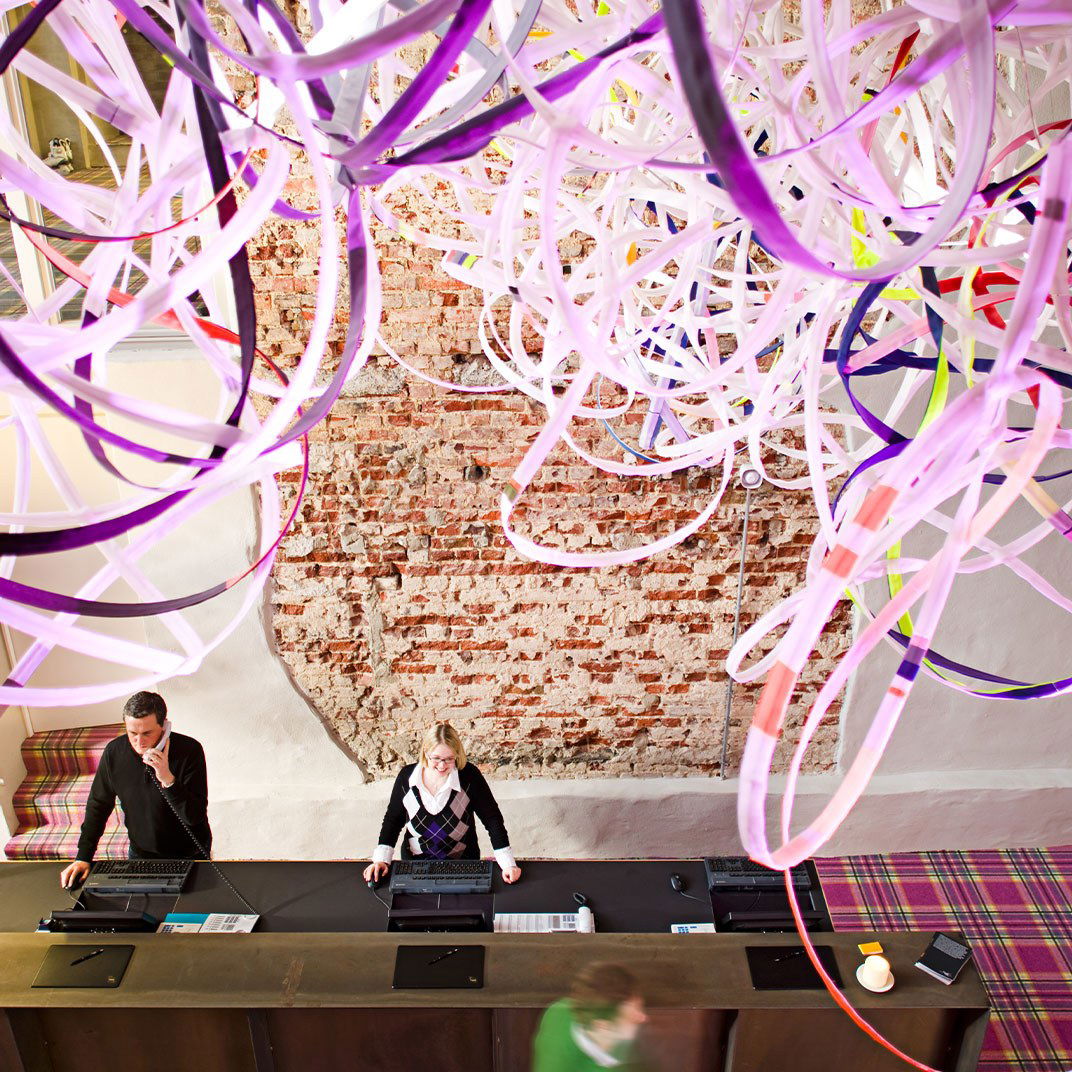
A Michelin Selected hotel occupying a converted brewery complex on the edge of Münster's old city, Factory Hotel translates industrial heritage into a contemporary stay with genuine architectural character. The Germania Brauerei bones — exposed brick, original ironwork, high-volume spaces — give it a different register from the city's conventional hotel offer, and from the broader category of German adaptive-reuse properties.
Industrial Bones, Contemporary Stay
Münster is a cycling city, a university city, and one of the most extensively rebuilt cities in postwar Germany — its historic centre so carefully reconstructed that the seams between original fabric and 1950s restoration are nearly invisible. Against that backdrop of deliberate preservation, the Germania Brauerei site at An der Germania Brauerei 5 represents a different architectural proposition entirely. Where most of Münster's hospitality offer gravitates toward the restored-gabled-house aesthetic of the Prinzipalmarkt district, Factory Hotel occupies a former industrial brewing complex and makes no attempt to soften its origins. The result is a property that reads against the grain of the city's dominant visual language — which is precisely its editorial interest.
Across Germany, the adaptive reuse of industrial buildings for hotel use has produced a recognisable typology: retained structural elements (brick, steel, concrete) combined with design-forward interiors that use the original volume rather than subdividing it away. The approach works when the source building has sufficient architectural presence and when the conversion discipline holds. The Germania Brauerei site has both: brewery buildings carry height, rhythm, and a material honesty that most purpose-built hotels have to simulate. Factory Hotel inherits those qualities rather than purchasing them through interior design spend alone.
The Germania Brauerei Setting
The address itself signals the building's history. The Germania Brauerei was one of Münster's significant brewing operations, and the site carries the structural logic of industrial production , functional volumes, load-bearing masonry, spatial sequences organised around process rather than comfort. Converting that kind of building into a hotel requires negotiating between the raw geometry of the original and the hospitality expectations of a contemporary guest. Hotels that resolve that tension well tend to produce spaces with a quality of atmosphere that newer-built properties find difficult to manufacture: the sense that the room you are in existed for a serious purpose before you arrived.
In the broader German market, this positions Factory Hotel in a specific competitive cohort. Properties like Telegraphenamt in Berlin occupy similarly converted heritage structures, where the building's civic or industrial past becomes the primary design statement. The difference in Münster is one of scale and city context: Berlin's adaptive-reuse hotel scene is dense and competitive; Münster's is not, which means Factory Hotel operates with less peer pressure in its immediate market and more distinctiveness relative to the local offer.
Michelin Selection and What It Signals
Factory Hotel holds a MICHELIN Selected designation in the Michelin Hotels guide 2025, which is the guide's entry-level recognition tier for hotels meeting consistent quality standards across comfort, service, and overall guest experience. In the German hotel market, Michelin selection places a property in a reviewed and validated cohort rather than the broader unreviewed mass , useful context when assessing whether the quality signals are independent or self-reported. For a mid-sized city like Münster, Michelin selection is not a common credential, and it positions Factory Hotel clearly above the standard business-travel offer that dominates the local accommodation supply.
To calibrate that positioning against peer sets elsewhere in Germany: properties like the Fairmont Hotel Vier Jahreszeiten in Hamburg, Excelsior Hotel Ernst in Cologne, or the Sofitel Frankfurt Opera operate in larger cities with denser luxury competitive sets and carry additional layers of recognition. Factory Hotel is not competing in that tier. Its peer set is design-led independent or boutique properties in German secondary cities , a category where Michelin selection carries meaningful weight as an independent quality signal.
Münster as a Hotel Base
Münster rewards slower travel. The city centre is compact enough to cover on foot or by bicycle , the local cycling infrastructure is among the most developed of any German city , and the Prinzipalmarkt, the Überwasser quarter, and the museum district around the Domplatz are all within a short radius of each other. The university presence keeps the food and bar offer younger and more varied than the population size would otherwise suggest, and our full Münster restaurants guide covers the range of dining options in more detail.
The Germania Brauerei address sits at a slight remove from the immediate historic centre, which is consistent with the logic of adaptive reuse: brewery sites, tanneries, and factory complexes were historically located at the edge of urban cores rather than within them. That positioning gives Factory Hotel a different arrival experience from a hotel on the Prinzipalmarkt , quieter, less tourist-pressured, with the walk or cycle into the centre functioning as an orientation rather than an inconvenience.
For travellers comparing Münster to other German city bases, the closest regional alternatives with equivalent or higher recognition levels include Breidenbacher Hof in Düsseldorf and the Esplanade Saarbrücken, both operating in larger urban contexts. Within Germany's resort and countryside tier, properties like Althoff Seehotel Überfahrt in Rottach-Egern, Schloss Elmau in Elmau, or Hotel Traube Tonbach in Baiersbronn sit in a categorically different price bracket and experience register. Factory Hotel's pitch is urban, design-led, and tied to a specific building rather than a landscape setting.
Planning Your Stay
The hotel's address at An der Germania Brauerei 5 is accessible from Münster Hauptbahnhof, which sits on the main rail corridor connecting Dortmund and Osnabrück and is well-served by Deutsche Bahn regional and intercity services. The city is also reachable from Münster/Osnabrück Airport, though most travellers arrive by rail from within Germany. Booking is handled through standard channels; the Michelin Selected status means the property appears in Michelin's own hotel booking interface, which is worth using for the independent confirmation it provides. No specific pricing data is available in our records, but the industrial-conversion boutique tier in German secondary cities typically runs below equivalent-design properties in Frankfurt, Hamburg, or Munich. The Mauritzhof Hotel Münster is the closest local alternative worth comparing directly.
Frequently Asked Questions
What is the atmosphere like at Factory Hotel?
The atmosphere derives from the building rather than from layered décor. Converted brewery architecture carries height, exposed structural materials, and a spatial generosity that purpose-built hotels rarely achieve at equivalent price points. Münster's own character , a mid-sized university and administrative city with a well-preserved but reconstructed historic core , means the hotel sits in a city where design ambition reads clearly against a predominantly conservative backdrop. Michelin Selected status in the 2025 guide confirms that the quality of the experience holds up under independent review, not just marketing presentation. Guests looking for the cocooned luxury register of a Badrutt's Palace or Hôtel de Paris Monte-Carlo will find Factory Hotel operates in a different register entirely: less formal, architecturally driven, and better suited to travellers who prefer the building to do the atmospheric work.
What room should I choose at Factory Hotel?
Without current room-tier data in our records, the general principle for converted industrial properties applies: the rooms that retain the most original architectural fabric , high ceilings, exposed brick or steel, generous window openings , will deliver the most differentiated experience relative to what a standard hotel room provides. In brewery conversions specifically, the older production areas tend to yield more architecturally interesting volumes than ancillary or later-added structures. Michelin's selection process evaluates comfort and service consistency across the property, so any room should meet baseline quality standards; the decision is primarily about how much architectural character you want in the immediate sleeping environment. For comparison, design-led properties in Germany's independent tier , such as Villa Contessa in Bad Saarow or Söl'ring Hof in Sylt , tend to grade their room categories explicitly by view or structural feature, and it is worth asking Factory Hotel directly whether room categories map to different parts of the original building.
Recognized By

Similar venues by awards
Related editorial
- How travel will be redefined by 2040By 2040, Travel Will Stop Being a Place You Go and Become a State You Inhabit Thesis: The defining shift in travel by 2040 will not be faster planes or smarter hotels — it will be the collapse of the
- How travel will be redefined by 2040By 2040, Travel Won't Be an Industry — It Will Be Infrastructure My thesis is simple and, I suspect, unfashionable: by 2040 travel will stop behaving like a discretionary consumer category and start
- How travel will be redefined by 2040By 2040, Travel Won't Be a Trip — It Will Be a Stack My thesis is simple and, I think, uncomfortable: by 2040, "travel" will no longer describe a discrete journey from point A to point B.
Save or rate Factory Hotel on Pearl
Keep this venue in your Pearl passport, rate it after you visit, and track it alongside every other place you collect.