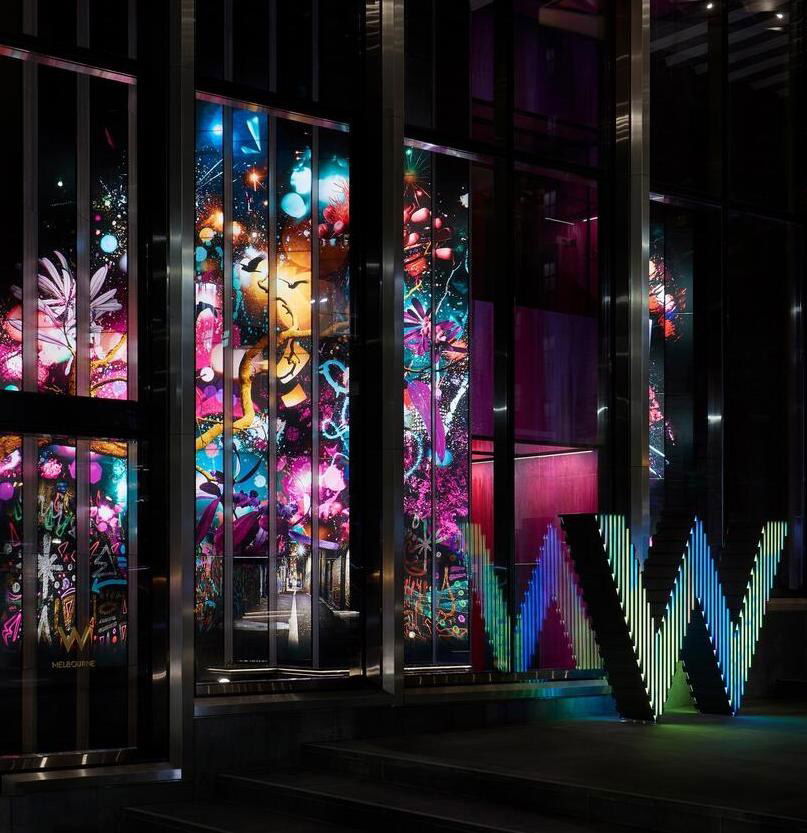
Hotel in Melbourne, Australia
W Melbourne
150ptsDesign-Led Flinders Lane Address

About W Melbourne
Among the first to ride the luxury-boutique wave, the W hotels are still going strong; W Melbourne stands tall above Flinders Lane, in the ultra-modern Collins Arch, a mixed-use skyscraper development in a prime urban location. Its public spaces are typically vibrant and colorful, from an indoor pool that sits below a golden ceiling to no fewer than five restaurants and bars, including all-day Italian dining at Lollo, the contemporary Japanese omakase Warabi, and design-led cocktail bar Curious, which hosts DJ nights and guest bartenders. And the rooms and suites, in classic W style, are no less eye-catching, their substantial comforts livened by bold colors and futuristic design elements.
Flinders Lane and the Architecture of Arrival
Flinders Lane has always operated as Melbourne's creative spine, running parallel to the Yarra with a density of galleries, studios, and independent restaurants that distinguishes it from the broader CBD grid. W Melbourne occupies a position at 408 Flinders Lane that places it inside this cultural corridor rather than above it, a distinction that matters in a city where the relationship between a hotel and its street defines the experience more than any lobby feature. The building reads as deliberate verticality against the low-slung Victorian terrace fabric of the lane, and arriving on foot from Flinders Street Station, you move through the city's architectural palimpsest before stepping inside.
Where W Melbourne Sits in the City's Luxury Hotel Market
Melbourne's upper hotel tier has expanded considerably over the past decade, with international brands including the Grand Hyatt Melbourne and Hyatt Centric Melbourne anchoring the Collins Street and Exhibition Street corridors, while design-forward independents such as Laneways by Ovolo, Melbourne and the Adelphi Hotel address a different appetite for local character. W Melbourne operates in a third category: a brand-affiliated property that invests heavily in aesthetic specificity, positioning itself not against the grand dame hotels of Spring Street but against peers that treat the building as a design argument in its own right.
The 2025 Michelin Selected designation places W Melbourne inside the guide's hotel recommendations for Australia, a recognition that validates its position at the upper end of the city's accommodation market and aligns it with a cohort that includes properties assessed for service standard, design integrity, and overall guest experience rather than room count or spa square footage. Across Australia, the Michelin hotel selection has been applied carefully, making the designation a meaningful signal rather than a broad sweep. For context on the Australian market, Capella Sydney and The Tasman in Hobart represent the kind of company W Melbourne keeps at this tier of recognition.
Sustainability as Infrastructure, Not Gesture
The conversation around responsible luxury in Australian hospitality has moved well past the towel-reuse card era. Properties that take environmental commitment seriously now embed it at the infrastructure level, from procurement chains and energy sourcing through to the materials used in construction and fit-out. This is the lens through which W Melbourne's Flinders Lane location is most instructively read: urban hotels in dense city cores carry a different sustainability calculus than resort properties, where land use, water draw, and ecological adjacency dominate the conversation.
In a city context, the sustainability metrics that carry weight include transport connectivity (W Melbourne's proximity to Flinders Street Station and the tram network means a significant proportion of guests can arrive without a vehicle and move through Melbourne without one), building performance, and food-and-beverage sourcing. Melbourne's hospitality industry has developed a reasonably sophisticated local-produce infrastructure, with suppliers from the Yarra Valley, Mornington Peninsula, and Victorian highlands feeding into city venues. Hotels that engage this network rather than defaulting to centralised distribution chains contribute to a supply model with shorter transit distances and stronger traceability. Whether and how W Melbourne engages this infrastructure is a question leading answered directly with the property, as sourcing specifics sit outside the confirmed data available here.
For comparison, design-led properties in other Australian cities have taken varied approaches to embedding environmental practice. 1 Hotel Melbourne, with its explicit sustainability brand identity, occupies one end of the spectrum. The Calile in Brisbane and Art Series - The Watson in Adelaide represent the design-forward independent approach in their respective cities. W Melbourne operates with the resources of a global brand behind it, which brings both the scale to invest in building-level sustainability systems and the accountability that comes with public brand commitments measured across a portfolio.
The W Brand Logic in a Melbourne Context
W Hotels operates globally with a consistent set of identity markers: music programming, design investment, food and beverage at the property level, and an events posture that targets a younger luxury demographic than the traditional grand hotel format. In Melbourne, that positioning intersects with a city that already has a highly developed nightlife and arts infrastructure, which means the brand's cultural programming has to earn its place rather than fill a gap. Melbourne audiences are not easily impressed by imported concepts, which historically has made the city a useful proving ground for whether a brand's cultural credentials are genuine or cosmetic.
The Flinders Lane address amplifies this test. The lane's gallery and studio tenants, and the broader community of creative practitioners who treat the area as a working neighbourhood rather than a destination, represent an audience with high standards for authenticity. A hotel that reads as a backdrop for content creation rather than a participant in the lane's actual culture will register as such quickly in a city with this level of critical sophistication.
Melbourne in a Broader Australian Travel Circuit
For visitors structuring a longer Australian itinerary, Melbourne typically anchors the southeastern leg, with connections to the Yarra Valley wine country to the east, the Mornington Peninsula to the south, and the Great Ocean Road to the southwest. The city's position as Australia's food and coffee capital is well documented, and its hotel market reflects a willingness to pay for design and experience that goes beyond the transactional. Properties at W Melbourne's tier compete not only with each other but with the case for spending nights elsewhere on the circuit, at Southern Ocean Lodge in Kingscote or Emirates One and Only Wolgan Valley, where the environmental argument is about wilderness adjacency rather than urban density. Both models have merit; they answer different questions about what a trip to Australia is for. For those whose itinerary extends to the Gold Coast, Mondrian Gold Coast and The Darling at The Star Gold Coast in Broadbeach represent the design-hotel tier in a very different coastal register. Internationally, the design-hotel standard W Melbourne is measured against includes properties such as The Fifth Avenue Hotel in New York City and Hotel de Paris Monte-Carlo, where the relationship between address, identity, and guest expectation is similarly load-bearing.
Planning a Stay
W Melbourne at 408 Flinders Lane sits within walking distance of Flinders Street Station, the central tram network, and Federation Square, making it one of the most transport-accessible addresses in the city's hotel inventory. For the full Melbourne accommodation picture and how W Melbourne fits within the city's options across categories and price points, the EP Club Melbourne city guide provides comparative context. Guests considering the broader design-hotel tier in Melbourne should also look at Art Series - The Larwill Studio and Crown Towers Melbourne to map the range of what the city's upper market covers before committing to a category.
Frequently Asked Questions
What room category do guests prefer at W Melbourne?
W Melbourne's room inventory follows the brand's standard tiering from entry Wonderful rooms through to the higher suite categories, with the upper-floor options offering Yarra River and CBD views that justify the premium in a city where skyline orientation can significantly affect the experience of a stay. The Michelin Selected designation suggests that across the property, the standard is consistent enough to earn editorial recognition, which typically means the base category meets a threshold rather than requiring an upgrade to find quality. Specific room-type guidance is leading confirmed directly with the property, as configuration details are not available in the current verified data.
What is the standout thing about W Melbourne?
The address on Flinders Lane, combined with the 2025 Michelin Selected recognition, places W Melbourne at the intersection of cultural positioning and verified quality standard. In a city where the relationship between a hotel and its immediate neighbourhood carries genuine weight with guests, the Flinders Lane location is a functional asset, not only a postcode signal. Few properties in Melbourne's upper tier sit this directly inside the city's creative working district rather than adjacent to it.
How hard is it to get in to W Melbourne?
W Melbourne operates as a bookable property through standard international hotel booking channels, and as a larger brand-affiliated hotel, it does not carry the waitlist or allocation dynamics of small-key boutique properties. Availability tightens considerably during Melbourne's major events calendar, particularly the Australian Open in January, the Formula 1 Grand Prix in March, and the AFL Grand Final period in September and October. Booking well ahead of those windows is advisable; at other times, lead times are more flexible than at properties with under 50 keys.
Is W Melbourne a good base for exploring Melbourne's laneway dining scene?
The Flinders Lane address puts W Melbourne inside the laneway network rather than requiring guests to travel to it, which is a meaningful practical advantage given how much of Melbourne's most considered dining and drinking happens in the CBD's secondary streets. The stretch of Flinders Lane and its cross-connections to AC/DC Lane, Centre Place, and the Degraves Street corridor contains a concentration of independent venues across coffee, natural wine, and contemporary Australian cooking that represents the strongest argument for staying in this part of the city over the Spring Street or Southbank alternatives. Guests using the hotel as a food-and-drink base will find the EP Club Melbourne dining guide a useful reference for mapping that terrain.
Recognized By
Similar venues by awards
Related editorial
- How travel will be redefined by 2040By 2040, Travel Will Stop Being a Place You Go and Become a State You Inhabit Thesis: The defining shift in travel by 2040 will not be faster planes or smarter hotels — it will be the collapse of the
- How travel will be redefined by 2040By 2040, Travel Won't Be an Industry — It Will Be Infrastructure My thesis is simple and, I suspect, unfashionable: by 2040 travel will stop behaving like a discretionary consumer category and start
- How travel will be redefined by 2040By 2040, Travel Won't Be a Trip — It Will Be a Stack My thesis is simple and, I think, uncomfortable: by 2040, "travel" will no longer describe a discrete journey from point A to point B.
Save or rate W Melbourne on Pearl
Keep this venue in your Pearl passport, rate it after you visit, and track it alongside every other place you collect.