
Hotel in Marrakesh, Morocco
Riad No. 37
500ptsNordic-Moroccan Restraint

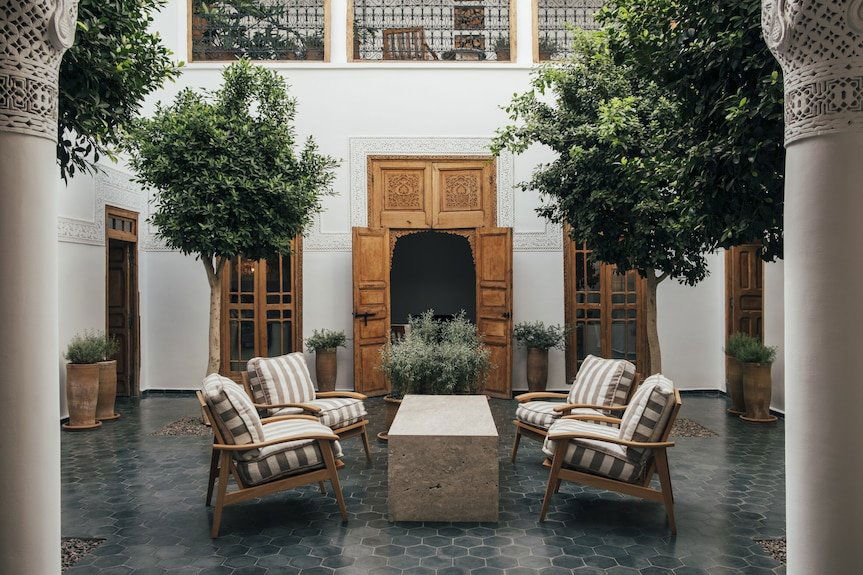
About Riad No. 37
An eight-room adults-only riad in Marrakesh's Dar El Bacha quarter, Riad No. 37 pairs the inside-out architecture of a traditional Moroccan courtyard house with a deliberately Scandinavian design sensibility. Its kitchen, shaped by New Nordic methodology applied to Moroccan ingredients, serves communal dinners that function more like private dinner parties than hotel meals. The result is a property that sits apart from both the grand palace hotels and the generic boutique riad market.
Where Moroccan Architecture Meets Nordic Restraint
Marrakesh's medina has accumulated hundreds of riad conversions over the past two decades, and the category has fractured into distinct tiers. At one end sit the grand palace addresses, places like La Mamounia and Royal Mansour, with full resort infrastructure and staff ratios that belong in a different conversation entirely. At the other sit smaller, design-led properties that trade on intimacy and editorial identity rather than scale. Riad No. 37, at Quartier Dar El Bacha, operates firmly in that second group, but it has made a design choice almost no comparable property has attempted: it reads as Scandinavian.
From the street, the building gives nothing away, which is architecturally faithful. The medina riad tradition is built around inversion: a plain, anonymous exterior wrapping inner courtyards invisible to passers-by. What the street does not signal is that inside, the colour palette refuses the warm ochres and jewel tones that define most Marrakesh interiors. Cool neutrals and warm browns provide the dominant register, creating a background that throws the property's ornamental carved woodwork and traditional craftsmanship into sharper relief. The Scandinavian design logic and the Moroccan architectural logic turn out to be complementary: both traditions prize craft, surface texture, and deliberate restraint over decorative accumulation.
The Eight-Room Formula and What It Produces
Small-footprint luxury in Marrakesh has become its own market segment. Properties like El Fenn and IZZA Marrakech have demonstrated that the medina's most interesting stays are often its most contained ones, where the ratio of staff attention to guest count becomes meaningful. Riad No. 37 carries this logic to a particular conclusion: eight rooms, a maximum of sixteen guests, and an adults-only policy. These are not incidental details; they are the operating system of the experience.
The eight rooms share a tadelakt-rich material vocabulary and a consistent colour scheme, but vary in layout, which matters more than it might appear. In a riad of this scale, repetition of plan would collapse the sense of individual character that justifies the format. The surfaces throughout are richly textured, which is architecturally correct for the tradition and practically useful in a building where natural light arrives filtered through courtyard openings rather than direct window exposures.
Two pools address the practical reality of Marrakesh's climate: one in a courtyard, one on the roof terrace. The roof position matters for the terrace pool, which offers a different relationship to the medina skyline and the light conditions at different hours. Fireplaces are available for the desert evenings when the temperature drops sharply, a detail that positions the property as a year-round address rather than purely a high-summer one.
The Kitchen: New Nordic Logic, Moroccan Materials
The dining programme at Riad No. 37 is where the property's editorial identity becomes clearest. The kitchen operates under the influence of Danish chef Klaus Meyer, whose name carries specific weight in the global conversation about New Nordic cuisine. Meyer's wider work has placed Scandinavian culinary methodology into contexts as varied as Bolivia and New York, and the Riad No. 37 kitchen continues that pattern: applying Nordic frameworks of seasonal restraint, ingredient provenance, and fermentation technique to Moroccan produce and traditional cooking methods.
Dinners are served family-style at a communal table, or privately elsewhere in the house if guests prefer. The communal format reflects a dining philosophy more common in the Nordic countries than in traditional Moroccan hospitality, where private family spaces are the norm. That tension between the two traditions is productive: it produces a meal that is neither a Moroccan tourist experience nor a European restaurant transplanted to Africa, but something that draws from both without defaulting to either.
For context on how Marrakesh's food culture sits within Morocco more broadly, our full Marrakesh restaurants guide covers the range from medina institutions to contemporary addresses.
Where Riad No. 37 Sits in the Marrakesh Market
The obvious peer comparison for a property of this philosophy and scale is not the palace hotels. Royal Mansour, Amanjena, Four Seasons Resort Marrakech, and Fairmont Royal Palm Marrakech compete on infrastructure, room count, and brand assurance. Riad No. 37 competes on something different: the feeling that staying in sixteen-guest-maximum property with a coherent design thesis and a genuinely interesting kitchen produces a distinct kind of stay, one that the larger addresses structurally cannot replicate regardless of their budget.
Within Morocco more broadly, the design-led small-property format appears at addresses like Dar Ahlam in Ouarzazate, Dar al Hossoun in Taroudant, and Dar Maya in Essaouira, each working within a similar logic of intimate scale and architectural specificity. Jnane Tamsna in Marrakech and Ksar Char-Bagh occupy the same general tier within the city. What separates Riad No. 37 from most of these is the Scandinavian design commitment, which is not a cosmetic choice but a structural one that runs through the material palette, the dining philosophy, and the approach to hospitality at scale.
Travellers arriving from international design hotel contexts, perhaps from properties like Aman New York or Aman Venice, will recognise the small-count, high-attention format immediately. The difference is that Riad No. 37 places that format inside a specific cross-cultural argument, rather than applying a global luxury template to a local setting.
For Morocco beyond Marrakesh, the same design-led sensibility appears at Hotel Sahrai in Fes and Hotel Sahrai in Fez, and the country's wider hotel range extends from Fairmont Tazi Palace Tangier to Banyan Tree Tamouda Bay on the Mediterranean coast.
Planning a Stay
The property sits in the Dar El Bacha quarter of the medina, a neighbourhood that carries its own historical weight as the former domain of Thami El Glaoui. The eight-room ceiling means that availability is genuinely constrained: at capacity, the property holds sixteen adults, so the booking window matters more than at a larger address. Given the adults-only policy and the communal dining format, the property works leading for travellers who want the antithesis of the anonymous hotel experience, where fellow guests share space at dinner rather than avoiding each other across a large lobby. No room availability is currently listed, so confirming current rates and booking conditions directly should be the first step before planning dates.
Frequently Asked Questions
- Is Riad No. 37 more formal or casual?
- The adults-only policy and the communal dinner format suggest a certain baseline of social expectation, but the overall atmosphere at a sixteen-guest-maximum riad with Nordic design sensibility leans toward composed informality rather than formal service ritual. Guests share a table at dinner, which produces something closer to a private house party than a restaurant service. The tadelakt-and-neutral-tones aesthetic reinforces that: considered, deliberate, and calm rather than ceremonious.
- What is Riad No. 37 known for?
- The property has built its identity around three things that rarely coexist in the Marrakesh riad market: Scandinavian design discipline applied to Moroccan architecture, a kitchen programme with New Nordic methodology running on local Moroccan ingredients and technique, and a guest count ceiling of sixteen that makes the atmosphere structurally different from larger boutique hotels. Klaus Meyer's culinary influence on the kitchen is the most direct external credential attached to the property.
- What's the approach to suites and rooms at Riad No. 37?
- The property has eight rooms that share a tadelakt material palette and consistent colour scheme but vary in individual layout, which is the primary differentiator between them. In a medina riad of this size, room configuration within the courtyard structure is what distinguishes one space from another. Guests looking for the most distinctive layout should enquire directly when booking, as the specific room configuration details are leading confirmed with the property.
- How hard is it to get a reservation at Riad No. 37?
- With eight rooms and an adults-only policy, the property operates at a maximum of sixteen guests. That ceiling makes availability meaningfully tighter than at larger medina hotels, particularly during peak travel periods into Marrakesh. No current availability is listed, so reaching out directly and booking early relative to your travel dates is advisable. The small scale that makes the stay worthwhile is also what makes last-minute access unlikely.
- How does the New Nordic approach apply to Moroccan cooking at Riad No. 37?
- The kitchen was shaped by the influence of Danish chef Klaus Meyer, whose work is associated with applying Nordic frameworks, including attention to fermentation, seasonal sourcing, and ingredient restraint, to culinary traditions outside Scandinavia. At Riad No. 37, that methodology is directed at Moroccan produce and techniques rather than imported ingredients, producing a dinner experience that is neither conventional Moroccan nor European in character. The communal table format reinforces the Nordic hospitality model, where shared meals are the dominant social form.
Recognized By

Related editorial
- Best Fine Dining Restaurants in ParisFrom three-Michelin-star icons to the next generation of Parisian chefs pushing boundaries, these are the restaurants that define fine dining in the world's culinary capital.
- Best Luxury Hotels in RomeFrom rooftop terraces overlooking ancient ruins to Michelin-starred hotel dining, these are the luxury hotels that make Rome unforgettable.
- Best Cocktail Bars in KyotoFrom sleek lounges to hidden speakeasies, Kyoto's cocktail scene blends Japanese precision with global influence in ways you won't find anywhere else.
Save or rate Riad No. 37 on Pearl
Keep this venue in your Pearl passport, rate it after you visit, and track it alongside every other place you collect.