
Hotel in Madrid, Spain
Heritage Madrid Hotel
150ptsBelle Époque Boutique Precision

About Heritage Madrid Hotel
On a quiet residential stretch of Salamanca, Heritage Madrid Hotel occupies the kind of address that rewards those who already know the neighbourhood. With cuisine by Mario Sandoval, interiors by Lorenzo Castillo, and rates from US$337 per night, the hotel positions itself within Madrid's design-led boutique tier, rated 4.9/5 by EP Club members and 4.7 across 376 Google reviews.
Salamanca's Quieter Register
The upper Salamanca district operates at a different frequency from Madrid's hotel corridors near the Prado or the Gran Vía. Calle de Diego de León sits where the neighbourhood shifts from commercial to residential, where the pace of the street slows and the architecture speaks in early twentieth-century bourgeois rather than grand civic gesture. Hotels in this part of the city don't announce themselves with canopied entrances and uniformed door staff visible from fifty metres. They tend to integrate into the fabric of the block, and the experience of arriving becomes something closer to entering a private address than checking into a property. Heritage Madrid Hotel operates in exactly this register, and that atmospheric choice sets the tone for everything that follows inside.
Boutique hotels in Salamanca have benefited from a broader shift in how premium travellers read Madrid. As the Mandarin Oriental Ritz and the Four Seasons Hotel Madrid anchor the grand-hotel tier near Paseo del Prado and the city centre, smaller properties in Salamanca have positioned themselves as the alternative for guests who want neighbourhood density without institutional scale. The Rosewood Villa Magna holds the upper end of that residential-luxury corridor on Paseo de la Castellana; Heritage Madrid reads further into the barrio, trading boulevard visibility for genuine street-level quiet.
Lorenzo Castillo and the Belle Époque Interior
Spanish interior design has produced a generation of practitioners who treat period vocabulary as active material rather than nostalgic backdrop. Lorenzo Castillo belongs to that group. His work tends to layer historical references with a critical rather than reverential hand, allowing furniture, fabric, and light to carry period associations while the overall composition remains contemporary in its confidence. At Heritage Madrid, the framework is Belle Époque, a register that in Madrid connects to the city's early twentieth-century expansion into the Ensanche and the cultural self-consciousness that accompanied it. The result is an interior that carries visual warmth rather than cool minimalism, where ornament has a function beyond decoration: it establishes a sense of accumulated time that newer design-led hotels in Madrid, however accomplished, cannot manufacture.
That quality of accumulated atmosphere is increasingly rare in the city's boutique hotel market. Properties like CoolRooms Palacio de Atocha and Gran Hotel Inglés work with historic structures but lean into renovation legibility. Heritage Madrid, under Castillo's direction, pursues a different ambition: an interior that feels inhabited rather than restored.
Mario Sandoval in the Kitchen
The association with Mario Sandoval positions the food programme within a specific tier of Spanish contemporary cooking. Sandoval's reputation rests on a technically precise engagement with Castilian and broader Spanish ingredient traditions, an approach that has earned him sustained critical recognition in a country where the conversation about restaurant cooking is unusually sophisticated. What that means practically for hotel guests is that the dining offer here does not operate as an amenity to be tolerated in favour of the neighbourhood's independent restaurants. It operates as a reason to stay in the evening rather than leave for Calle de Ponzano or the Mercado de San Antón.
Hotel restaurants in Madrid have historically occupied an awkward position in the city's dining culture, a culture that treats eating out as a long, late social event rather than a transactional necessity. The properties that have resolved that tension most successfully tend to do so by securing culinary direction that has credibility on its own terms, independent of the hotel context. Sandoval's involvement at Heritage Madrid is the signal that the food offer has been taken seriously at the level of investment and curation, not simply treated as a required line on the hotel's service list.
The Terrace as Social Infrastructure
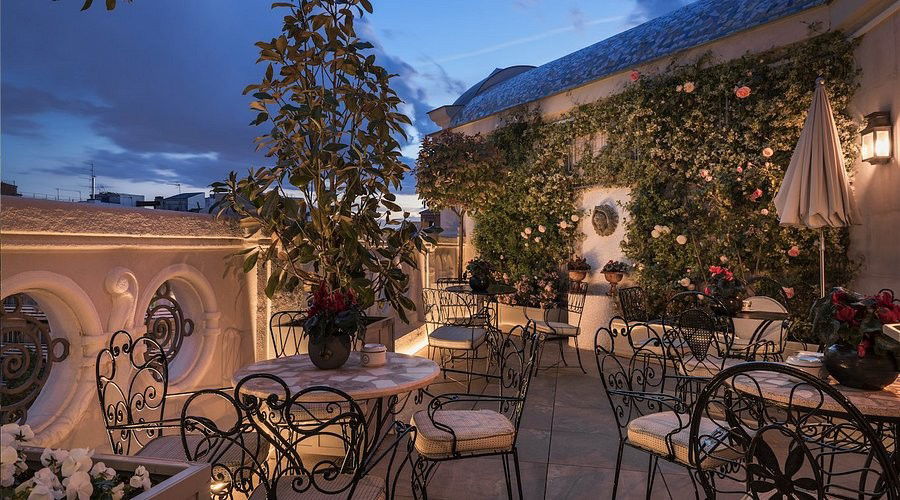
Madrid's outdoor drinking and eating culture is not incidental to the city's hospitality character; it is structural. The terrace at Heritage Madrid, described as relaxing and equipped with a bar, fits into a tradition that runs from the grand terrazas of the Retiro park perimeter to the rooftop bars of the centre. In upper Salamanca, terrace space of this kind carries particular value because the neighbourhood's residential density means outdoor hospitality at street level operates with a sense of enclosure and calm that more central locations cannot offer. The morning coffee and the late-afternoon aperitivo both read differently here than they would at a hotel terrace facing a major arterial road.
For guests arriving from Barajas International Airport, approximately ten kilometres from the hotel, or from Madrid Puerta de Atocha-Almudena Grandes rail station, the terrace serves as a decompression space before the city properly begins. It is worth arriving with time to use it rather than treating check-in as a transition point on the way somewhere else.
Placement in Madrid's Design-Led Boutique Field
The EP Club member rating of 4.9 out of 5, supported by a Google review score of 4.7 across 376 reviews, places Heritage Madrid at the high end of its category by guest assessment. Within Madrid's boutique hotel field, the comparable properties that occupy similar positioning include Hotel Unico Madrid and Hotel Rector, both of which work in the register of residential-scale luxury with design intention. Heritage Madrid's differentiating combination is the Castillo interior, the Sandoval dining association, and the specific quietness of its Salamanca address, factors that together constitute a distinct rather than generic offer within the category.
Rates from US$337 per night position the hotel above the midmarket but below the grand-hotel pricing of the Ritz or Four Seasons tier. For that positioning, guests are not trading down on design quality; they are trading the scale and formality of the grand properties for something more contained and considered. That trade is a reasonable one for travellers who find large-hotel lobbies more disorienting than reassuring, and who prefer to engage with a neighbourhood rather than be insulated from it.
For those extending a Spain itinerary beyond Madrid, the EP Club network covers properties across the country, from Abadía Retuerta LeDomaine and Atrio Restaurante Hotel in Cáceres to Akelarre in San Sebastián and Hotel Can Cera in Palma. Wine-focused properties including Terra Dominicata in Escaladei and Torre del Marqués Hotel Spa & Winery offer a contrasting rural register. Coastal options such as Cap Rocat in Cala Blava, La Residencia in Mallorca, and Marbella Club Hotel extend the network to the country's Mediterranean and Atlantic edges. See the full Madrid guide for broader context on where Heritage Madrid sits within the city's accommodation spectrum.
Planning Your Stay
What is Heritage Madrid Hotel known for?
In Madrid's boutique hotel conversation, Heritage Madrid is primarily identified by three elements: Lorenzo Castillo's Belle Époque interior, the culinary direction associated with Mario Sandoval, and an address in upper Salamanca that places guests inside one of the city's most coherent residential neighbourhoods rather than at its tourist axis. The EP Club member rating of 4.9/5 and a Google score of 4.7 from 376 reviews both reflect a property that consistently performs at the high end of its design-led category.
What room should I choose at Heritage Madrid Hotel?
Without room-category data in the current record, the most reliable guidance is to request a room facing away from the street if light sleeping is a priority, and to ask about terrace access at booking. The Belle Époque design language, credited to Lorenzo Castillo, runs throughout the property, so the interior quality is less likely to vary dramatically by room tier than at larger hotels where older wings and newer additions create visible disparities. Rates start from US$337 per night, which provides a baseline for planning, though specific room-type pricing is leading confirmed directly at the time of booking.
How far ahead should I plan for Heritage Madrid Hotel?
Salamanca is Madrid's most consistently in-demand neighbourhood for premium short stays, and the combination of strong ratings and limited boutique supply means Heritage Madrid is not a walk-in proposition for peak periods. If travel falls between April and June or September and October, when Madrid's conference and leisure calendars overlap, planning two to three months ahead is a reasonable baseline. For high-profile event weeks or public holidays, earlier is more reliable. Rates from US$337 per night provide a starting point; as with most design-led independents, the most competitive pricing tends to appear further from arrival dates rather than closer.
Recognized By

Related editorial
- Best Fine Dining Restaurants in ParisFrom three-Michelin-star icons to the next generation of Parisian chefs pushing boundaries, these are the restaurants that define fine dining in the world's culinary capital.
- Best Luxury Hotels in RomeFrom rooftop terraces overlooking ancient ruins to Michelin-starred hotel dining, these are the luxury hotels that make Rome unforgettable.
- Best Cocktail Bars in KyotoFrom sleek lounges to hidden speakeasies, Kyoto's cocktail scene blends Japanese precision with global influence in ways you won't find anywhere else.
Save or rate Heritage Madrid Hotel on Pearl
Keep this venue in your Pearl passport, rate it after you visit, and track it alongside every other place you collect.