
Hotel in L'Isle-sur-la-Sorgue, France
L\u0027Isle de Leos - MGallery
150ptsSorgue-Side Town Hotel

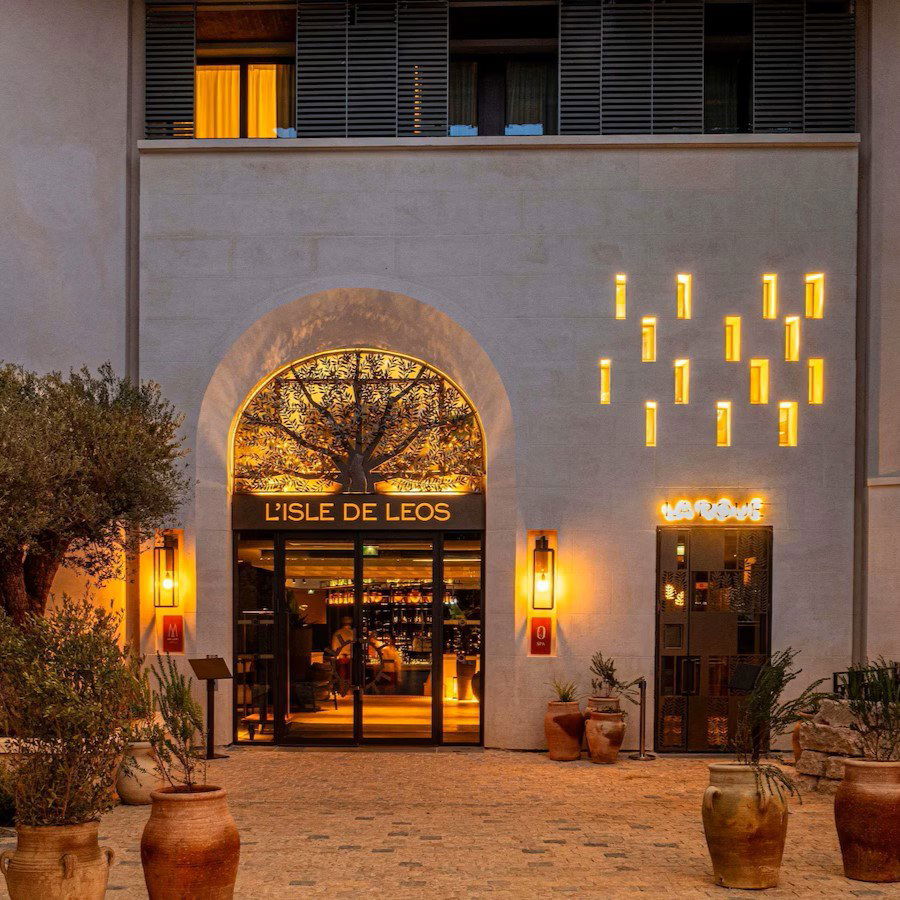
About L\u0027Isle de Leos - MGallery
Selected by the Michelin Guide Hotels 2025, L'Isle de Leos - MGallery occupies a considered position in L'Isle-sur-la-Sorgue, the Provençal market town known across Europe for its antique trade and the slow green channels of the Sorgue river. Part of Accor's MGallery collection, it sits in the tier of design-conscious boutique hotels that draw their identity from place rather than brand formula.
Where the Sorgue Sets the Pace
L'Isle-sur-la-Sorgue announces itself differently depending on when you arrive. On a Sunday morning in summer, the town's antique markets spill along the canal banks, and the sound of water turning the old mossy wheels competes with the noise of dealers and collectors working the stalls. On a Tuesday in November, the same streets are nearly silent, the plane trees stripping back to bare branches over still green water. L'Isle de Leos - MGallery sits at the edge of this rhythm, at 1 Porte de Bouigas, close enough to the centre that the town's character arrives without effort, but positioned to offer a degree of remove from its weekend crowds.
The MGallery collection, within Accor's portfolio, is designed around a specific proposition: hotels that carry a distinct local identity rather than a standardised brand aesthetic. The better properties in this collection succeed by anchoring guests to a place rather than delivering a portable luxury formula. L'Isle de Leos operates in that register, in a town whose own identity is already strong enough to do a great deal of the work.
The Provençal Hotel Tier This Property Occupies
Luxury accommodation in Provence has developed a layered peer set over the past two decades. At one end sit the large estate properties with Michelin-starred restaurants and extensive spa infrastructure, properties like Baumanière Les Baux-de-Provence in Les Baux, La Bastide de Gordes in Gordes, or Villa La Coste in Le Puy-Sainte-Réparade. At the other, a smaller category of boutique town hotels has emerged that trades estate scale for direct immersion in village or market-town life.
L'Isle de Leos sits in this second tier. Its Michelin Selected status in the 2025 Michelin Hotels guide places it in a quality-validated cohort that includes properties across France receiving recognition without the full Michelin Keys distinction of the estate-scale addresses. Within L'Isle-sur-la-Sorgue itself, the comparable alternatives are limited: Grand Hôtel Henri and La Maison sur la Sorgue represent the small pool of design-led accommodation this town supports. None of the three tries to compete with the Luberon hilltop estates on grounds of spectacle. The competition here is about quality of placement and quality of service within a modest format.
Service Orientation in a Town-Hotel Format
The guest experience at properties of this scale and type tends to depend more heavily on staff culture than at larger resorts where amenities absorb a greater share of the experience. Without a spa wing, a destination restaurant, or a pool commanding a panoramic view, the service encounter becomes the primary mechanism through which the hotel earns its rate. This is a structural fact of town-centre boutique hotels rather than a weakness specific to any one property.
MGallery's brand framework places explicit emphasis on storytelling and local knowledge as service pillars, which translates, in practice, to an expectation that staff function as informed intermediaries between the guest and the destination. In a town as specific as L'Isle-sur-la-Sorgue, with its particular calendar of markets, its antique trade geography, and its network of nearby Luberon villages, this orientation has real functional value. The Sunday market at L'Isle is one of the largest and most serious antique markets in France, drawing professional dealers as well as private buyers; knowing which sections to prioritise and how early to arrive matters more than it might in a generalist tourist town.
For guests extending into the wider region, the Luberon villages within reasonable reach, Gordes, Roussillon, Bonnieux, Ménerbes, each have distinct characters and optimal visiting conditions. Staff who can make those distinctions credibly are genuinely useful. The same logic applies to table recommendations: the Sorgue valley has enough serious dining to reward guidance that goes beyond the obvious, as explored in our full L'Isle-sur-la-Sorgue restaurants guide.
The MGallery Frame and What It Signals
Accor's MGallery label has expanded to over 100 properties globally, which makes individual hotel quality variable within the collection. The brand itself functions as a signal of design intent and local-identity ambition rather than a guarantee of any particular standard. Among French MGallery addresses, the stronger properties include converted historic buildings and former private estates; the collection's credibility depends on each individual property's execution rather than brand consistency in the way that a Four Seasons or Aman property might deliver it.
Michelin's 2025 hotel selection provides a more granular validation. The Michelin Selected tier, distinct from the full Michelin Key distinctions awarded to the very top-tier properties, represents the guide's endorsement that a property meets a standard worth recommending to its readership. For context, the Michelin hotel program covers a wide spectrum of French addresses, from Le Bristol Paris in Paris and Hotel Du Cap-Eden-Roc in Cap d'Antibes at the very upper register, through regional luxury like Royal Champagne Hotel & Spa in Champillon and Domaine Les Crayères in Reims, down to carefully chosen boutique addresses at this scale. The selected designation at L'Isle de Leos represents Michelin's judgment that the property earns consideration within its format category.
When to Visit and How to Approach the Stay
The town's rhythm should govern the timing decision. The Sunday antique market, which runs year-round but is largest and most active from spring through October, attracts significant visitor volume, and arriving on Saturday evening to be in position for Sunday morning is the logic that most drives bookings at hotels in the centre. Provence's shoulder seasons, April to May and September to October, combine manageable temperatures with thinner crowds and full market activity, and represent the strongest case for this type of stay.
The July and August peak brings the full weight of regional tourism, which affects both the town's walkability and the availability of tables at the better nearby restaurants. Guests planning a July stay should secure restaurant bookings well in advance of arrival; the Luberon's dining calendar fills quickly once school holidays begin across France.
For those building a wider Provence itinerary, the Sorgue valley positions well as a base for day excursions. The distances to Avignon, to the Dentelles de Montmirail wine villages, and to the central Luberon are all manageable without long drives. Guests considering the Riviera alongside inland Provence might reference the contrast in character offered by properties like The Maybourne Riviera in Roquebrune-Cap-Martin or La Réserve Ramatuelle in Ramatuelle, both of which operate at considerably greater scale and price. Elsewhere in southern France, Hôtel & Spa du Castellet in Le Castellet and Château de la Chèvre d'Or in Èze offer additional reference points at different price tiers. For stays requiring urban infrastructure alongside Provençal access, Le Negresco in Nice anchors the eastern end of the regional spectrum. Further afield in France, Les Sources de Caudalie in Bordeaux, Hôtel Chais Monnet & Spa in Cognac, La Ferme Saint-Siméon in Honfleur, and Hôtel du Palais in Biarritz each represent the same class of regionally distinctive hotel in different corners of the country. For Alpine contrast, Four Seasons Megève and Le K2 Palace in Courchevel sit at a different scale entirely. Casadelmar in Porto-Vecchio represents a Corsican alternative for those weighing island options. International comparisons for this format of design-boutique town hotel might include The Fifth Avenue Hotel in New York City or Badrutt's Palace Hotel in St. Moritz, both operating in destination towns with strong independent character where hotel placement within the locale matters as much as the rooms themselves. Hôtel de Paris Monte-Carlo closes the Mediterranean reference set at its most formal register.
Frequently Asked Questions
- What is L'Isle de Leos - MGallery known for?
- L'Isle de Leos is known as L'Isle-sur-la-Sorgue's Michelin Selected boutique hotel, part of Accor's MGallery collection, recognised in the Michelin Hotels 2025 guide. The property's position in the town centre places guests directly within one of France's most active antique markets and within easy reach of the Luberon villages, giving it a locational identity that most comparably priced Provence hotels, which sit on rural estates, cannot replicate.
- What's the most popular room type at L'Isle de Leos - MGallery?
- Specific room category data is not available in our current records. At MGallery properties of this scale, rooms with views toward the water channels or the old town tend to attract the strongest demand. Given the property's Michelin Selected status and its boutique format, early booking is advisable for peak periods, particularly the weekends surrounding the Sunday antique market between April and October.
Recognized By

Similar venues by awards
Related editorial
- How travel will be redefined by 2040By 2040, Travel Will Stop Being a Place You Go and Become a State You Inhabit Thesis: The defining shift in travel by 2040 will not be faster planes or smarter hotels — it will be the collapse of the
- How travel will be redefined by 2040By 2040, Travel Won't Be an Industry — It Will Be Infrastructure My thesis is simple and, I suspect, unfashionable: by 2040 travel will stop behaving like a discretionary consumer category and start
- How travel will be redefined by 2040By 2040, Travel Won't Be a Trip — It Will Be a Stack My thesis is simple and, I think, uncomfortable: by 2040, "travel" will no longer describe a discrete journey from point A to point B.
Save or rate L\u0027Isle de Leos - MGallery on Pearl
Keep this venue in your Pearl passport, rate it after you visit, and track it alongside every other place you collect.