
Hotel in Juillac-le-Coq, France
Le Logis
225ptsFull-Buyout Château Privacy



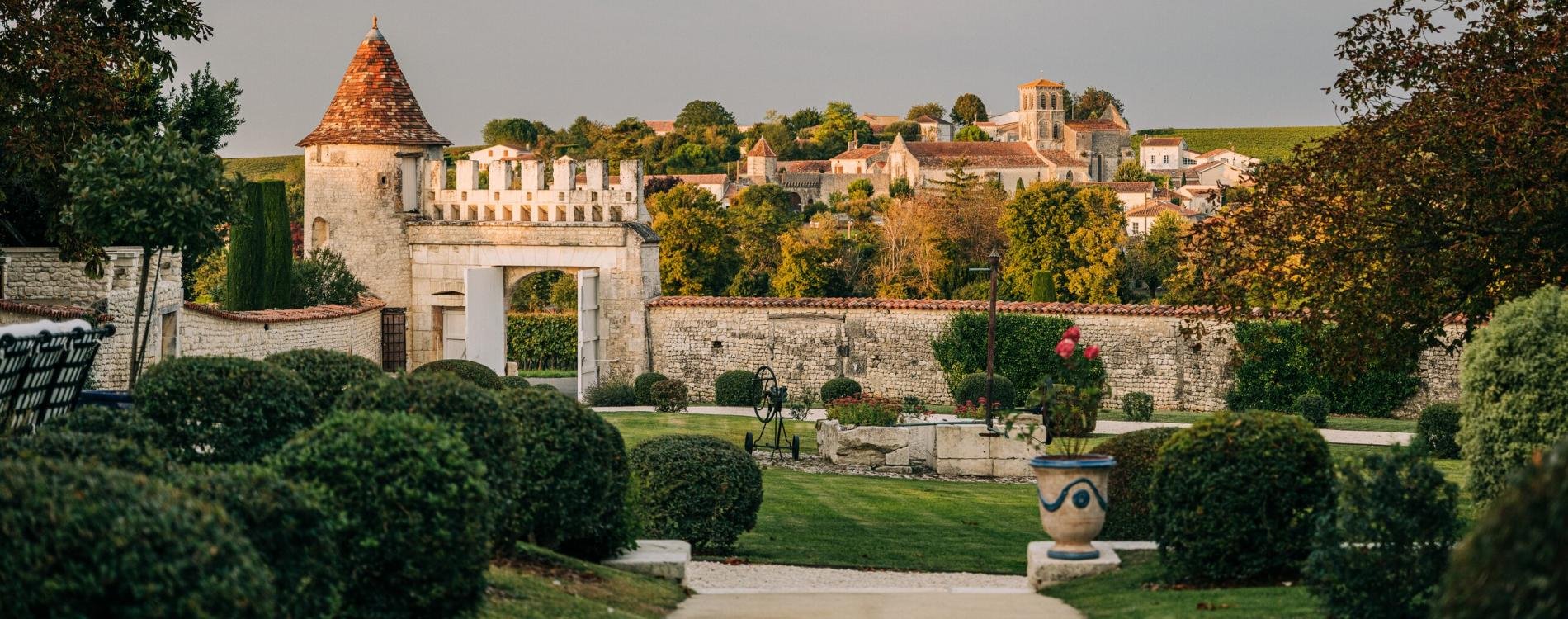
About Le Logis
A 16th-century manor in the Cognac countryside, Le Logis operates exclusively as a private estate for groups of up to 14 guests. Formerly the invitation-only retreat of Grey Goose and now operated by Forbes Travel Guide, it sits within Virtuoso's network as the organisation's sole private château in France. Full-buyout stays of three nights minimum place it in a narrow tier of estate hospitality with few comparable alternatives in southwest France.
Stone, Beam, and Borrowed Time: Architecture as the Experience
The Cognac countryside does not announce itself. The rolling vineyards of Charente arrive gradually as you move southwest from Angouliers toward Juillac-le-Coq, the rows of vines that supply some of France's most scrutinised spirit production sitting low against a wide sky. Le Logis materialises from this landscape as medieval walls first, the manor house behind them visible only once you are already inside. That sequence — exterior fortification giving way to a private interior world — is not incidental to the experience. It is the experience.
The building dates to the 16th century and carries the physical evidence of that period in its original stone construction and timber beam work. What the renovation has done, rather than erase that history, is layer subsequent design periods across it: French antiques, art deco references, and midcentury furniture coexist inside rooms where the structural bones remain intact. This approach to historic interiors , treating successive eras as accumulation rather than contradiction , is more common in Burgundian maisons de maître and Provençal bastides than in the Cognac region, and it gives Le Logis an aesthetic register that reads older and more complex than a conventional luxury renovation. For comparable French estate conversions that take a similar position on period layering, Château du Grand-Lucé in Le Grand-Lucé and Château Lafaurie-Peyraguey in the Sauternes operate in related territory, though neither shares Le Logis's full-estate private-hire format.
The Private Estate Model in France
Market for private château hire in France is thinner than it might appear. Most properties operating under heritage designations accept individual room bookings and function as conventional hotels with shared facilities. A smaller category offers full buyouts but within branded hotel infrastructure, where other guests may occupy adjacent buildings or public spaces remain accessible to non-residents. Le Logis sits in a different tier: complete exclusivity from arrival to departure, with no shared public areas, no other guests on-site, and a dedicated staff whose entire attention is directed at a single group of up to 14 people for the duration of the stay.
That model has a particular precedent in the property's recent history. Before its current configuration, Le Logis operated as the invitation-only private retreat of Grey Goose, the vodka brand formerly owned by Bacardi. Access was by selection rather than reservation, which placed it outside the commercial hospitality market entirely. Its transition to bookable private estate represents a structural shift, though the emphasis on exclusivity and staff-to-guest ratio that defined its previous incarnation carries through. The property is now operated by Forbes Travel Guide, the credentialing organisation whose hotel ratings carry Tier A trust authority in luxury hospitality assessment, and it holds a 2026 Star Wine List award, reflecting the quality of its wine programme in a region where wine credibility is earned against serious benchmarks. Le Logis is also Virtuoso's only private château in France, a designation that places it within a curated network used by specialist travel advisers booking high-end private travel.
For groups comparing this format against other French private-estate options, the peer set is narrow. Les Sources de Caudalie in Bordeaux and Château de la Gaude in Aix-en-Provence operate as hotel properties rather than private estates. Properties like Baumanière Les Baux-de-Provence and Domaine Les Crayères in Reims anchor themselves in restaurant reputation. Le Logis does neither: its claim is spatial and experiential, the building and its grounds as the primary offering.
Fourteen Rooms, One Group
The 14 guest rooms are individually decorated, with no two sharing an identical configuration. Each has a private bathroom, and the presence of claw-foot tubs in multiple rooms signals a commitment to period fixture authenticity that aligns with the building's broader design logic. The vineyard views from the rooms situate guests inside one of France's most consequential wine-producing zones; Cognac's Grande Champagne and Petite Champagne crus lie within the surrounding countryside, and the visual context of vine rows against Charentais sky operates as both aesthetic and geographical grounding.
The amenity set at Le Logis crosses generational and interest lines with some deliberateness: a heated outdoor pool and jacuzzi for warmer months; a cinema for evenings; a fully equipped gym; bicycles for vineyard-route exploration; a pickleball court; and a petanque field that anchors the property to its regional culture. The bar, described in available materials as a jewel-box-like space, operates as a distinct architectural moment within the house , a curated contrast to the stone-and-beam vernacular of the main rooms. This kind of interior set-piece bar, designed to read as a separate design register from the rest of the property, has become a distinguishing feature of the premium private-estate category, visible in comparable form at La Réserve Ramatuelle and Château de la Messardière in Saint-Tropez.
Context: Cognac as a Wine and Spirits Region
Charente and Charente-Maritime departments produce nearly all of the world's Cognac, and the vineyards surrounding Juillac-le-Coq fall within the Cognac AOC's most prized zones. The Star Wine List recognition Le Logis received in 2026 implies a wine programme that takes this geographical context seriously. In a region defined by aged spirit production rather than table wine culture, building a wine list that earns specialist recognition requires deliberate curation rather than reflexive local sourcing. This positions Le Logis's cellar as an active editorial statement about the property's hospitality ambitions, not simply a convenience for guests. For reference, other French estate properties that have used wine programming as a positioning tool include Château Lafaurie-Peyraguey, whose LALIQUE restaurant operates in Sauternes, and Les Sources de Caudalie, whose vinotherapy model anchors the entire guest experience to Bordeaux wine culture.
Planning a Stay
Le Logis operates exclusively on a full-buyout basis, with a minimum stay of three nights required. The property accommodates up to 14 guests across its 14 rooms, making it sized for extended family groups, multi-generational celebrations, or corporate gatherings that require privacy and dedicated staffing. Enquiries and bookings are handled through Virtuoso-affiliated travel advisers or directly through the Forbes Travel Guide operating infrastructure. There is no rack-rate walk-in access; the property exists outside the conventional booking-engine market. Those building a broader French itinerary can cross-reference the EP Club editorial at our full Juillac-le-Coq guide, and compare the private-estate format against larger hotel properties including Cheval Blanc Paris, Hotel du Cap-Eden-Roc, The Maybourne Riviera, Cheval Blanc Courchevel, Four Seasons Megève, Royal Champagne Hotel & Spa, Hôtel & Spa du Castellet, La Bastide de Gordes, Villa La Coste, Castelbrac in Dinard, Château de la Chèvre d'Or in Èze, Château de Montcaud in Sabran, Casadelmar in Porto-Vecchio, Aman Venice, Aman New York, and The Fifth Avenue Hotel in New York.
Frequently Asked Questions
- What is the atmosphere like at Le Logis?
- Le Logis operates as a private residence rather than a hotel. The atmosphere follows from the full-buyout format: no shared dining rooms, no lobby traffic, no other guests. The 16th-century stone and timber architecture sets a period register that the renovation has layered with French antiques, art deco, and midcentury pieces rather than replaced. The result is a house that reads as accumulated and lived-in rather than staged. The Star Wine List recognition and Forbes Travel Guide operation signal that the hospitality standard is calibrated at the leading of the private-estate category in France.
- What is the signature room at Le Logis?
- All 14 guest rooms are individually decorated, which makes direct comparison between them speculative without verified room-by-room data. What the available record confirms is that each room has a private bathroom, that several feature claw-foot tubs, and that all rooms overlook the property's vineyards. The jewel-box bar is the most distinctively described interior space within the estate, positioned as a deliberate design contrast to the stone-and-beam vernacular of the main rooms. Groups planning extended stays should note that room allocation across 14 individually configured spaces is itself part of the private-estate proposition: no room hierarchy enforced by a standard hotel configuration.
Recognized By


Related editorial
- Best Fine Dining Restaurants in ParisFrom three-Michelin-star icons to the next generation of Parisian chefs pushing boundaries, these are the restaurants that define fine dining in the world's culinary capital.
- Best Luxury Hotels in RomeFrom rooftop terraces overlooking ancient ruins to Michelin-starred hotel dining, these are the luxury hotels that make Rome unforgettable.
- Best Cocktail Bars in KyotoFrom sleek lounges to hidden speakeasies, Kyoto's cocktail scene blends Japanese precision with global influence in ways you won't find anywhere else.
Save or rate Le Logis on Pearl
Keep this venue in your Pearl passport, rate it after you visit, and track it alongside every other place you collect.