
Hotel in Canterbury, United Kingdom
Flockhill Lodge
150ptsWorking Station Wilderness

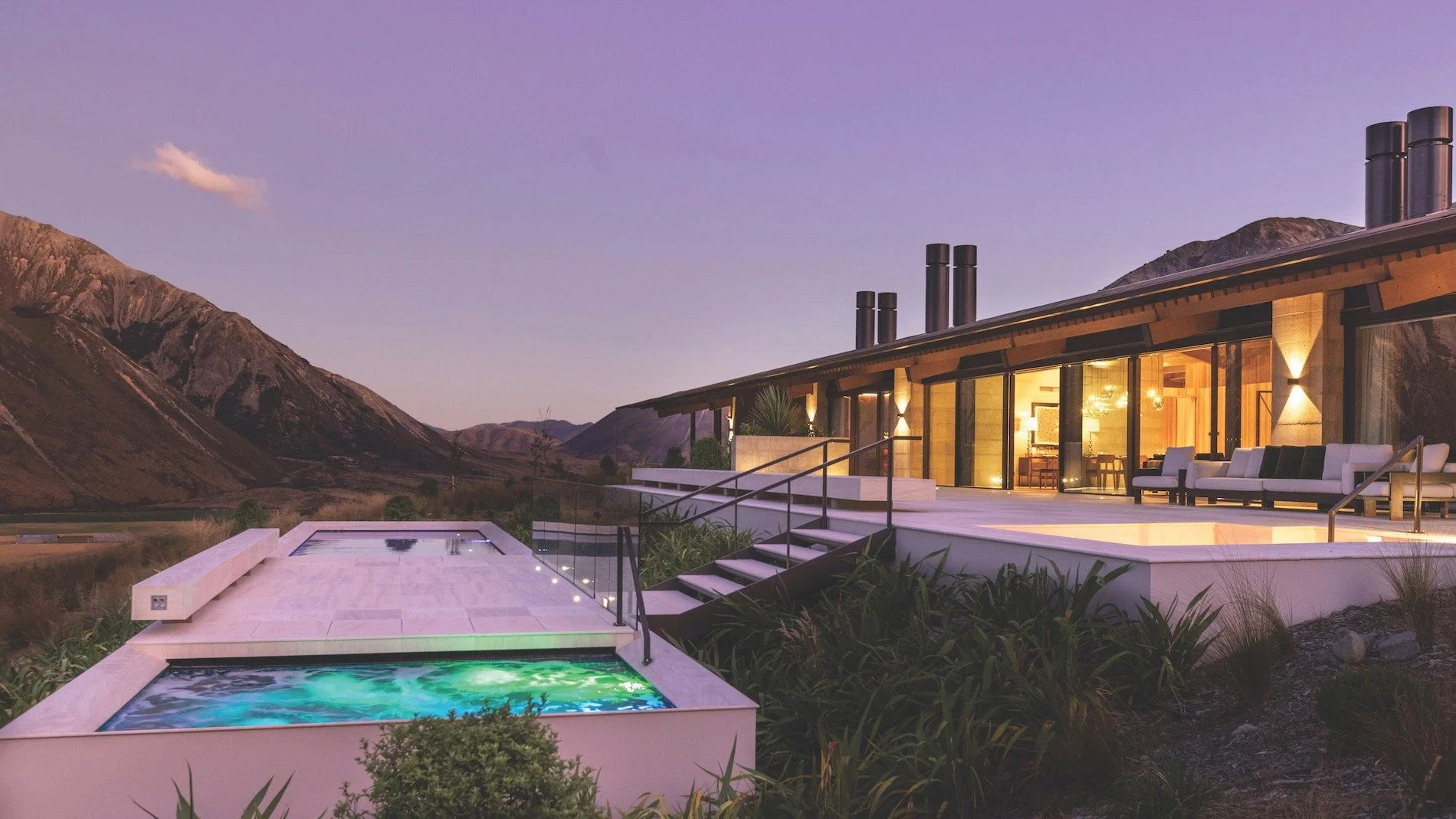
About Flockhill Lodge
A 4,000-acre working sheep station in New Zealand's Canterbury high country, Flockhill Lodge accommodates just 16 guests across contemporary architecture designed to dissolve the boundary between interior and alpine wilderness. Floor-to-ceiling windows frame two mountain ranges, while the kitchen draws on lamb from the property's own flock and produce from an organic garden on-site.
Where the Building Earns Its Place in the Landscape
The Canterbury high country operates on a scale that renders most architecture irrelevant. Between the Southern Alps and the lower ranges of the Craigieburn Valley, the tussock grasslands roll outward in every direction, and the light shifts fast enough that a ridge that looked grey at noon reads amber by three. Buildings that try to compete with this tend to look foolish. The ones that survive the comparison are those designed to frame it.
Flockhill Lodge belongs to the latter category. Its contemporary structure, set within a 4,000-acre working sheep station on the Great Alpine Highway near Lake Pearson, uses floor-to-ceiling glazing not as an aesthetic flourish but as a structural commitment: the outside is always present, always in the room with you. That design logic places Flockhill in a specific tier of New Zealand wilderness lodges, those that have rejected the historic-homestead model in favour of architecture that is visually transparent rather than romantically opaque.
The Logic of Small Capacity
Sixteen guests. That number does a lot of work in wilderness hospitality. At that capacity, the property operates closer to a private house than a hotel, and the service model follows accordingly. There is no lobby in the conventional sense, no rotation of strangers through a shared dining room. What the 16-guest ceiling creates, practically speaking, is a setting where the ratio of staff to guests tips toward the personal, and where the experience of the wider station can remain genuinely uncrowded.
The comparison set for a property like this sits well outside conventional hotel categories. In the UK, properties that pursue analogous low-capacity, deep-immersion formats include Lime Wood in Lyndhurst, which uses the New Forest as its environmental frame, or the working-estate logic of The Newt in Somerset, where the land itself is programmatic. Internationally, the Aman model offers the closest structural parallel: Aman Venice and Aman New York both operate on the principle that extremely limited keys justify refined service depth. Flockhill applies that same principle to a wilderness context.
Architecture as Editorial Statement
The floor-to-ceiling window format at Flockhill is worth considering in architectural terms rather than purely aesthetic ones. In high-alpine environments, the visual boundary between inside and outside carries genuine psychological weight. Rooms that frame the mountain view as a picture treat nature as scenery. Rooms where the glazing runs full height, from floor to ceiling and wall to wall, make a different argument: that the landscape is not decoration but context, and that the interior is simply a heated, sheltered extension of the terrain outside.
This approach has become a marker of a particular generation of wilderness lodges across New Zealand, Patagonia, and Scandinavia, properties where the architecture functions as a philosophical position on what luxury in remote settings should mean. The building does not impose. It holds its position in the landscape precisely by refusing to compete with it.
That restraint extends to the material choices typical of this lodge category. Contemporary structures in high-country New Zealand tend to draw on timber, stone, and glass in combinations that reference the regional geology without literal quotation. The result, at its leading, is a building that reads as earned rather than dropped in.
The Station as Programme
Flockhill is a working sheep station, and that fact is not incidental to the experience. The property's kitchen draws on lamb from its own flock, which places the supply chain at roughly zero distance. Vegetables come from an organic garden on-site. In a dining context where provenance has become the primary currency of premium hospitality, a station this size can make claims that a city hotel sourcing from regional suppliers cannot: the animal was raised here, on this land, visible from these windows.
Activity programming at a wilderness property of this scale follows the landscape rather than a fixed menu. Helicopter access to remote peaks, fly-fishing in the rivers running through and adjacent to the station, and guided walks through tussock grasslands each operate at a different intensity level, allowing the experience to calibrate to the guest. That range matters in practice: the guest who wants to cover altitude by air and the one who wants four hours at the river with a fly rod are not in conflict when the property is 4,000 acres.
Sustainability infrastructure at this scale, renewable energy systems and conservation partnerships, is partly practical necessity (grid connectivity at this distance is not guaranteed) and partly positioning. Properties in this tier now routinely incorporate conservation commitments as a structural element of the offering rather than a marketing addendum. For guests arriving from Edinburgh via Malmaison Edinburgh, or from London having passed through Claridge's or Estelle Manor, the conservation context at Flockhill represents a significant gear change in what the stay is about.
Placing Flockhill in the High Country Context
Canterbury's high country sits roughly 90 minutes west of Christchurch by road, and the transition from the Canterbury Plains to the alpine zone happens with some speed once the foothills begin. Lake Pearson and the Craigieburn Valley mark the point where the landscape stops being agricultural in any conventional sense and becomes something more austere. Flockhill Lodge sits within that zone, positioned between two mountain ranges.
For travellers routing through New Zealand who have already absorbed the comparatively curated luxury of the North Island or Queenstown's adventure-tourism infrastructure, the high country around Craigieburn offers a quieter register. The wilderness here is not organised around spectacle in the way that Milford Sound or the Remarkables have been. That absence of tourism infrastructure is, for this lodge category, the point.
Readers planning longer itineraries through remote wilderness properties in Scotland as a counterpart experience might consider Langass Lodge in the Outer Hebrides, Dun Aluinn in Aberfeldy, or Monachyle Mhor in Stirling, each of which applies a comparable logic of landscape-first hospitality at small scale. The Scottish Highlands and the Canterbury high country are not climatically equivalent, but the design problem they pose to hoteliers, how to create a premium experience where the environment is the primary asset, is the same.
For the complete picture of Canterbury's wider hotel and restaurant offering, see our full Canterbury restaurants guide.
Planning Your Stay
Given the 16-guest ceiling, advance booking at Flockhill runs longer than most conventional hotel categories. Properties at this capacity level in comparable remote settings typically book out months ahead during peak season, and the New Zealand high country season runs roughly from October through April. Guests travelling from the UK, whether routing from a prior stay at Gleneagles, Babington House, or Hell Bay Hotel, will be arriving into Christchurch International Airport, from which the drive to Craigieburn Valley takes under two hours. The lodge does not publish room rates publicly in standard aggregator formats, which is standard practice for this tier of exclusive-use or near-exclusive-use wilderness property. Contact through official channels for current availability and pricing.
Frequently Asked Questions
What is Flockhill Lodge known for?
Flockhill Lodge is known for two things in combination: the scale of its land holding, a 4,000-acre working sheep station positioned between two mountain ranges in New Zealand's Canterbury high country, and the deliberate constraint of its capacity at just 16 guests. That pairing produces a wilderness experience where access to genuinely remote terrain is both extensive and exclusive. The kitchen's use of lamb from the property's own flock and produce from an on-site organic garden extends the self-sufficiency logic into the dining programme.
Is Flockhill Lodge more low-key or high-energy?
The answer depends on how you use the station's activity range. Fly-fishing and guided walks through tussock grasslands run at a quiet, sustained pace. Helicopter excursions to remote alpine peaks are at a different register entirely. The property's positioning in this regard is calibrated: it accommodates both intensities without forcing either. For guests arriving from high-volume tourism routes through Queenstown, the lodge's default register will read as low-key regardless of which activities they book.
What's the most popular room type at Flockhill Lodge?
Room-type data is not publicly available in standard distribution formats for this property. At a 16-guest maximum, the accommodation offering is necessarily limited in total keys, and the floor-to-ceiling glazing that defines the architectural approach appears consistent across the lodge's contemporary structures. The practical implication is that mountain views are not a premium add-on at this property but a structural given.
Should I book Flockhill Lodge in advance?
Yes, and significantly so. A 16-guest property in a remote wilderness setting with no walk-in capacity operates on a fundamentally different booking timeline than a standard hotel. Peak season in the Canterbury high country runs from the Southern Hemisphere spring through late summer, broadly October to April. Guests travelling long-haul from the UK or Europe, whether this forms part of a broader itinerary or a standalone trip, should treat the lodge booking as the anchor around which everything else is planned rather than the last element to confirm.
Recognized By

Similar venues by awards
Related editorial
- Best Fine Dining Restaurants in ParisFrom three-Michelin-star icons to the next generation of Parisian chefs pushing boundaries, these are the restaurants that define fine dining in the world's culinary capital.
- Best Luxury Hotels in RomeFrom rooftop terraces overlooking ancient ruins to Michelin-starred hotel dining, these are the luxury hotels that make Rome unforgettable.
- Best Cocktail Bars in KyotoFrom sleek lounges to hidden speakeasies, Kyoto's cocktail scene blends Japanese precision with global influence in ways you won't find anywhere else.
Save or rate Flockhill Lodge on Pearl
Keep this venue in your Pearl passport, rate it after you visit, and track it alongside every other place you collect.